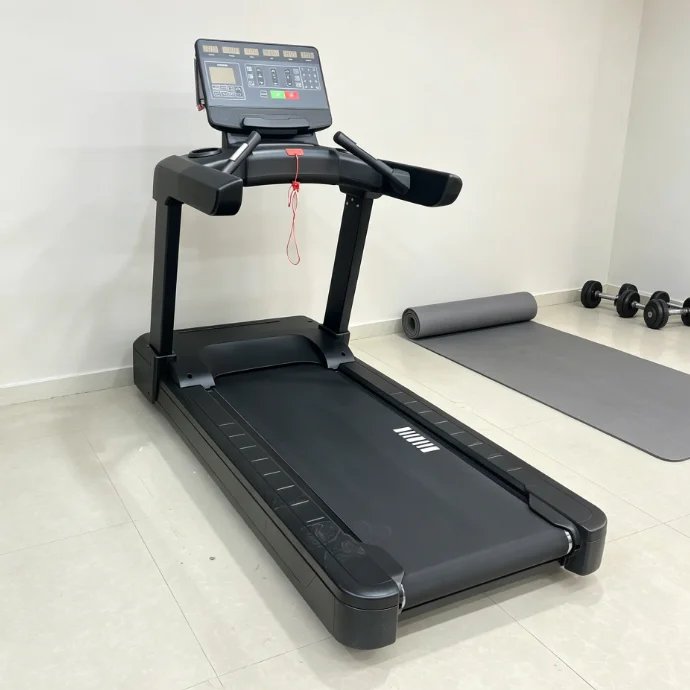
![Hsm Electric Walking Treadmill with Remote Controller for Home Use [WARN] draft identifier mismatch](https://bicksport.com/wp-content/uploads/2026/08/hsm-electric-walking-treadmill-with-remote-controller-for-home-use-warn-draft-identifier-mismatch-aa7e19.webp)
Quiet Deployment Ready — Engineered for noise-sensitive floors where cardio equipment sits directly above occupied guest rooms and shared spaces.
Technical Specifications
| Parameter | Value |
|---|---|
| Designation | W04H1 |
| Product Type | Foldable Treadmill |
| Motor Type | Electric Motorized Drive |
| Speed Range | 1–6 km/h (walking pace) |
| Maximum Speed | <15 km/h |
| Running Surface | 1000 × 400 mm |
| Folded Dimensions | 1250 × 520 × 125 mm |
| Console Type | LED Screen (Speed / Distance / Time / Calories) |
| Preset Programs | 6 programs |
| Remote Controller | Included |
| Max User Weight | 100–160 kg |
| Condition | New |
| Certification | CE, RoHS |
| Customization | Available (logo, packaging) |
| Origin | Ningbo |
Application Suitability
| Deployment Scenario | Typical Use |
|---|---|
| High-end residential home gym | Daily walking routines in apartments or condos where floor space and neighbor noise are constraints |
| Corporate wellness room | Low-impact cardiovascular sessions for employees during breaks, complementing desk-based work schedules |
| Hotel fitness center on guest room floors | Compact walking station for guests preferring low-intensity cardio without leaving their floor |
| Boutique fitness studio | Supplementary walking-focused equipment paired with high-intensity stations for cooldown or active recovery |
| Senior living community fitness area | Gentle, controlled walking sessions with straightforward LED console operation for older adults |
Why Motor Burnout Happens Before the Warranty Expires
Continuous duty rating and peak horsepower are not the same specification, and confusing them is the most common reason walking treadmills fail prematurely in shared-use environments.
When a foldable motorized treadmill home fitness unit gets placed in a corporate wellness room or hotel guest floor, it often runs six to eight hours daily across dozens of users. A motor rated only for peak output cannot sustain that thermal load — the windings overheat, insulation degrades, and the unit goes silent within months. Procurement teams rarely see this coming because the spec sheet looked adequate on paper. The difference between a motor that lasts through a warranty period and one that requires mid-cycle replacement comes down to whether the continuous duty rating matches the actual deployment scenario [NEED_CITE: motor duty cycle classification for continuous commercial operation]. Facilities that skip this verification step end up budgeting for replacements they never planned.
Positioning Within a Mixed Cardio Zone
This foldable motorized treadmill home fitness model occupies the low-intensity walking segment of a cardio layout, covering speeds from 1 to 6 km/h across six preset programs. It pairs naturally with ellipticals and stationary bikes that handle moderate to vigorous intensity, creating a progression path for users who warm up on the walking treadmill before moving to higher-output equipment. The 1000 × 400 mm running surface accommodates adult users within the 100–160 kg range while keeping the footprint compact enough for tight floor plans. Deploy it along perimeter walls or in corridor-adjacent wellness nooks where full-depth commercial treadmills would obstruct traffic flow.
Deployment Environment and Continuous Run Requirements
Running a motorized walking treadmill for extended daily sessions demands attention to thermal management and electrical supply. The unit draws standard single-phase power, but facilities should confirm voltage and frequency match local grid standards before the container ships — plug and voltage mismatches discovered after delivery cause weeks of idle equipment. Place the treadmill on a level surface with a vibration-dampening mat beneath it to prevent low-frequency resonance from transmitting through floor slabs to rooms below. Adequate clearance around the motor housing allows passive cooling airflow, which becomes critical when the unit operates across back-to-back user sessions. Facilities planning to connect usage data to a management system should verify whether the LED console supports data export, since basic LED displays typically operate as standalone units without network interfaces [NEED_CITE: EN 957 requirements for commercial cardio equipment console connectivity].
Motor and Drive Specification Breakdown
The electric motorized drive on this unit targets walking-pace operation between 1 and 6 km/h, which places fundamentally different thermal demands on the motor compared to running-speed treadmills. At walking speeds, the motor operates under sustained moderate load rather than short burst cycles, meaning continuous duty rating matters more than peak output. The LED console tracks speed, distance, time, and calorie estimates — providing users with essential feedback without the complexity of touchscreen interfaces that require firmware updates and network configuration. Six preset programs allow facilities to offer structured walking sessions without requiring staff to program custom routines. The included remote controller gives users speed adjustment without reaching for the console, which matters in rehabilitation and senior fitness contexts where balance during operation is a concern.
What Specification Shortcuts Cost After Deployment
Choosing equipment based on peak horsepower figures rather than continuous duty ratings leads to a predictable cycle: motors overheat under sustained daily use, units go offline, and maintenance teams scramble for replacements while guest complaints accumulate. In hotel environments, a treadmill that transmits motor vibration through the floor structure generates noise complaints that reach the front desk before maintenance even opens a work order. LED consoles that lack data connectivity create information blind spots — facility managers cannot track usage patterns, identify underperforming units, or justify equipment rotation across locations. These problems compound because they remain invisible during the procurement evaluation phase, surfacing only after the equipment has been running under real-world conditions for several months [NEED_CITE: impact of continuous duty cycle mismatch on treadmill motor lifespan in commercial settings].
Why This Product Line Addresses Those Gaps
Every unit undergoes 10,000-hour durability testing on motors and bearings, which directly addresses the premature burnout problem that plagues facilities running cardio equipment across extended daily sessions. Sub-35dB whisper-quiet operation has been verified in hotel deployments, meaning this treadmill can sit on guest room floors without generating the low-frequency hum that triggers noise complaints. The LED console keeps operation straightforward for users who need walking-pace cardio without interface complexity, while the included remote controller supports accessibility across diverse user populations. Full OEM customization covers logo and packaging, allowing operators to maintain brand consistency across their fitness environments. The compact 1250 × 520 × 125 mm folded footprint means facilities can store units when floor space is needed for other functions, and 24/7 technical support ensures that operational questions get resolved without waiting for business hours in a different time zone.
Documentation & Test Records
- CE declaration of conformity confirming European safety compliance for this treadmill model
- RoHS compliance certificate verifying restriction of hazardous substances in electronic components
- Motor specification sheet detailing continuous and peak output ratings
- LED console technical documentation covering display parameters and preset program logic
- Installation and commissioning guide with floor leveling and electrical connection procedures
- Spare parts list covering belt, motor brushes, and remote controller components
Installation, Commissioning & Maintenance
- Confirm floor leveling and place vibration-dampening mat beneath the 1250 × 520 mm base footprint before first power-on
- Verify voltage and plug type match local supply; use dedicated circuit to prevent shared-load voltage drops affecting the motorized drive
- Run initial belt alignment and tension check after first week of use, then at regular intervals based on daily session volume
- Wipe down LED console and handrail surfaces daily to prevent sweat corrosion on electronic contacts and metal finishes
- Inspect remote controller battery and signal response monthly to ensure consistent speed adjustment without console interaction
- Lubricate running belt per maintenance schedule to preserve the 1000 × 400 mm deck surface and reduce motor load
Equipment Selection and Inquiry Guidance
Provide your cardio zone square footage and planned unit count to receive a 3D layout covering equipment spacing, user flow, and ventilation clearance for this treadmill model. Specify your expected daily run hours per unit so the motor duty cycle can be matched to your operational reality. Confirm deployment floor level and adjacent occupied spaces to validate that the noise profile meets your environment’s requirements. State your target market voltage and plug standard to ensure electrical compatibility before shipment, and indicate whether console data integration with your facility management system is a requirement.
Frequently Asked Questions
Q: What is the difference between peak and continuous motor power on a walking treadmill?
A: Peak power indicates the maximum output the motor can deliver in short bursts, while continuous power reflects what it can sustain over extended sessions. For a walking treadmill used across multiple daily users, continuous power is the relevant specification because the motor operates under steady load for hours. A unit sized only for peak output will overheat and degrade prematurely in shared-use environments.
Q: How does the 1000 × 400 mm running surface affect user comfort compared to wider decks?
A: The 1000 × 400 mm surface accommodates natural walking stride for most adult users within the 100–160 kg weight range. For walking-pace use between 1 and 6 km/h, this width provides adequate lateral stability. Users transitioning from wider commercial decks may notice the narrower footprint initially, but the compact dimension is what enables the foldable design to fit constrained residential and corporate spaces.
Q: Can the LED console data be exported or integrated with third-party fitness systems?
A: The LED screen displays speed, distance, time, and calorie data for immediate user feedback during sessions. Basic LED consoles typically operate as standalone displays without network connectivity or data export capability. Facilities requiring usage tracking and system integration should specify this requirement during the inquiry stage so console options can be evaluated against operational needs.
Q: What maintenance does the motorized drive and belt system require for quiet long-term operation?
A: Regular belt lubrication and tension adjustment reduce friction on the motorized drive, which directly affects noise levels and motor thermal load. Keep the motor housing free of dust accumulation to maintain passive cooling airflow. Inspect belt alignment periodically to prevent uneven wear on the 1000 × 400 mm deck surface. These routine steps preserve quiet operation and extend motor service life in daily-use environments.
Q: How does the foldable mechanism affect frame stability during use?
A: The foldable design folds to 1250 × 520 × 125 mm for storage but operates in the unfolded position during use, where the frame locks into a rigid configuration. Structural integrity in the deployed state supports users up to 160 kg at walking speeds. The folding mechanism is engineered for deployment and storage cycles rather than use-while-folded scenarios, which keeps the frame stable during walking sessions.
![HSM MT23B Foldable Motorized Treadmill with Manual Incline DC Motor [WARN] draft identifier mismatch](https://bicksport.com/wp-content/uploads/2026/08/hsm-mt23b-foldable-motorized-treadmill-with-manual-incline-dc-motor-warn-draft-identifier-mismatch-567df3.webp)
![HSM MT80 Foldable DC Treadmill Household Fashion Design [WARN] draft identifier mismatch](https://bicksport.com/wp-content/uploads/2026/08/hsm-mt80-foldable-dc-treadmill-household-fashion-design-warn-draft-identifier-mismatch-c4dae3.webp)