
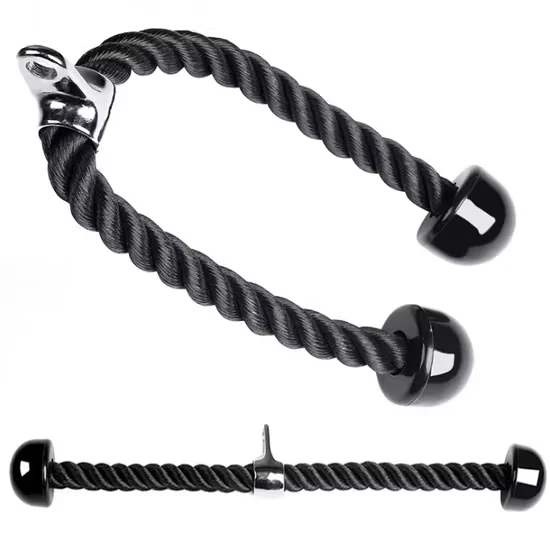
Nylon Rope Durability — High-strength braided nylon withstands continuous tricep cable training without fraying or generating metal-on-metal noise.
Technical Specifications
| Parameter | Value |
|---|---|
| Product Type | Cable Machine Attachment |
| Product Name | Tricep Rope |
| Material | Nylon |
| Specification | 40CM |
| Color | Customized Colors |
| Logo | Customized Logo Available |
| MOQ | 50PCS |
| Application | Outdoor, Indoor |
| Certification | CE (HS Code 9506911900) |
Application Suitability
| Deployment Scenario | Typical Use |
|---|---|
| hotel fitness center on guest room floors | Tricep pushdowns and face pulls during early-morning or late-night sessions where noise must stay contained |
| chain gym cable station zone | High-frequency isolation work across multiple members per hour, requiring attachment durability and quick wipe-down |
| corporate wellness room | Compact cable attachment for functional strength circuits in space-limited employee fitness areas |
| high-end residential home gym | Quiet cable training without metal clatter disturbing adjacent living spaces |
| professional sports training center | Precise tricep and shoulder isolation with consistent rope flex through full range of motion |
Why Noise Complaints Reach the Front Desk Before Maintenance Does
The attachment-to-carabiner contact point is where most cable station noise originates.
When a tricep rope swings back and the metal snap hook strikes the pulley housing at the end of each rep, the resulting click transmits through the cable and frame into the floor structure above or beside occupied rooms. In hotel fitness centers operating around the clock, these repetitive impacts accumulate into a noise profile that guests report before any mechanical failure ever surfaces. The heavy-duty cable machine attachment tricep rope design addresses this by using a nylon body that absorbs terminal swing energy and a connection interface treated to reduce metal-on-metal impact [NEED_CITE: noise transmission through cable machine attachment connections in multi-floor fitness facilities].
Cable Attachment Role in the Strength Training Zone
This tricep rope covers pushdown, overhead extension, and face pull movements across low-to-moderate rep ranges typically used for isolation work. In a commercial cable zone, it pairs with straight bars, V-bars, and ankle cuffs to give members a complete attachment menu without requiring dedicated single-station machines. The 40CM length accommodates both narrow-grip pushdowns and wider face pull positions, fitting users across a broad shoulder-width spectrum. The heavy-duty cable machine attachment tricep rope integrates into existing pulley stations without modifying the cable path or weight stack configuration.
Deployment Environment and Continuous Use Considerations
In a chain gym cable zone running fourteen hours daily, a single tricep rope attachment may see hundreds of sets per week, each involving repetitive tension loading and release cycles. The nylon braiding must resist fraying under this sustained use while the end caps and connection hardware maintain structural integrity through thousands of attachment and detachment events. For hotel deployments above guest floors, the absence of loud metal clanking at the end of each rep matters more than the resistance curve itself [NEED_CITE: acoustic performance criteria for cable attachments in multi-story hospitality fitness centers]. Storage hooks or attachment racks near the cable station keep the rope off the floor and reduce trip hazards in high-traffic zones.
Nylon Construction and Connection Hardware Explained
The braided nylon body resists tensile deformation under heavy stack loads while maintaining enough flex for the rope to split naturally during pushdowns. Unlike rigid steel or hard plastic attachments, nylon absorbs vibration at the grip point, reducing the sharp impact sound that travels up the cable when a member releases tension abruptly. The connection hardware at the top uses a standard carabiner interface compatible with most commercial pulley station swivels and quick-release clips. The 40CM specification provides adequate length for bilateral movements without excess slack that could tangle during rotational exercises. Color and logo customization allow facility operators to match the attachment to their brand palette or distinguish it from lighter-duty options in a mixed-use environment.
What Happens When Attachment Quality Is Compromised
A frayed rope mid-session forces a member to stop and staff to remove the attachment from rotation, creating downtime during peak hours. Metal snap hooks that corrode or develop sharp edges pose a laceration risk and generate increasingly loud clicking as surface degradation worsens. In a hotel gym, a single snapped attachment can result in an incident report and equipment audit that pulls multiple units from service simultaneously. Operators who select attachments based solely on unit price often face replacement cycles that cost more in labor and member dissatisfaction than the initial savings justified [NEED_CITE: total cost of ownership for commercial cable machine attachments under continuous public use].
Why This Attachment Line Fits the Product Range
The nylon tricep rope complements a full commercial cardio and strength deployment by filling the isolation attachment requirement at the same durability standard applied to the primary equipment. Quiet operation at the connection point aligns with the sub-35dB environment that hotel fitness centers require from their cardio installations. The customization options for color and logo extend the same OEM capability available across the cardio family, letting operators maintain visual consistency from treadmills to cable stations. Bulk ordering at the 50-piece minimum supports multi-location rollouts where each site receives identically branded attachments. The CE certification documentation aligns with the compliance package provided for the primary equipment, simplifying the facility’s overall certification file.
Documentation & Test Records
- CE declaration of conformity covering cable attachment hardware and materials
- Material tensile strength test report for braided nylon under rated loads
- Connection hardware load rating and corrosion resistance documentation
- Noise level assessment at the carabiner-to-pulley contact point
- OEM customization specification sheet for color and logo application
- Installation guide for attachment rack placement and storage requirements
Installation, Commissioning & Maintenance
- Verify pulley station swivel compatibility with the standard carabiner interface before deployment
- Mount attachment storage hooks within arm reach of the cable station to minimize floor clutter
- Inspect nylon braiding weekly for fraying at the end caps and connection point
- Wipe down nylon surface after each use session to prevent sweat residue buildup and fiber degradation
- Replace the attachment when braiding shows visible core exposure or connection hardware develops surface pitting
Planning Your Cable Attachment Deployment
Provide your cable station count and daily member throughput to determine the attachment quantity and rotation schedule needed. Specify the deployment floor and adjacent occupied spaces to confirm that noise levels at the connection point meet your facility requirements. Indicate whether color and logo customization is needed to align with your existing equipment branding. Share your target market voltage and plug standards if your cable stations require electrical compatibility verification alongside the attachment order.
Frequently Asked Questions
Q: How does nylon compare to leather or rubber for tricep rope grip and durability?
A: Nylon provides a firm, textured grip that remains consistent when wet, unlike leather which becomes slippery with sweat and requires conditioning. Rubber grips tend to degrade and crack under high-frequency commercial use. Braided nylon maintains its structural integrity through thousands of sets and wipes clean with standard gym disinfectant without material breakdown.
Q: What is the recommended replacement interval for tricep ropes in commercial gyms?
A: Replacement timing depends on daily set volume and maintenance practices rather than a fixed calendar schedule. Facilities running cable stations over ten hours daily should inspect ropes weekly for braiding wear at the end caps and connection hardware integrity. Most commercial deployments plan for annual replacement cycles aligned with broader attachment audits.
Q: How do you ensure custom logos remain legible after extended use?
A: Logo application uses heat-transfer or molded-in techniques that bond the marking to the nylon fiber rather than sitting on the surface. This prevents the logo from peeling or fading under repeated grip contact, sweat exposure, and disinfectant cleaning. Custom color runs are processed at the yarn level for consistent pigmentation throughout the rope cross-section.
Q: Does this tricep rope fit all standard commercial cable station pulleys?
A: The attachment uses a standard carabiner clip compatible with most commercial pulley station swivels and quick-release mechanisms. Before placing a bulk order, verify the swivel opening diameter on your specific cable station model to confirm clearance. The 40CM rope length and connection geometry work with both single and dual-cable configurations.
![Heavy Duty Multi-Functional Pull-up Bars for Commercial Gym Strength Training [WARN] draft identifier mismatch](https://bicksport.com/wp-content/uploads/2026/08/heavy-duty-multi-functional-pull-up-bars-for-commercial-gym-strength-training-warn-draft-identifier-mismatch-27c800.webp)

![Commercial Core Strength Training Sit-up Cushion for Fitness Facilities [WARN] draft identifier mismatch](https://bicksport.com/wp-content/uploads/2026/08/commercial-core-strength-training-sit-up-cushion-for-fitness-facilities-warn-draft-identifier-mismatch-f47fea.webp)
