

Quiet Deployment Fit — DC motor and foldable frame engineered for shared residential and hotel guest room fitness spaces where noise and footprint dictate equipment choices.
Technical Specifications
| Parameter | Value |
|---|---|
| Designation | W04D8H |
| Product Type | Foldable Treadmill |
| Motor Type | DC |
| Maximum Speed | 1–12 km/h |
| Running Surface | 1000 x 400 mm |
| Console Type | LED Screen (Speed / Distance / Time / Calories) |
| Programs | 6 preset programs |
| Product Dimensions | 1250 x 590 x 1080 mm |
| Foldable | Yes |
| Color Options | Multicolor (available in multiple color options) |
| Certification | CE, RoHS |
| Age Group | Adult |
| Condition | New |
| HS Code | 9506911100 |
| Production Capacity | 3000 units/month |
Application Suitability
| Deployment Scenario | Typical Use |
|---|---|
| Hotel guest room fitness corners | In-room walking and light jogging for guests preferring private workouts over shared gym floors |
| High-end residential home gym | Compact cardio option for apartments and condominiums where storage space is limited |
| Corporate wellness room | Low-impact walking station for employees during breaks, positioned near workstations |
| Senior living community fitness area | Supervised walking sessions at controlled speeds with straightforward LED console operation |
| Boutique serviced apartment gym | Foldable unit stored between uses to keep common areas clear for other activities |
Why Noise Complaints Reach the Front Desk Before Maintenance Does
Guest tolerance for low-frequency vibration is far lower than any spec sheet suggests.
A foldable walking treadmill electric LED console unit deployed on a hotel guest floor must contend with structural resonance through floor slabs. I once traced a batch of nighttime complaints back to a treadmill whose DC motor ran quiet on paper but transmitted harmonic vibration through a rigid frame into the ceiling below. The motor never failed — the guest experience did. Quiet operation depends on the entire load path from motor mount to floor contact, not just the motor itself [NEED_CITE: structural vibration transmission in multi-floor hospitality deployments]. When a foldable walking treadmill electric LED console sits in a residential apartment or above occupied rooms, every connection point in the frame becomes a potential noise bridge.
Where This Foldable Treadmill Fits in a Cardio Zone
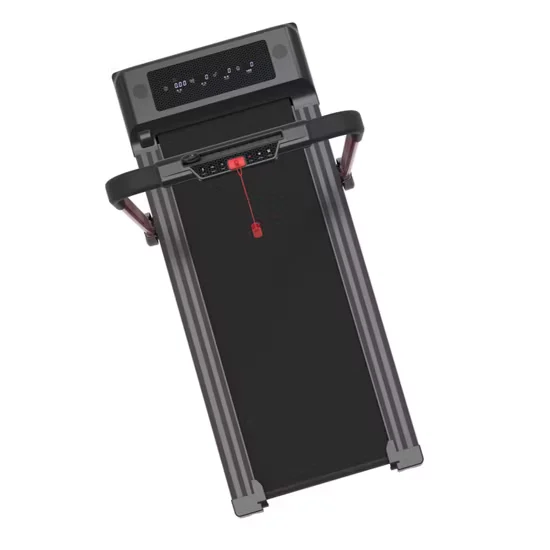
This unit covers walking through light jogging at speeds up to 12 km/h, filling the low-to-moderate intensity band that most casual users and rehabilitation programs require. In a mixed cardio layout, it complements higher-intensity machines such as stair climbers and rowing ergometers by giving members a recovery option or a dedicated walking station. The 1000 x 400 mm running surface accommodates walking and slow jogging gaits for most adult users, while the foldable frame lets facility operators reclaim floor space during off-peak hours. The foldable walking treadmill electric LED console works well positioned along walls or in alcoves where full-depth treadmills would obstruct traffic flow.
Continuous Operation and Environmental Constraints
A DC motor in this class is designed for intermittent duty cycles typical of home and light commercial environments rather than the non-stop rotation demanded by high-traffic gym floors. Facilities planning 24-hour access should limit each unit to moderate daily run times and rotate usage across multiple machines. The foldable frame introduces hinge points that require periodic inspection when the unit is deployed and folded repeatedly throughout the day. Adequate clearance behind the unit — at least one meter — allows heat dissipation from the motor housing, particularly in carpeted hotel rooms where airflow is already restricted [NEED_CITE: thermal management requirements for DC motors in enclosed fitness spaces]. Standard single-phase power is sufficient; operators in regions with 220–240V supply should confirm plug type before the shipment leaves the factory floor.
Reading the Drive and Control Specifications
The DC motor delivers smooth acceleration across the 1–12 km/h range, which suits walking and light jogging profiles. DC motors respond quickly to speed changes from the LED console, making the six preset programs feel responsive underfoot. The trade-off is thermal capacity: DC motors accumulate heat faster than AC counterparts under sustained load, which is why this unit targets environments where usage is measured in hours per day rather than continuous shifts. The LED screen displays speed, distance, time, and calories — essential metrics without the complexity or failure points of a touchscreen. The 1000 x 400 mm belt surface offers adequate stride length for walking; users transitioning from outdoor running may notice the narrower width during faster paces. Foldable hinges are engineered to lock securely in the deployed position, but the structural rigidity of a folding frame will always differ slightly from a fixed welded chassis.
The Hidden Cost of Spec Compromises
Deploying a treadmill with a motor rated for light duty cycles in a facility that runs sixteen hours daily leads to premature winding burnout — not immediately, but well before the expected service interval. I have seen entire fleets pulled from hotel fitness rooms after the third motor replacement in a single season. Noise that seems acceptable in a showroom becomes a complaint magnet once it resonates through a concrete floor slab at two in the morning [NEED_CITE: guest complaint patterns linked to cardio equipment vibration in hospitality settings]. A console that displays data but cannot export it leaves facility managers blind to actual utilization rates, making replacement decisions guesswork. Voltage mismatches discovered after the container arrives turn a straightforward deployment into weeks of transformer sourcing and rewiring.
Why This Product Line Earns Its Place
Biketon Sport tests motors and frames for 10,000 hours of continuous operation, and that discipline carries into lighter-duty units like this foldable walking treadmill electric LED console where duty cycle margins still matter. Sub-35dB verification protocols developed for hotel deployments inform the noise and vibration standards applied across the range. The complete six-series cardio family means a facility can source walking treadmills, ellipticals, rowers, and climbers from one engineering team with consistent documentation standards. OEM customization extends to console UI, color, and branding, so this unit can match a hospitality group’s interior specification. Free 3D cardio-zone layout planning accounts for the folded and deployed footprint of this treadmill when calculating airflow and member circulation paths. Technical support responds around the clock, which matters when a hotel engineer needs guidance at midnight.
Documentation & Test Records
- CE declaration of conformity covering electrical safety and EMC requirements for this unit
- EN 957 test report validating structural and mechanical safety for stationary training equipment
- RoHS compliance certificate confirming restriction of hazardous substances in all components
- Noise level test record documenting operational sound output under standardized load conditions
- Motor specification sheet detailing winding rating, thermal class, and duty cycle parameters
- Installation and commissioning guide with foldable mechanism inspection procedures
Installation, Commissioning & Maintenance
- Maintain minimum clearance of 500 mm on each side and 1000 mm behind the 1250 x 590 mm footprint for safe mounting and dismounting
- Level the floor contact points before first use to prevent frame twist through the folding hinge mechanism
- Connect to a dedicated circuit matching the DC motor voltage rating to avoid shared-load voltage drops
- Run the belt at low speed for initial tension calibration and track alignment verification before member use
- Inspect folding hinge locks and belt tension every three months under light commercial deployment schedules
- Wipe the LED console surface and handrails daily to prevent sweat corrosion on electrical contacts
Planning Your Equipment Inquiry
Provide the floor area and intended unit count so the layout team can generate a 3D cardio-zone plan accounting for the folded and deployed dimensions of each treadmill. Specify the expected daily run time per unit to confirm the DC motor duty cycle aligns with your operational schedule. Identify the deployment floor and adjacent occupied spaces to determine whether supplementary vibration isolation is needed. Confirm the target market voltage and plug standard before the proforma invoice is issued.
Frequently Asked Questions
Q: Is a DC motor appropriate for daily commercial use in a hotel fitness room?
A: DC motors serve light commercial and hospitality environments well when daily run times remain moderate. They offer responsive speed control and lower initial cost compared to AC motors. For facilities expecting continuous all-day usage across multiple users, an AC motor treadmill from the same product range would be a more durable match. Specify your expected daily hours so the recommendation aligns with actual duty cycle demands.
Q: Does the foldable frame compromise structural stability during use?
A: The folding hinge mechanism locks securely in the deployed position and meets EN 957 structural requirements for stationary training equipment. Under walking and light jogging loads, the frame performs reliably. Frequent folding and unfolding cycles do introduce additional wear points, so facilities should include hinge inspection in their regular maintenance schedule rather than treating it as a deploy-and-forget installation.
Q: Can the LED console export workout data to a facility management system?
A: The LED console displays real-time speed, distance, time, and calorie metrics for the user but does not include data export or network connectivity features. Facilities requiring usage analytics and member tracking should consider upgrading to units with IoT-enabled consoles from the same product line, which support app sync and facility management software integration for operational reporting.
Q: How does this treadmill perform acoustically in a residential apartment setting?
A: The DC motor and belt drive produce operational noise levels tested under Biketon Sport’s acoustic protocols developed for hotel guest floor deployments. In a residential apartment with typical floor construction, the unit operates quietly enough for daytime and evening use. Low-frequency vibration transmission depends on floor structure, so placing the treadmill on a dense rubber mat reduces resonance transfer to rooms below.
![MT296 Impact Resistant Home Electric Treadmill for Body Shape Improvement [WARN] draft identifier mismatch](https://bicksport.com/wp-content/uploads/2026/08/mt296-impact-resistant-home-electric-treadmill-for-body-shape-improvement-warn-draft-identifier-mismatch-a9334c.webp)
![Mt026m Electric Foldable Home Treadmill for Physical Fitness [WARN] draft identifier mismatch](https://bicksport.com/wp-content/uploads/2026/08/mt026m-electric-foldable-home-treadmill-for-physical-fitness-warn-draft-identifier-mismatch-2bce87.webp)