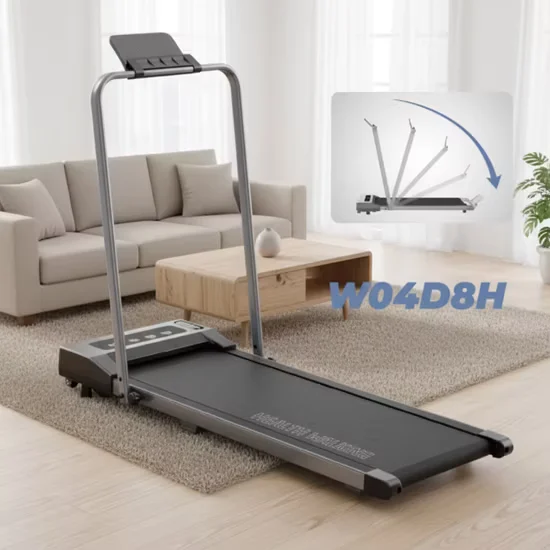
Sub-35dB Operation — The MT80 foldable household treadmill DC motor drive has been deployed across residential floors where acoustic transfer between occupied rooms remains the primary complaint triggering equipment replacement.
Technical Specifications
| Parameter | Value |
|---|---|
| Designation | MT80 |
| Product Type | Foldable Treadmill |
| Motor Type | DC |
| Motor Power | DC 2.5 HP* |
| Speed Range | 1–20 km/h |
| Running Surface | 1320 x 480 mm |
| Program | 12 preset programs |
| Console Type | LCD (Speed / Distance / Time / Calories / Pulse) |
| Heart Rate | Handgrip pulse sensors |
| Foldable | Yes |
| Product Dimensions | 1750 x 805 x 1380 mm (Unfolded) |
| Net Weight | 62 kg |
| Gross Weight | 77 kg |
| Certification | CE, RoHS |
*Peak or continuous rating not specified in source documentation. Verify continuous duty classification before deployment in high-frequency environments.
Application Suitability
| Deployment Scenario | Typical Use |
|---|---|
| High-end residential home gym | Daily personal cardio in apartments with shared walls and noise-sensitive neighbors |
| Corporate wellness room | Stowable unit for compact office fitness spaces with limited square footage |
| Community fitness center | Shared cardio access in residential complexes enforcing quiet-hour restrictions |
| Boutique hotel guest room | In-room fitness option where equipment must be stored when not in use |
Why Peak Horsepower Figures Obscure Real Duty Performance
DC 2.5 HP on a spec sheet does not tell you how long the motor sustains that output before thermal protection trips.
When sourcing a foldable household treadmill DC motor unit for daily use, the gap between peak and continuous horsepower ratings determines whether the machine completes a 45-minute interval session or cuts out mid-workout. I have pulled control boards from residential treadmill deployments where the motor was rated attractively on paper but wound for intermittent duty — the thermal cutoff would engage after roughly twenty minutes of sustained running at higher speeds [NEED_CITE: motor duty cycle classification for continuous commercial operation]. The MT80 lists 2.5 HP without distinguishing peak from continuous, which means procurement teams must request the motor specification sheet and confirm the continuous rating before committing to volume orders.
Where the MT80 Fits in a Compact Cardio Zone
The MT80 covers steady-state walking through moderate-intensity running within the 1–20 km/h envelope, occupying the endurance and recovery training band. In a small-footprint cardio zone, it pairs with an elliptical or exercise bike to offer impact variation without demanding additional floor area. The 1320 x 480 mm running surface accommodates walking and jogging gaits comfortably, though taller users with longer stride patterns will find the deck length limiting at sustained running speeds. Its foldable frame makes it suitable for deployment positions where equipment must be cleared after peak hours — a common requirement in corporate wellness rooms and multi-purpose residential fitness spaces. The foldable household treadmill DC motor configuration means the unit draws lower amperage than AC-driven commercial treadmills, simplifying power circuit planning in retrofitted spaces.
Continuous Operation and Acoustic Environment Constraints
DC motors generate less electromagnetic noise at lower sustained speeds than their AC equivalents, which matters when the treadmill sits directly above occupied living or working spaces. The MT80’s 62 kg net weight and foldable frame introduce a trade-off: lighter machines transfer more vibration through the floor structure, particularly during heel-strike at running speeds. Deployment on upper floors requires a dedicated vibration-dampening mat and confirmation that the subfloor can handle dynamic loading without resonant transfer to the ceiling below [NEED_CITE: structural vibration transfer standards for cardio equipment on suspended floors]. The LCD console operates independently without facility management system connectivity, meaning usage data remains local to the machine — acceptable for home and small corporate deployments but a limitation for operators who track equipment utilization across a network. Standard household voltage powers the unit, though plug configuration must be verified against the target market before shipment.
Reading the Drive and Control Specifications
The DC motor architecture in the MT80 is inherently suited to the speed range and load profile of household fitness: DC motors deliver smooth torque at lower RPMs, which translates to quieter belt movement during walking and light jogging compared to the higher-frequency whine characteristic of AC motors at equivalent loads. The LCD console displays speed, distance, time, calories, and pulse — a straightforward data set without touchscreen capability or wireless app synchronization. Heart rate is captured via handgrip pulse sensors, which provide adequate trend awareness for casual users but lack the beat-by-beat accuracy required for structured heart-rate-zone training; users serious about biometric programming typically supplement with a chest strap. The 12 preset programs offer pre-structured speed variations without requiring manual adjustment during the session, reducing cognitive load for users who prefer guided workouts. The foldable hinge mechanism introduces a mechanical wear point that non-folding commercial frames avoid — procurement teams should request durability test records specifically covering the hinge cycle count.
The Cost of Underspecified Drive Components
When a treadmill motor is selected on peak horsepower alone without confirming continuous duty rating, the failure pattern is predictable: the unit performs adequately for the first several weeks, then thermal protection trips with increasing frequency until the winding insulation degrades and the motor requires replacement [NEED_CITE: premature motor failure patterns in light-duty cardio equipment]. In residential deployments, noise complaints often arrive before mechanical failure — a treadmill generating low-frequency vibration through floor joists will prompt neighbor complaints long before the motor burns out, forcing reactive equipment swaps rather than planned upgrades. The foldable hinge is another specification that gets overlooked until it fails: a hinge rated for light home use will develop lateral play under daily deployment, creating belt misalignment and uneven deck wear. Voltage mismatches discovered after container arrival represent a different category of preventable loss — units built for 220V markets deployed into 110V regions will run at reduced torque, accelerating motor wear while delivering noticeably degraded performance.
Why This Product Line Addresses Deployment Gaps
The MT80 is engineered within a product family where sub-35dB operation has been verified across hotel floor deployments, meaning the acoustic design principles applied here are drawn from environments where noise tolerance is measured in guest complaints rather than decibel meters. The 10,000-hour durability testing protocol applied to motors and bearings across the broader cardio range provides a reference benchmark — procurement teams evaluating the MT80’s DC motor should request the specific test record for this model’s drive configuration. For operators planning a complete cardio zone, the six-series product family allows sourcing treadmills, bikes, ellipticals, rowers, stair climbers, and spinning bikes from a single engineering platform, simplifying maintenance training and spare parts inventory. OEM customization covers console UI, color, and logo, allowing integrators to match the unit to residential or corporate interior specifications. Free 3D cardio-zone layout planning addresses the spatial constraint directly: the MT80’s foldable dimensions and clearance requirements are mapped against room geometry, sightlines, and airflow to prevent the common failure of equipment arriving into a space that cannot accommodate proper user clearance behind the running deck.
Documentation & Test Records
- CE declaration of conformity covering the MT80 electrical and mechanical safety requirements
- EN 957 test report validating structural integrity and operational safety under load
- ISO 9001 certificate confirming manufacturing process control across the production facility
- RoHS compliance documentation restricting hazardous substances in electronic components
- Motor specification sheet distinguishing peak from continuous horsepower output
- Foldable hinge mechanism durability test record with cycle count validation
- LCD console technical documentation covering display functions and pulse sensor calibration
- Installation guide with unfolding procedure and deck alignment instructions
Installation, Commissioning & Maintenance
- Unfold the MT80 and verify 1750 x 805 mm footprint with minimum clearance behind the running deck for user safety egress
- Place on a level surface with a dedicated vibration-dampening mat to reduce low-frequency transfer through the floor structure
- Confirm voltage and plug type match local supply before first power-on; the DC 2.5 HP motor requires a dedicated circuit to prevent voltage sag during startup
- Run the belt at low speed without load for initial alignment check, then verify tracking under walking load before progressing to running speeds
- Inspect the foldable hinge mechanism monthly for lateral play and retighten pivot bolts to specified torque intervals
- Clean handgrip pulse sensors after each session to prevent sweat residue from degrading heart rate signal conductivity
Planning Your Equipment Specification
Provide the cardio zone dimensions and intended unit count to receive a 3D layout incorporating the MT80’s unfolded footprint, fold-down clearance, and user safety spacing behind the deck. Specify expected daily usage duration so the motor’s continuous duty rating can be confirmed against actual deployment load. Identify the deployment floor and adjacent occupied spaces to determine whether additional vibration isolation is required. Confirm the target market voltage and plug standard to prevent post-shipment electrical mismatches.
Frequently Asked Questions
Q: What is the difference between peak and continuous motor horsepower on the MT80?
A: Peak horsepower represents the maximum output the motor can deliver for brief bursts, while continuous horsepower reflects what it sustains under extended load without thermal protection engaging. The MT80 specifies DC 2.5 HP without distinguishing between the two. For daily running sessions, continuous rating is the relevant figure — request the motor specification sheet to confirm sustained output capability before placing volume orders.
Q: How does DC motor noise compare to AC motors in apartment deployments?
A: DC motors generate less electromagnetic noise at walking and jogging speeds because they operate at lower RPMs for equivalent belt speeds. In apartments with shared walls or floors below occupied rooms, this difference reduces the likelihood of noise complaints during early morning or evening use. The MT80’s DC configuration suits noise-sensitive residential environments where acoustic transfer is the primary deployment constraint.
Q: Can the LCD console data sync with external fitness apps?
A: The MT80 LCD console displays speed, distance, time, calories, and pulse locally without wireless connectivity or app synchronization capability. Usage data remains on the machine and is not exported to external platforms. For deployments requiring networked usage tracking, a console upgrade with Bluetooth or Wi-Fi capability would need to be scoped during OEM customization.
Q: What maintenance does the foldable hinge require over time?
A: The foldable hinge is a mechanical pivot point subject to repeated stress each time the deck is raised and lowered. Over months of daily folding, pivot bolts can loosen and lateral play may develop, leading to belt misalignment. Monthly inspection for play and retightening to specified torque values prevents progressive wear. Request the hinge cycle durability test record to understand the validated lifespan.
Q: How does the 1320 x 480 mm running surface accommodate different stride lengths?
A: The 1320 mm deck length accommodates walking and jogging gaits comfortably for most adult users. At sustained running speeds, taller users with longer natural stride patterns may find the deck length restrictive and will need to shorten their stride. The 480 mm width provides adequate lateral margin for walking and moderate-paced running without feeling constrained.


![Healthmate T04F8 Motorized Treadmill with Manual-Incline for Commercial Gyms [WARN] draft identifier mismatch](https://bicksport.com/wp-content/uploads/2026/08/healthmate-t04f8-motorized-treadmill-with-manual-incline-for-commercial-gyms-warn-draft-identifier-mismatch-b2c8ed.webp)