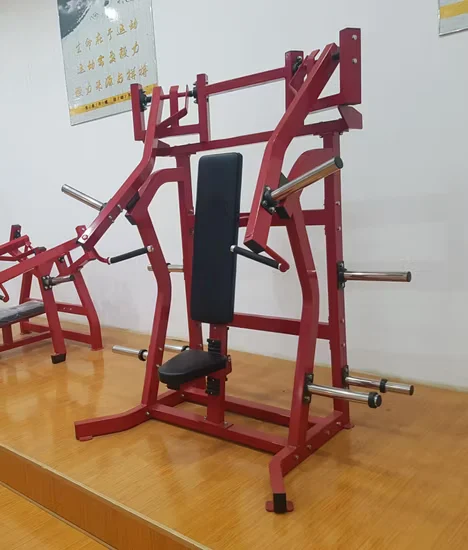
![Hammer Strength ISO-Lateral Super Incline Press Gym Equipment [WARN] draft identifier mismatch](https://bicksport.com/wp-content/uploads/2026/08/hammer-strength-iso-lateral-super-incline-press-gym-equipment-warn-draft-identifier-mismatch-13d23a.webp)
10,000-Hour Durability Validation — Structural welds and sealed bearings tested under continuous commercial loading cycles before leaving the Shandong production floor.
Technical Specifications
| Parameter | Value |
|---|---|
| Designation | OS-H008 |
| Product Type | ISO-Lateral Super Incline Press Machine |
| Model NO. | OS-H008 |
| Exercise Part | Chest |
| Frame Material | Reinforced Steel |
| Resistance Mechanism | ISO-Lateral Independent Arms |
| Product Dimensions | 1500 × 1350 × 1650 mm |
| Net Weight | 137 kg |
| Max User Weight | 180 kg |
| Footprint Category | Compact Commercial |
| Certification | ISO 9001, CE |
| Production Capacity | 500 pieces per month |
Application Suitability
| Deployment Scenario | Typical Use |
|---|---|
| Hotel fitness center on guest room floors | Upper-body strength stations in limited-footprint 24-hour access zones |
| Chain gym cardio zone | High-frequency incline press complementing selectorized circuit lines |
| Corporate wellness room | Compact chest training within multi-discipline strength clusters |
| High-end residential home gym | Commercial-grade durability in private training environments |
| Sports performance training center | Unilateral loading protocols for athlete strength development |
Why Frames Crack Before Warranties Expire on the Gym Floor
Reinforced steel frames and independent arm linkages engineered to absorb thousands of loading cycles without weld fatigue.
Light-commercial strength frames deployed in public facilities show stress fractures at high-load junction points within the first year of continuous use. Weld seams at the main upright-to-base connection bear concentrated shear forces during heavy incline presses, and sub-spec steel grades cannot endure the repetitive load patterns of a busy gym floor. Operators who specified equipment without reviewing weld penetration depth reports and steel grade certificates ended up replacing entire units rather than repairing localized damage [NEED_CITE: commercial strength equipment frame fatigue classification standards]. The OS-H008 ISO-Lateral Super Incline Press Machine commercial gym equipment addresses this failure mode through reinforced joint geometry and ISO-lateral independent arm movement that distributes load across the full frame structure rather than concentrating stress at cross-linkage pivot points.
Where This Press Fits in a Layered Strength Zone
The OS-H008 targets the upper-chest and anterior deltoid range through an incline pressing arc, complementing flat and decline stations already present in a full-body strength circuit. Its ISO-lateral independent arm mechanism suits facilities that program unilateral loading for athletes recovering from asymmetry or members seeking balanced muscle development. In a layered strength zone, this unit sits between compound pressing machines and isolation fly stations, occupying a mid-traffic position that encourages progressive overload rotation. The 1500 × 1350 × 1650 mm footprint allows placement along perimeter walls or within interior clusters, accommodating users up to 180 kg across a wide anthropometric range. As a compact ISO-Lateral Super Incline Press Machine commercial gym equipment option, it integrates into zones where sightline preservation and member flow spacing remain priorities.
Continuous Loading Cycles and Deployment Environment Constraints
Facilities running strength zones for twelve or more hours daily subject every weld and bearing to repetitive fatigue stress that light-commercial frames cannot withstand. The 137 kg net weight provides a stable base on standard rubber flooring without requiring bolt-down anchors, but floor leveling within tolerance remains essential to prevent frame twist under off-center loading [NEED_CITE: EN 957 requirements for commercial strength equipment stability]. Noise transmission through floor joists matters less for plate-loaded or ISO-lateral machines than for motorized cardio, yet metal-to-metal contact at weight horn stops still generates impact pulses that travel through concrete slabs to occupied spaces below. Adequate side clearance ensures members can load and unload plates without disrupting adjacent station traffic. Voltage compatibility does not apply to this purely mechanical unit, simplifying international deployment.
Engineering Decisions Behind the ISO-Lateral Mechanism
ISO-lateral independent arm movement eliminates the cross-linkage drag found in traditional converging-arc machines, allowing each arm to track its own pressing path without forcing the non-working side into compensatory stabilization. This design choice means unilateral loading remains smooth throughout the full range of motion, which matters when athletes or rehabilitating members load asymmetrically. The reinforced steel frame construction provides the mass and rigidity necessary to absorb eccentric loading phases without visible deflection at the uprights. At 137 kg, the frame weight sits above most light-commercial competitors, translating to reduced vibration transfer during heavy sets and a planted feel that members associate with professional-grade equipment. The 180 kg maximum user weight rating reflects frame yield testing under combined static and dynamic loads, not merely a regulatory minimum [NEED_CITE: ISO 9001 testing protocols for commercial strength frame load ratings].
What Happens When Specifications Are Chosen on Price Alone
Strength machines specified solely on initial purchase cost tend to reveal their compromises within eighteen months of continuous gym deployment. Frames built from thinner-gauge steel develop visible flex at high-load junctions, and members notice the instability during heavy incline sets, leading them to avoid that station entirely. Weight horns with insufficient retention sleeves allow plates to shift during eccentric phases, creating metallic clatter that carries across open floor plans and disrupts adjacent training zones. Pivot bearings rated for light-commercial cycles develop play that manifests as arm wobble, prompting maintenance calls that pull technicians away from cardio and electronic equipment [NEED_CITE: commercial gym equipment bearing lifespan under high-frequency loading]. Units pulled from the floor for frame repair or replacement represent lost member engagement and wasted floor space during downtime.
Why This Product Line Carries the Facility Specification
Every OS-H008 frame undergoes the same 10,000-hour durability validation applied across the full cardio and strength catalog, ensuring weld integrity and bearing performance under simulated continuous commercial loading. The ISO-lateral independent arm mechanism is tested for smooth tracking across the full pressing arc under asymmetric loads, replicating real-world unilateral training protocols. Compact dimensions and 137 kg net weight allow facility planners to position this unit within 3D strength-zone layouts that account for member flow corridors, sightlines from entry points, and airflow paths around clustered equipment. OEM customization extends to frame color, weight horn branding, and upholstery specification at flexible minimum order quantities. Deployment documentation includes a 3D layout covering footprint spacing and adjacent station clearances, plus 24/7 technical support access for commissioning questions and spare parts identification.
Documentation & Test Records
- CE declaration of conformity covering structural and mechanical safety requirements
- EN 957 test report validating load ratings and stability under maximum user weight
- ISO 9001 certificate documenting manufacturing quality management systems
- Frame durability test record for continuous high-frequency commercial loading cycles
- Steel grade specification sheet and weld penetration depth documentation
- Installation guide covering floor leveling, clearances, and commissioning procedures
Installation, Commissioning & Maintenance
- Maintain 600 mm side clearance for safe plate loading around the 1500 × 1350 mm footprint
- Level rubber flooring within tolerance before positioning the 137 kg frame to prevent twist
- Verify weight horn retention sleeves secure plates during eccentric loading phases
- Inspect pivot bearings and ISO-lateral arm tracking at quarterly maintenance intervals
- Wipe steel frame and upholstery after each session to prevent sweat corrosion
- Rotate wear points on weight horn contact surfaces annually based on usage volume
Request a Strength Zone Layout and Specification Match
Provide your strength zone square footage and current equipment list to receive a 3D layout covering station spacing, member flow corridors, and sightline preservation for this ISO-Lateral Super Incline Press Machine commercial gym equipment. Specify average daily operating hours so we can confirm frame and bearing durability alignment with your facility’s usage density. Indicate deployment floor level and adjacent occupied spaces to assess impact transmission through structural connections. Share any OEM requirements including frame color, upholstery material, and branding placement on weight horns or shrouds.
Frequently Asked Questions
Q: ISO-lateral versus plate-loaded converging press — which fits high-traffic commercial floors?
A: ISO-lateral independent arms eliminate cross-linkage drag, allowing members to load each side without affecting the opposite arm’s movement path. In high-traffic environments where users vary widely in strength and training goals, this independence reduces wait times for bilateral exercises and accommodates unilateral protocols without requiring separate machines. Plate-loaded converging presses suit facilities prioritizing fixed movement arcs over loading flexibility.
Q: Does the 137 kg frame require bolt-down installation on commercial gym flooring?
A: At 137 kg net weight with a reinforced steel base footprint, the OS-H008 maintains stability during heavy incline presses on standard rubber flooring without anchor bolts. Floor leveling remains essential to prevent frame twist under off-center loading. Bolt-down installation may be specified for facilities with uneven subfloors or seismic requirements, but standard deployment relies on mass and base geometry for planted positioning.
Q: How do I verify steel grade and weld quality for continuous commercial use?
A: Request the steel grade specification sheet and weld penetration depth report from the manufacturer before purchase. These documents confirm base material yield strength and weld joint integrity at high-load junctions. Facilities should also review the frame durability test record documenting performance under simulated continuous loading cycles, validating that the structure endures real-world high-frequency operation without fatigue cracking.
Q: What spacing and airflow considerations apply when placing this press in a strength zone?
A: Allow minimum 600 mm side clearance on each side for safe plate loading and member passage around the 1500 × 1350 mm footprint. Position the unit to preserve sightlines from entry points and staff desks, supporting member engagement and supervision. Maintain airflow corridors between clustered stations so that ventilation reaches all occupied positions during peak usage periods.
![H5058 Commercial Step Up Gym Fitness Equipment for Gym Club [WARN] draft identifier mismatch](https://bicksport.com/wp-content/uploads/2026/08/h5058-commercial-step-up-gym-fitness-equipment-for-gym-club-warn-draft-identifier-mismatch-a6b97d.webp)
![Hammer Strength Flat Bench Press Machine for Commercial Gym Equipment[WARN] draft identifier mismatch](https://bicksport.com/wp-content/uploads/2026/08/hammer-strength-flat-bench-press-machine-for-commercial-gym-equipmentwarn-draft-identifier-mismatch-12966b.webp)