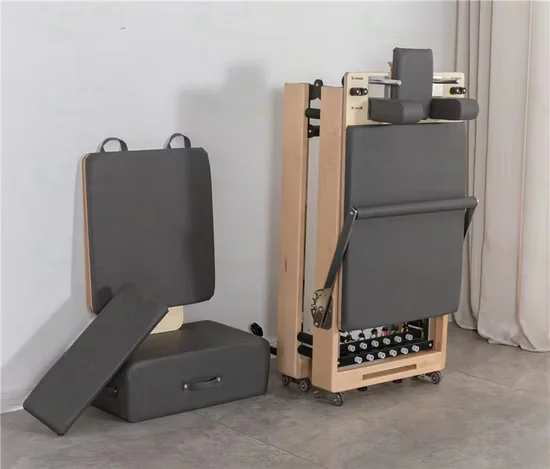
![Foldable Solid Maple Wood Pilates Reformer for Yoga Studio Training [WARN] draft identifier mismatch](https://bicksport.com/wp-content/uploads/2026/08/foldable-solid-maple-wood-pilates-reformer-for-yoga-studio-training-warn-draft-identifier-mismatch-2c9953.webp)
Acoustic Isolation & Spatial Efficiency — Solid maple density and damped folding hinges contain carriage vibration within shared-wall studio footprints.
Technical Specifications
| Parameter | Value |
|---|---|
| Designation | SRY-20c |
| Product Type | Foldable Pilates Reformer |
| Frame Material | Solid Maple Wood |
| Product Dimensions | 2300690580mm |
| Net Weight | 70kgs |
| Foldable | Yes |
| Included Accessories | Long Box, Jump Board, Platform |
| Color | Solid Color (Customizable) |
| Logo | Customization Available |
| Target User | Adult, Unisex |
| Warranty | 3 Years |
| HS Code | 9506911900 |
Application Suitability
| Deployment Scenario | Typical Use |
|---|---|
| Boutique Pilates Studio | High-frequency group and private reformer sessions requiring quiet carriage operation |
| Upper-Floor Wellness Room | Shared-wall or residential-adjacent fitness spaces demanding low vibration transmission |
| High-End Home Gym | Compact, stowable reformer for multi-use living areas with premium finish |
| Corporate Wellness Center | Employee fitness programming with accessory versatility for varied training needs |
Why Carriage Vibration Reaches the Unit Below Before the Studio Manager Notices
Solid maple frame density and damped contact points interrupt the vibration path from carriage impact to structural flooring.
When reformer carriages reverse direction at full extension, the kinetic energy travels through the frame and into hardwood or concrete subfloors. Studios occupying upper floors in mixed-use buildings generate structure-borne noise that manifests as rhythmic tapping in the rooms beneath [NEED_CITE: vibration transmission through commercial flooring assemblies]. Home-grade platforms with composite wood or hollow-frame construction amplify rather than absorb this impulse. A dense maple chassis, paired with engineered folding hinges that maintain rigid lock under dynamic load, addresses both the acoustic complaint and the spatial compromise that forces studios to remove equipment between class blocks.
How This Platform Fits Into a Multi-Discipline Studio Layout
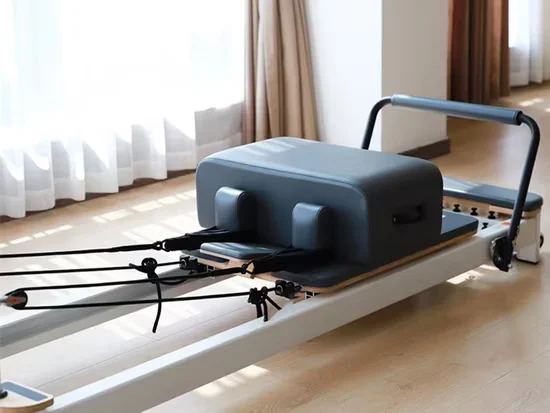
This unit covers full-spectrum Pilates programming from rehabilitation-grade spring work to explosive jump board plyometrics, occupying a single floor footprint. The long box enables supine and seated progressions, while the platform extends carriage travel range for advanced practitioners. Deploy it in reformer-dedicated zones or mixed-use rooms where the foldable chassis allows the space to convert for mat classes or functional training. The maple finish integrates visually with premium interior specifications, and the 180kg user capacity accommodates the full athlete and member size range without frame deflection. The foldable maple wood pilates reformer commercial configuration allows facility operators to adjust equipment density based on booking demand.
Continuous Use Demands and Environmental Controls
Commercial studios running back-to-back classes demand carriage tracks and spring systems that maintain consistent tension and glide throughout twelve-hour operating windows. Maple responds to humidity shifts with dimensional movement that can alter track alignment over seasonal cycles [NEED_CITE: solid wood dimensional stability in climate-controlled environments]. Facilities must maintain stable relative humidity to preserve track tolerance and finish integrity. Floor contact points require evaluation for the specific subfloor composition — direct coupling to concrete amplifies vibration transmission, while rubber isolation pads decouple the frame. Units placed on suspended timber floors demand particular attention to load distribution and resonance frequency matching.
Reading the Resistance Curve and Frame Engineering
Spring-based resistance systems deliver progressive tension that increases with carriage displacement, requiring users to generate peak force at full extension where mechanical advantage shifts. This differs from pneumatic or magnetic resistance that can deliver linear or adjustable curves independent of travel distance. The spring anchor points and carriage pulley routing determine how tension is distributed across the movement envelope — misalignment introduces lateral carriage drift and premature wheel wear. Solid maple provides natural vibration damping that composite materials require added mass to achieve, meaning the frame contributes to noise reduction without overbuilding weight into a unit that operators must fold and reposition daily.
What Cut-Cost Frame Materials Cost in Member Retention
Composite wood and hollow-box steel frames flex under loaded carriage travel, introducing rattle and lateral play that practitioners interpret as equipment instability. Springs calibrated on a rigid test bench deliver different resistance profiles when mounted to frames with measurable deflection. Members experiencing joint discomfort or inconsistent resistance feedback attribute the problem to their own form rather than equipment tolerances, leading to gradual attrition rather than formal complaints [NEED_CITE: equipment perception and member retention in group fitness]. Facilities replacing reformer fleets within eighteen months of purchase pay acquisition cost twice while absorbing downtime during changeover.
Why This Line Earns Its Studio Placement
The sub-35dB acoustic target applies to carriage glide and spring return, verified through facility deployment rather than bench testing alone. Spring tension consistency across full carriage travel ensures that the resistance a practitioner feels in the first repetition matches the fiftieth. The foldable chassis does not sacrifice frame rigidity — hinge engineering maintains locked structural continuity during use, and the unit withstands daily open-close cycles without hinge play development. OEM customization extends to logo, color, and accessory configuration, allowing multi-location networks to maintain brand consistency across deployments. The three-year warranty reflects confidence in component longevity under commercial duty cycles.
Documentation & Test Records
- CE declaration of conformity for commercial fitness equipment
- EN 957 test report covering static and dynamic load verification
- ISO 9001 quality management certification
- Frame material specification and finish durability records
- Accessory compatibility and load rating documentation
- Installation, commissioning, and maintenance guide
Installation, Commissioning & Maintenance
- Maintain minimum 600mm clearance on all sides for safe carriage extension and accessory mounting
- Level frame on solid subfloor using adjustable feet; add isolation pads for suspended timber floors
- Verify spring tension consistency across full carriage travel before releasing unit for member use
- Inspect carriage wheels and track alignment quarterly; clean debris from wheel channels monthly
- Maintain studio humidity within manufacturer-specified range to prevent maple dimensional movement
- Wipe down frame and carriage with non-corrosive cleaner after each session to protect finish from sweat
Equipment Selection and Deployment Inquiry
Provide your studio square footage, ceiling height, and planned reformer count to receive a 3D layout addressing spacing, sightlines, and member flow between units. Specify average daily operating hours and class scheduling density to confirm spring and track suitability for your duty cycle. Indicate whether units will deploy on grade-level concrete or suspended floors above occupied spaces to determine isolation requirements. State your target market and any branding customization requirements for logo, color, or accessory bundling.
Frequently Asked Questions
Q: How does solid maple compare to engineered wood for reformer frame vibration control?
A: Solid maple’s natural density provides inherent vibration damping that engineered composites achieve only through added mass or supplementary isolation materials. The continuous grain structure distributes carriage impact energy rather than concentrating it at joints, reducing structure-borne noise transmission to floors below. This matters for studios operating above residential or office spaces where low-frequency tapping becomes a lease compliance issue.
Q: What load capacity and cycle durability should I expect from foldable reformer hinges?
A: Hinge mechanisms must maintain rigid lock under full user load during dynamic carriage movement without developing play over thousands of open-close cycles. The hinge load rating should exceed maximum user weight with safety factor applied. Daily folding for multi-use room conversion demands engineering that resists wear-induced looseness, which introduces carriage drift and noise.
Q: How does spring resistance progression affect exercise programming and joint loading?
A: Spring-based systems deliver increasing resistance as carriage travel extends, meaning practitioners encounter peak tension where their limbs are fully extended. This progression aligns with natural strength curves in some movements but conflicts with others, requiring instructors to select spring combinations that match exercise intent. Consistent calibration across the fleet ensures uniform class experience.
Q: What noise and vibration considerations apply when deploying reformers on upper floors?
A: Carriage direction changes and jump board impacts generate impulse loads that transmit through frame contact points into structural flooring. Deploying units above occupied spaces requires evaluation of subfloor composition, isolation pad specification, and ceiling construction in rooms below. Solid maple frames reduce high-frequency resonance compared to lighter composite materials, but floor decoupling remains essential for mixed-use buildings.
Q: How do long box, jump board, and platform accessories integrate for full programming?
A: The long box enables supine and seated exercises requiring elevated support, the jump board converts the reformer for plyometric conditioning, and the platform extends effective carriage travel for advanced movements. All three must mount securely to the base frame without introducing play or requiring tools that slow class changeover. Verify that accessory attachment points are reinforced within the maple structure to withstand repetitive impact loading.

![--- **H1 标题:** Commercial Wood Pilates Reformer Bed from Manufacturer [WARN] draft identifier mismatch **Meta Title:** Commercial Wood Pilates Reformer Bed | Oak Maple Beech Equipment Manufacturer **Meta Description:** Full-size commercial Pilates reformer crafted from solid oak, maple, and beech wood with customizable accessories, 3-year warranty, and OEM/ODM capability for studios and wellness facilities. --- ### 一、6 组 URL 路径 | # | URL Path | |---|---| | 1 | `/commercial-pilates-reformer-bed` | | 2 | `/wood-pilates-reformer-equipment` | | 3 | `/oak-maple-beech-pilates-reformer` | | 4 | `/studio-pilates-reformer-bed` | | 5 | `/professional-pilates-reformer-machine` | | 6 | `/commercial-wood-reformer-pilates` | --- ### 二、5 个长尾关键词及对应页面标题(H1) | # | Long-tail Keyword | Page Title (H1) | |---|---|---| | 1 | `commercial wood pilates reformer bed for studio` | Commercial Wood Pilates Reformer Bed for Studio Use | | 2 | `oak maple beech pilates reformer equipment` | Oak Maple Beech Pilates Reformer Equipment for Professional Studios | | 3 | `pilates reformer bed with long box and jump board` | Pilates Reformer Bed with Long Box and Jump Board Accessories | | 4 | `solid wood pilates reformer for fitness center` | Solid Wood Pilates Reformer for Fitness Center and Wellness Facilities | | 5 | `customizable commercial pilates reformer machine` | Customizable Commercial Pilates Reformer Machine with OEM Support |](https://bicksport.com/wp-content/uploads/2026/08/h1-e6a087e9a298efbc9a-commercial-wood-pilates-reformer-bed-from-manufacturer-warn-draft-identifier-mismatch-meta-titleefbc9a-commercial-wood-pilates-reformer-bed-oak-maple-9f411c.webp)