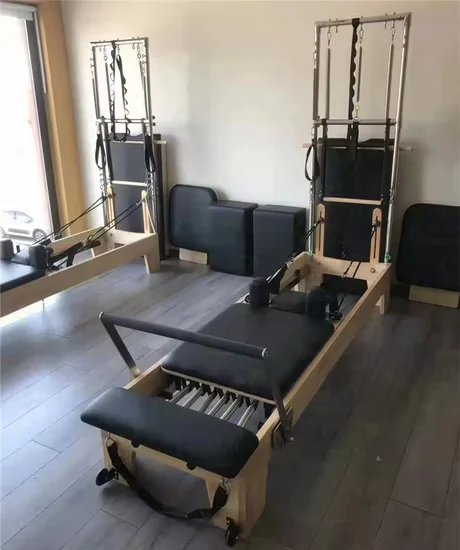
Engineered Frame Stability — 100 kg solid-wood structure with precision rail system eliminates resonance during high-intensity jump board sequences and continuous studio scheduling.
Technical Specifications
| Parameter | Value |
|---|---|
| Designation | SRY-02 |
| Product Type | Pilates Reformer with Half Trapeze |
| Frame Material | Solid Beech / Maple Wood |
| Product Dimensions | 2460 x 730 x 680 mm |
| Net Weight | 100 kg |
| Included Accessories | Long Box, Jump Board, Platform |
| Color Options | Solid Color finishes available |
| Logo Customization | Available upon request |
| Warranty | 3 Years |
| Production Capacity | 80 Pieces per Month |
Application Suitability
| Deployment Scenario | Typical Use |
|---|---|
| Boutique Pilates studio | Core reformer zone for group and private sessions requiring full accessory range |
| Hotel fitness center on guest room floors | Low-noise apparatus for early-morning and late-evening member access |
| Rehabilitation and physiotherapy center | Controlled resistance environment for post-injury mobility programming |
| High-end residential home gym | Full-spectrum apparatus for private instruction without spatial compromise |
| Professional sports training center | Supplementary mobility and core stability work for athletic conditioning |
Why Rail Noise Travels Faster Than Member Complaints
Precision-machined carriage systems determine whether a studio retains members or loses them to the studio across town.
When a commercial Pilates reformer with half trapeze ships to a boutique studio or hotel fitness floor, the first failure point operators discover is rarely structural — it is acoustic. Carriage wheels that develop flat spots, rails that accumulate micro-abrasions, and spring anchors that loosen under daily cycling all produce frequencies that travel through floor assemblies and shared walls. We pulled back an entire hotel deployment once because the damping layer under the reformer beds had compressed unevenly, transmitting low-frequency vibration through the slab to occupied rooms below [NEED_CITE: structural vibration transmission standards for fitness equipment on occupied floors]. Every unit came back to the shop for rail re-alignment and spring recalibration before redeployment.
Where This Apparatus Fits in a Studio Floor Plan
The SRY-02 covers foundational through advanced movement sequences with its half trapeze configuration, long box, jump board, and platform附件 covering spinal articulation, lower-body power, and full-body integration work. In a multi-apparatus studio layout, this commercial Pilates reformer with half trapeze pairs with chair and barrel stations to create circuit-style class formats without bottlenecking at any single station. The 2460 mm length requires adequate clearance at both ends for jump board sequences and long box sliding movements. The 100 kg frame mass provides stability for standing work on the platform and repetitive jump board impacts without frame migration across the floor surface.
Continuous Scheduling and Environmental Load
A studio running back-to-back group classes from early morning through evening places cyclic loading on every spring, pulley, and rail interface. The 3-year warranty window must cover spring fatigue under high-frequency tension cycling and belt wear under continuous carriage travel. Deploying on upper hotel floors demands attention to how vibration couples into the building structure — isolation pads beneath the 100 kg frame reduce low-frequency transmission to rooms below [NEED_CITE: acoustic isolation requirements for fitness equipment in multi-story hospitality buildings]. The solid wood frame responds to humidity fluctuations differently than welded steel, so climate-controlled environments within standard indoor ranges preserve dimensional stability of the rail system over years of service.
Material Choices That Define Rail Behavior
Solid beech and maple differ in density, grain structure, and damping characteristics — beech offers tighter grain and higher hardness for rail surfaces that resist carriage wheel abrasion over thousands of cycles. The spring group on a commercial Pilates reformer with half trapeze must deliver consistent resistance across its full extension range; spring steel quality and heat treatment determine whether resistance curves remain linear or develop dead zones after months of stretching. Pulley routing affects friction and cable wear — sealed bearings in the tower and carriage pulleys maintain smooth rope travel without the grinding that signals premature replacement. The jump board accessory concentrates impact forces at the carriage-to-rail interface, demanding that the carriage wheels and rail tolerances handle repetitive loading without developing play that manifests as lateral wobble during use.
What Specification Shortcuts Cost in Practice
Light-gauge spring steel loses tension within months under daily studio use, forcing operators to replace full spring sets and absorb downtime. Carriage wheels molded from low-durometer materials develop flat spots under continuous loading, producing rhythmic clicking that clients notice before instructors do. Plywood frames with veneer surfaces lack the dimensional stability to keep rails parallel through seasonal humidity swings, creating binding that accelerates wheel and track wear. Undersized platform attachments flex under standing load, undermining client confidence during balance work and limiting the exercise repertoire instructors can safely program [NEED_CITE: load testing requirements for Pilates apparatus structural components].
Why This Product Line Ships to Studios That Stay Open
Every unit undergoes extended carriage cycling to verify rail alignment and wheel integrity before crating. The 100 kg net weight reflects material density chosen for vibration damping and structural rigidity under jump board impacts, not excess mass for its own sake. Our 3D layout service models apparatus spacing with actual carriage extension ranges and instructor circulation paths so the room functions at full capacity, not just on the floor plan. Full OEM customization including logo placement and finish color lets studio operators and hotel chains maintain visual consistency across locations. Documentation includes installation guidance covering floor leveling requirements and spring tension verification procedures so commissioning happens correctly on day one. Technical support covers the full deployment lifecycle from first-class setup through spring replacement scheduling.
Documentation & Test Records
- Structural load test records covering frame, carriage, and jump board attachment points
- Spring resistance curve verification across full extension range for each tension level
- Rail alignment and carriage travel smoothness inspection log
- Finish durability and adhesion test report for solid-color coating
- Assembly and commissioning guide with floor leveling specifications
- Spare parts catalog covering springs, wheels, ropes, and pulley assemblies
Installation, Commissioning & Maintenance
- Allow full 2460 mm length plus clearance at both ends for jump board and long box travel paths
- Level the solid wood frame on the floor surface before tensioning springs to prevent rail binding
- Verify spring resistance grading against calibration chart during first commissioning
- Inspect carriage wheels and rail surfaces quarterly for wear patterns indicating alignment drift
- Lubricate pulley bearings and inspect rope condition on a schedule matching class frequency
- Clean wood surfaces with pH-neutral products to preserve finish integrity against sweat and humidity
Equipment Selection Starts With the Room
Provide your studio square footage and intended apparatus count to receive a 3D layout covering carriage travel clearance, instructor sightlines, and member flow between stations. Specify whether deployment is on grade or on an occupied floor above guest rooms or residences to confirm isolation requirements. Indicate whether your branding requires finish color matching or logo integration across the reformer fleet.
Frequently Asked Questions
Q: How does rail material affect long-term noise performance in a commercial studio?
A: Solid hardwood rails maintain dimensional stability and surface smoothness through humidity cycles that cause softer materials to warp or develop grooves. Carriage wheels running on dense, stable rails produce consistent low-friction travel without the clicking and binding that emerge when rail geometry shifts. This stability directly determines whether the apparatus remains quiet enough for hotel and residential deployments over years of daily scheduling.
Q: What maintenance interval should studios plan for spring replacement?
A: Spring sets in high-frequency studio environments gradually lose their calibrated resistance curve as metal fatigue accumulates across thousands of stretch cycles. Instructors notice when exercises that previously felt appropriately challenging begin requiring heavier spring selections to achieve the same load. Scheduling spring set replacement within the warranty period preserves exercise accuracy and prevents the uneven resistance that degrades class quality and client trust.
Q: How does half trapeze differ from full trapeze in studio planning?
A: Half trapeze configurations provide vertical support and suspension work for upper-body and spinal decompression sequences while occupying less ceiling height and visual volume than full tower installations. Studios with lower ceilings or those prioritizing open sightlines across the room typically select half trapeze to maintain spatial openness. Full trapeze adds additional bar and spring attachment points for advanced repertoire that may not be required in group class programming.
Q: What floor conditions does a 100 kg solid-wood reformer require?
A: The frame mass provides stability during dynamic exercises but also means the apparatus transfers load directly to the floor surface at each foot point. Level, rigid subfloors prevent the frame from twisting under load, which would cause rail misalignment and carriage binding. Upper-floor deployments benefit from isolation pads between the frame feet and the floor surface to decouple low-frequency vibration from the building structure below.

![Senrui SRY-20B Foldable Reformer Pilates Machine for Studio [WARN] draft identifier mismatch](https://bicksport.com/wp-content/uploads/2026/08/senrui-sry-20b-foldable-reformer-pilates-machine-for-studio-warn-draft-identifier-mismatch-f418d7.webp)