
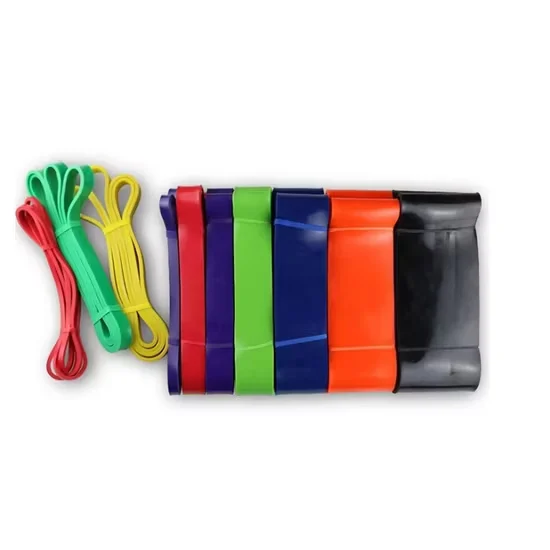
Progressive Resistance Engineering — Natural latex construction verified across eleven width variants from 6.4mm to 102mm for graded commercial programming.
Technical Specifications
| Parameter | Value |
|---|---|
| Product Type | Fitness Resistance Band |
| Model NO. | ARB-1000 |
| Material | Natural Latex |
| Specification (Length) | 2080mm |
| Available Widths | 6.4 / 13 / 19 / 21 / 29 / 32 / 45 / 64 / 83 / 102 mm |
| Color | Customized Color options available |
| Logo | Customized Logo Available |
| MOQ | 50 sets |
| HS Code | 9506911900 |
| Origin | China |
| Production Capacity | 10,000 sets / Year |
Application Suitability
| Deployment Scenario | Typical Use |
|---|---|
| corporate wellness room | functional movement screening and warm-up activation |
| hotel fitness center on guest room floors | supplementary strength accessory for compact training spaces |
| chain gym cardio zone | cooldown and mobility routines between high-intensity intervals |
| high-end residential home gym | full-body progressive resistance for limited footprint environments |
| sports performance training center | glute activation and pre-habilitation protocols for athletes |
Why Material Consistency Matters When Retail Bands Fail Commercial Demands
Natural latex maintains tension profiles that synthetic alternatives cannot replicate under continuous facility use.
Facility operators sourcing resistance accessories often discover that generic retail bands degrade rapidly under high-frequency rotation. The customizable latex resistance band commercial strength training market is flooded with products that lose elasticity within weeks of deployment, creating member complaints and frequent replacement cycles [NEED_CITE: material fatigue testing for natural latex under continuous load]. When bands snap during peak usage hours, the liability exposure extends beyond equipment replacement.
Positioning This Resistance Band Series Within Cardio and Functional Zones
This product covers eleven width increments, enabling facility staff to match resistance profiles to specific training objectives. Thinner variants at 6.4mm through 21mm support activation routines and mobility work, while the 45mm to 102mm widths accommodate heavy compound movements and assisted pull-up progressions. The customizable latex resistance band commercial strength training applications pair with cardiovascular equipment for integrated programming — bands deployed adjacent to treadmill zones for warm-up sequences, or positioned within functional training corners for strength circuits.
Material Durability and Deployment Density Considerations
Natural latex construction requires awareness of storage conditions and rotation schedules. Unlike steel-cable systems, elastomeric materials respond to UV exposure, temperature fluctuation, and oxidation [NEED_CITE: latex degradation factors in commercial gym environments]. Facilities operating sixteen-hour daily access windows benefit from staggered band sets, allowing individual units to rest between usage cycles. Climate-controlled storage extends service life, while direct sunlight placement accelerates material breakdown regardless of manufacturing quality.
Resistance Calibration Across Width Variants
Each width increment delivers a distinct force curve that trained staff can map to exercise progressions. The 6.4mm band provides minimal assistance for rotator cuff work and ankle mobilization, scaling upward through the 13mm, 19mm, and 21mm options for general warm-up protocols. Heavier widths at 64mm, 83mm, and 102mm generate substantial assistance for bodyweight movements or significant resistance for sprint harness training. This graduated system eliminates guesswork when programming for diverse member populations across corporate wellness and athletic performance contexts.
The Hidden Cost of Underspecifying Resistance Accessories
Facilities treating resistance bands as commodity consumables experience predictable failures. Retail-grade synthetics stretch beyond recovery within weeks, forcing monthly reorder cycles that compound annual spend [NEED_CITE: total cost of ownership comparison for commercial vs retail resistance bands]. More critically, inconsistent resistance profiles force trainers to estimate load rather than prescribe it, undermining program credibility when members track progression metrics. Bands that snap under load create safety incidents that damage facility reputation beyond equipment replacement cost.
Why This Product Line Matches Commercial Deployment Standards
This series provides eleven verified width options that align with standard progression protocols used in professional training environments. Natural latex construction delivers predictable force curves across the full range, unlike synthetic blends that exhibit non-linear behavior as they age. OEM customization including color and logo application allows facilities to brand resistance zones or create member takeaway packages. The 50-set MOQ enables pilot deployment across multiple locations without overcommitting inventory, while production capacity supports phased rollout schedules for multi-site gym networks requiring consistent accessory availability.
Documentation & Test Records
- Material composition certificate confirming natural latex purity and allergen disclosure
- Resistance force calibration data for each width variant from 6.4mm to 102mm
- Production batch traceability records linking manufacturing date to material lot
- Tensile strength test results documenting elastic limit and failure point specifications
- Packaging specification sheets for customized logo and branding alignment
Installation, Commissioning & Maintenance
- Storage in climate-controlled environment away from direct UV exposure and ozone sources
- Rotation schedule assigning band sets to specific time blocks to distribute usage load
- Visual inspection protocol checking for micro-tears, discoloration, and surface tackiness changes
- Cleaning procedures using manufacturer-approved solutions that avoid petroleum-based degradation
- Width labeling system ensuring staff and members select appropriate resistance for prescribed movements
- Quarterly replacement cycle based on usage intensity rather than arbitrary calendar intervals
Inquiry Process for Facility Accessory Programs
Specify deployment scenario — corporate wellness, hotel fitness, or athletic performance — to receive width recommendations matched to typical programming. Confirm whether bands support member retail programs or remain facility-controlled inventory, as this affects customization and packaging requirements. Indicate multi-site rollout timelines to verify production capacity alignment with phased deployment schedules.
Frequently Asked Questions
Q: What distinguishes natural latex from synthetic rubber for commercial resistance applications?
A: Natural latex maintains consistent force curves across thousands of stretch cycles, while synthetic blends exhibit non-linear degradation patterns that make resistance prescription unreliable. Facilities tracking member progression metrics require predictable material behavior — natural latex delivers this through uniform elastic recovery that synthetic alternatives cannot match under continuous high-frequency use.
Q: How do facility operators select appropriate width for different training objectives?
A: Thinner widths between 6.4mm and 21mm support activation and mobility work with minimal assistance load. Mid-range options from 29mm to 45mm suit general strength training and assisted bodyweight progressions. Heavy widths at 64mm through 102mm provide substantial assistance for pull-up variations or significant resistance for sprint harness training and explosive movement development.
Q: What customization options are available for OEM branding programs?
A: Color matching to facility brand guidelines and logo application on bands or packaging are both supported. Customization extends to retail-ready packaging for member takeaway programs or bulk packaging for facility-controlled inventory distribution. Artwork approval processes confirm logo placement, color accuracy, and packaging specifications before production commitment.
Q: How should facilities structure maintenance and replacement schedules for latex bands?
A: Storage conditions, usage frequency, and environmental exposure determine service life more than arbitrary calendar intervals. Facilities operating extended daily access windows benefit from rotating multiple band sets to distribute load. Visual inspection protocols identify degradation signs — surface tackiness changes, discoloration, and micro-tear formation — before catastrophic failure occurs during member use.
Q: What MOQ and lead time considerations apply for multi-site deployments?
A: The 50-set minimum order quantity enables pilot programs across individual locations without overcommitting inventory before operational feedback. Multi-site networks planning phased rollout should confirm production capacity alignment with deployment timelines, particularly when custom branding extends lead time beyond standard catalog orders.

![Commercial Double D-Ring Ankle Cuffs for Gym Cable Machine Workouts [WARN] draft identifier mismatch](https://bicksport.com/wp-content/uploads/2026/08/commercial-double-d-ring-ankle-cuffs-for-gym-cable-machine-workouts-warn-draft-identifier-mismatch-4a9482.webp)