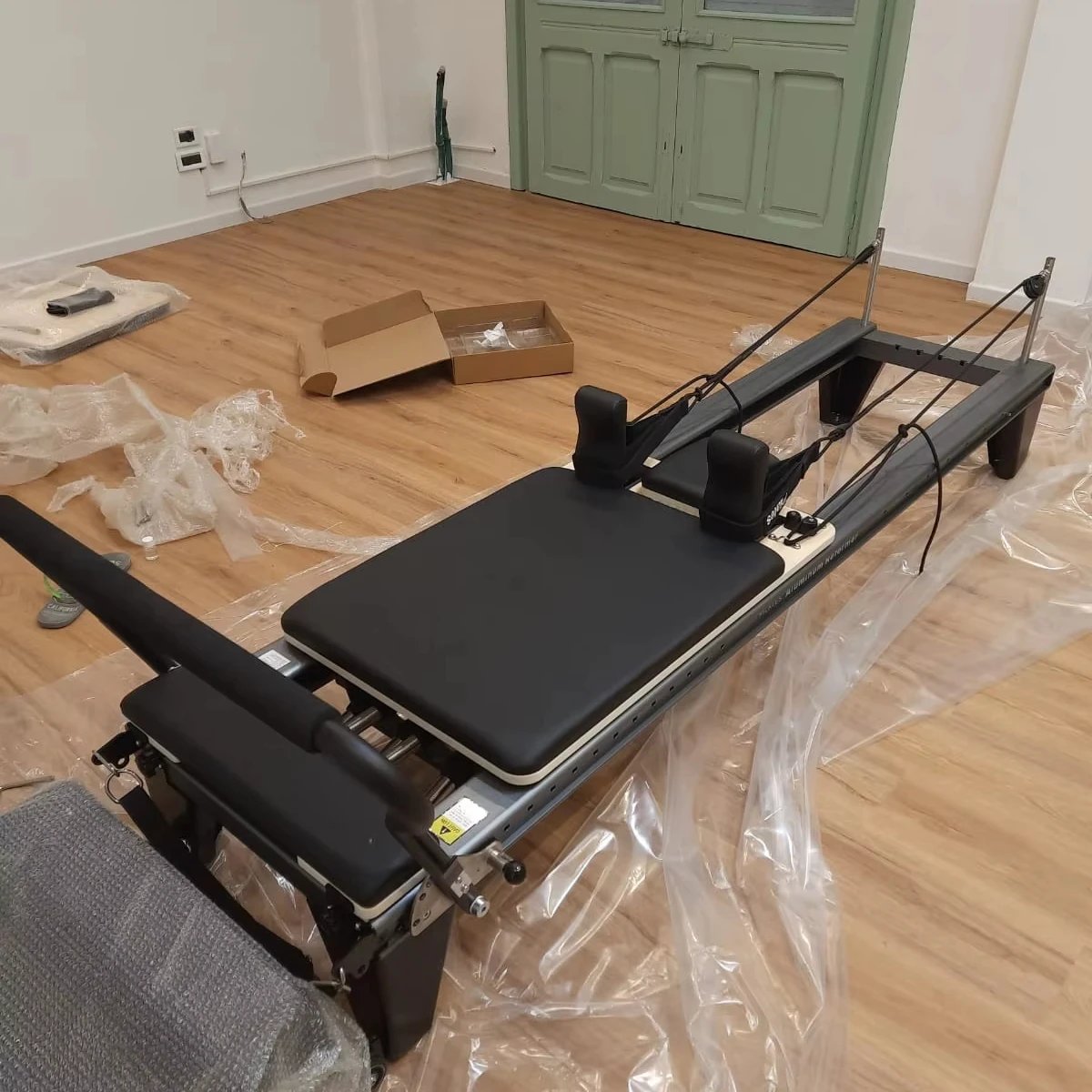
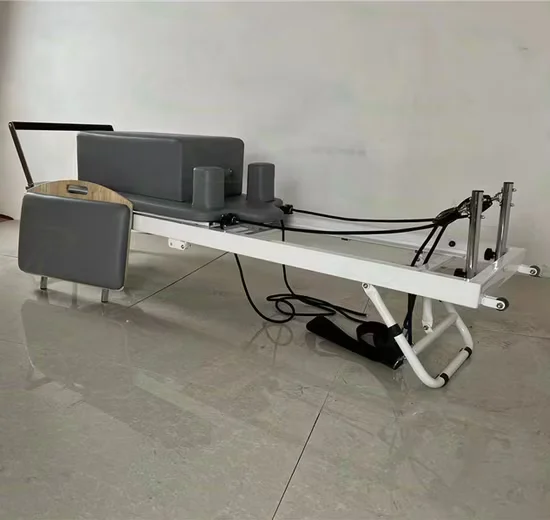
Solid Wood Damping — Precision rail carriage on a 100 kg hardwood frame absorbs spring oscillation to keep shared-wall wellness spaces quiet during peak studio hours.
Technical Specifications
| Parameter | Value |
|---|---|
| Product Type | Pilates Reformer |
| Designation | SRY-02 |
| Brand | Senrui |
| Frame Material | Solid Wood |
| Product Dimensions | 2460 × 730 × 680 mm |
| Net Weight | 100 kg |
| Accessories Included | Long Box, Jump Board, Platform |
| Resistance Type | Spring-Based |
| Color Options | Solid Color |
| Logo Customization | Available |
| Warranty | 3 Years |
| Production Capacity | 80 Pieces / Month |
| HS Code | 9506911900 |
Application Suitability
| Deployment Scenario | Typical Use |
|---|---|
| Boutique Pilates studio | Group reformer classes with full accessory programming across beginner to advanced levels |
| Hotel wellness floor adjacent to guest rooms | Low-vibration reformer sessions that avoid triggering noise complaints through shared walls |
| High-end residential home gym | Aesthetic wood-frame unit matching interior finishes while supporting daily private training |
| Rehabilitation and physiotherapy center | Controlled spring-resistance movement for joint recovery and post-injury mobility work |
| Corporate wellness room | Compact single-unit deployment enabling guided reformer sessions during employee break windows |
Why Carriage Vibration Reaches the Front Desk Before Maintenance Does
A heavy solid-wood frame absorbs the oscillation that lightweight steel or aluminum frames transmit directly into floor slabs and partition walls.
When a Pilates reformer sits on a hotel wellness floor or above occupied residential space, every carriage return and spring snap sends structure-borne vibration through the building. Guests and tenants hear the metallic chatter before they ever see the equipment. I have watched hotel operators pull entire batches of lightweight-frame reformers after a single season of noise complaints from the rooms below [NEED_CITE: structure-borne vibration transmission in commercial fitness deployments]. The commercial Pilates reformer wooden frame approach addresses this at the source: frame mass acts as a damper, and precision rail wheels eliminate the metal-on-metal rattle that cheaper carriage systems generate mid-stroke.
Where This Reformer Sits in a Studio Layout
A studio deploying this commercial Pilates reformer wooden frame unit gains a single-footprint solution that covers mat-equivalent work, jump board cardio intervals, and long box alignment drills without requiring three separate machines. It pairs naturally with Cadillac towers and Wunda chairs to fill out a full apparatus room, occupying a linear footprint that leaves instructor walkway clearance on both sides. The 180 kg user capacity and full-size carriage accommodate the widest range of client body types in a group class rotation.
Continuous Class Scheduling and Room Environment Requirements
A studio running back-to-back group classes from early morning through evening places cumulative carriage mileage on the rail system that far exceeds private-session wear [NEED_CITE: commercial Pilates equipment duty cycles in high-frequency studio operation]. The spring-based resistance needs no electrical supply, eliminating voltage compatibility headaches for international hotel deployments. However, the 2460 mm length plus instructor clearance on each side demands careful floor planning; cramming units too close generates elbow-room complaints even when the equipment itself is silent. Solid wood frames are also sensitive to humidity swings, so climate-controlled rooms with stable moisture levels prolong joint and surface integrity far more than unventilated basement spaces.
Spring Tension, Rail Tolerance, and Frame Mass Explained
Spring-based resistance delivers a progressive tension curve — the further the carriage travels, the higher the load — which mirrors the natural strength curve of most muscle groups without electronic calibration. The precision wheel-and-rail carriage system on this commercial Pilates reformer wooden frame unit maintains consistent glide across the full stroke without the metallic chatter that worn ball bearings or misaligned tracks introduce over time. A 100 kg solid-wood frame provides inherent mass damping: when a client performs explosive jump board repetitions, the frame absorbs kinetic energy that a lighter steel tube frame would channel into the floor. Upholstery and logo customization allow studio operators to match brand palettes without aftermarket modifications.
What Spec Compromises Cost in a Reformer Deployment
Choosing a reformer with undersized springs leads to tension inconsistency within months, forcing instructors to verbally cue resistance levels that the equipment should deliver mechanically [NEED_CITE: spring fatigue and tension drift in commercial Pilates reformers]. Lightweight frames that save on shipping weight transfer every carriage impact into the building structure, and noise complaints accumulate faster than maintenance tickets. Skipping accessory compatibility means the studio buys separate jump boards and long boxes that never quite fit the rail profile, creating wobble and safety concerns during dynamic movements.
Why This Product Line Earns Its Place in a Facility
Every unit undergoes rail tolerance verification before leaving the Shandong production floor, so carriage glide remains consistent from the first session to the thousandth. The 10,000-hour durability testing protocol applied to our cardio equipment engineering extends to the spring and wheel assemblies here, ensuring tension curves hold under continuous studio scheduling. Full OEM customization covers logo placement, frame color, and upholstery to align with a boutique studio’s brand identity or a hotel chain’s interior standard. Our free 3D layout service factors in the 2460 mm reformer footprint plus instructor clearance and airflow paths, so no unit ends up wedged against a wall where ventilation and access both suffer. Technical support responds around the clock, critical when a stuck carriage or worn spring threatens to cancel a fully booked morning class.
Documentation & Test Records
- CE declaration of conformity for commercial fitness equipment
- EN 957 test report covering structural integrity and safety
- ISO 9001 certificate for manufacturing quality management
- Noise level test record for carriage and spring operation
- Durability test documentation for springs, rails, and wheels
- OEM customization scope sheet with logo and color options
Installation, Commissioning & Maintenance
- Allow minimum 2460 mm length plus 600 mm instructor clearance on both long sides for safe operation
- Level the floor contact points to prevent frame twist that accelerates rail wear on this 100 kg unit
- Inspect spring tension markers monthly and replace springs showing visible deformation or loss of return force
- Wipe down solid wood frame and leather upholstery after each session to prevent sweat corrosion
- Verify long box, jump board, and platform attachment pins seat fully before client use each day
Planning Your Reformer Procurement
Share your studio floor plan and unit count so we can produce a 3D layout that accounts for carriage travel clearance and instructor circulation paths. Specify your deployment environment — hotel wellness floor, residential building, or standalone studio — so we can confirm noise and humidity suitability. Indicate your target market for shipping and documentation alignment, and let us know if OEM branding on frame or upholstery is required for your rollout.
Frequently Asked Questions
Q: How does a solid wood frame compare to a steel frame for commercial Pilates reformer use?
A: Solid wood provides higher mass damping, absorbing carriage vibration that steel frames transmit into floors and walls. This matters most in hotel and shared-residential deployments where noise complaints drive equipment replacement. Steel frames weigh less and ship cheaper, but the acoustic trade-off often surfaces only after installation when guests in adjacent rooms start reporting disturbance.
Q: What maintenance does the spring resistance system require over time?
A: Springs should be visually inspected monthly for deformation, rust, or loss of return tension. Unlike magnetic or friction systems, springs have no electronic components to calibrate, but metal fatigue is inevitable under high-frequency studio scheduling. Replacement intervals depend on daily session count and the intensity profile of classes run, so we document tension specifications to simplify reordering.
Q: Which accessories ship with the reformer and which need separate ordering?
A: The SRY-02 ships with a long box, jump board, and platform as standard inclusions, enabling a full exercise repertoire from a single unit without additional procurement. If your studio requires specialty attachments such as a sitting box or foot strap set beyond the standard kit, confirm availability and compatibility during the quotation stage.
Q: What can be customized under OEM for this wooden Pilates reformer?
A: Logo placement on the frame, upholstery color, and leather or vinyl material selection are all available for customization at flexible minimum order quantities. Frame stain color can be matched to a studio or hotel interior palette. Confirm custom Pantone references and logo artwork files during the scoping phase to avoid production delays.
Q: How much floor space should be allocated per reformer in a group studio?
A: Each unit measures 2460 × 730 mm, but you must add instructor walkway clearance on both long sides and carriage travel space at the ends. A practical allocation per station is roughly 3.5 meters long by 1.8 meters wide to ensure safe movement during jump board exercises and full carriage extension without adjacent clients interfering.