
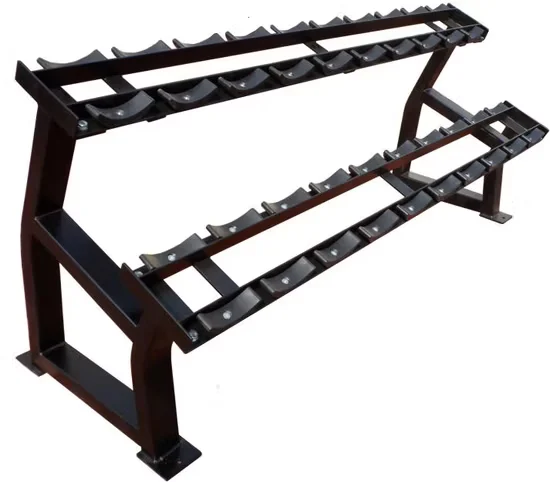
Heavy-Duty Frame — 66 kg reinforced steel structure resists deformation under continuous dumbbell retrieval cycles in commercial facilities.
Technical Specifications
| Parameter | Value |
|---|---|
| Product Type | Dumbbell Rack |
| Material | Steel |
| Net Weight | 66 kg |
| Product Dimensions | 2210 × 700 × 800 mm |
| Color | Optional |
| OEM | Available |
| Exercise Part | Rack |
| Application | Fitness Center, Gymnasium |
| Certification | ISO 9001, CE |
Application Suitability
| Deployment Scenario | Typical Use |
|---|---|
| hotel fitness center on guest room floors | compact dumbbell organization for 24-hour guest access with floor load considerations |
| chain gym free weight zone | high-frequency dumbbell retrieval during peak hours with heavy commercial inventory |
| corporate wellness room | streamlined dumbbell storage for structured strength circuits during lunch-hour traffic |
| community recreation center | durable dumbbell organization serving diverse membership across multiple daily sessions |
| sports performance training center | heavy dumbbell staging for progressive overload programming and athlete conditioning blocks |
Why Bent Welds and Tipping Racks End Up on Incident Reports
A 66 kg reinforced steel base keeps the commercial dumbbell rack stable when members drop heavy pairs during rush-hour free weight sessions.
Gym operators learn the hard way that underweight racks warp within months when commercial-grade dumbbell sets cycle through hundreds of daily pickups. The welds on light-duty frames crack under asymmetric loading — a member grabs one 30 kg bell while the opposite side still holds 40 kg pairs, twisting the uprights off-square. I have replaced entire dumbbell walls where the top tier sagged visibly, creating both liability exposure and member complaints about disorganized free weight zones [NEED_CITE: structural load rating standards for commercial free weight storage].
Positioning This Rack in a Free Weight Floor Plan
This commercial dumbbell rack covers the full dumbbell inventory of a mid-to-large commercial facility, organizing pairs across a 2210 mm wide footprint that aligns with standard free weight zone dimensions. It sits alongside plate-loaded benches and functional trainers as a central retrieval point, reducing member congestion during peak hours. The steel frame accommodates the weight range that adult users of varying strength levels require, from rehabilitation sets through heavy compound-lift pairs. The open-shelf layout supports quick visual inventory checks by floor staff.
Floor Loading, Clearance, and Daily Traffic Demands
The 2210 × 700 mm base requires a dedicated footprint with clearance on all three retrieval sides — typically 1200 mm minimum aisle width for members carrying dumbbells back to benches [NEED_CITE: commercial gym equipment spacing and safety clearance standards]. Deploying on upper hotel floors demands verifying structural floor load capacity against the combined weight of the steel rack plus a full commercial dumbbell set. Ground-level installations benefit from rubber matting underneath to absorb impact from dropped bells and protect the frame base from moisture. High-traffic facilities should schedule weekly weld inspection walkthroughs to catch hairline fractures before they propagate.
Material Grade and Structural Weld Integrity
The all-steel construction prioritizes rigidity over portability, which matters when a 2210 mm wide rack carries hundreds of kilograms across multiple tiers. Commercial rack longevity depends on weld penetration depth and post-weld stress relief — shortcuts here produce joints that look solid on day one but develop fatigue cracks after repeated asymmetric loading. The 66 kg net weight signals substantial steel gauge in the uprights and cross-members, resisting the torsional twist that lighter frames suffer when members load or unload one side. Color options allow facility operators to coordinate with existing equipment lines without compromising structural performance [NEED_CITE: steel grade specifications for commercial fitness equipment frames].
The Real Cost of Specifying Lightweight Storage
Facilities that purchase residential-grade dumbbell racks for commercial floors face predictable failure patterns. Thin-gauge steel uprights bend within the first year under continuous dumbbell turnover, and replacement costs compound when the entire rack must be swapped during a scheduled maintenance window. Disorganized weight zones frustrate members who cannot locate matching pairs quickly, pushing them toward alternative facilities with better-equipped free weight areas. Weld failures on overloaded shelves create sharp edges and pinch points that trigger liability documentation. These operational losses trace directly back to selecting storage equipment without matching it to commercial duty cycles [NEED_CITE: equipment failure patterns in high-traffic commercial fitness environments].
What This Product Line Brings to Your Facility
The 66 kg steel base reflects the same durability engineering we apply across our cardio range — components tested through extended continuous-use cycles rather than occasional residential benchmarks. The 2210 × 700 × 800 mm dimensions fit within our 3D cardio-zone layouts, where we model sightlines and member flow around the dumbbell rack to prevent bottlenecks near bench areas. OEM customization extends to powder-coat color and branding to match your facility palette. Our vertical manufacturing integration means the same quality control that runs our motor durability testing also inspects weld integrity on every rack before crating. Technical support covers spare part sourcing and replacement shelf components on the same 24/7 schedule as our cardio equipment lines.
Documentation & Test Records
- CE declaration of conformity for commercial dumbbell rack steel gym storage deployment
- EN 957 test report covering structural stability and load-bearing verification
- ISO 9001 certificate for manufacturing process compliance
- Weld inspection records and material grade documentation
- Dimensional accuracy report matching 2210 × 700 × 800 mm specification
- Spare parts list covering shelf brackets, rubber feet, and fasteners
Installation, Commissioning & Maintenance
- Confirm floor load capacity supports 66 kg rack plus full dumbbell inventory before positioning
- Level the 2210 × 700 mm base using adjustable rubber feet on commercial gym flooring
- Maintain 1200 mm clearance on all retrieval sides for safe member traffic flow
- Inspect weld joints at each tier quarterly for hairline fracture development
- Wipe steel surfaces weekly with non-corrosive cleaner to prevent sweat-induced oxidation
- Verify rubber end caps and shelf liners remain seated to protect dumbbell heads
Planning Your Free Weight Zone Specification
Share your free weight square footage and complete dumbbell inventory list to receive a 3D layout showing rack placement, aisle clearance, and member flow paths. Specify your target deployment floor — ground level or elevated — so we verify structural load compatibility. Indicate preferred powder-coat color or branding requirements if coordinating with an existing equipment palette. Confirming these parameters upfront prevents dimensional conflicts and ensures the commercial dumbbell rack steel gym storage configuration matches your operational requirements.
Frequently Asked Questions
Q: What steel grade and welding standards ensure commercial rack durability?
A: Commercial dumbbell racks require steel with sufficient gauge thickness to resist bending under asymmetric dumbbell loads. Weld penetration depth and post-weld treatment determine whether joints survive years of daily loading cycles without fatigue cracking. We document material grade and weld inspection results alongside EN 957 structural verification so facility operators can evaluate durability before committing to a specification.
Q: How to calculate required rack capacity based on dumbbell inventory?
A: Count your total dumbbell pairs and organize them by weight increment. Each tier typically holds five to ten pairs depending on shelf spacing and bell diameter. Your rack dimensions must accommodate the full set with room for members to grasp and return pairs without congestion. Share your inventory list during the inquiry phase so we match the 2210 mm width to your actual dumbbell count.
Q: Can rack dimensions be customized for specific facility layouts?
A: The standard 2210 × 700 × 800 mm configuration fits most commercial free weight zones, but OEM customization covers color and branding alignment with your facility design standards. If your space requires a different footprint, discuss dimensional adjustments during the specification review. Our 3D layout service maps the rack within your floor plan to verify clearance and member flow before production begins.
Q: What maintenance is required for long-term commercial use?
A: Quarterly weld inspections catch hairline fractures before they compromise structural integrity. Weekly surface cleaning with non-corrosive solutions prevents sweat accumulation from corroding the steel frame. Rubber shelf liners and end caps should be checked for displacement after heavy use periods. These straightforward routines keep the commercial dumbbell rack performing reliably across thousands of daily retrieval cycles.


![Commercial Strength Fitness Gym Equipment Smith Machine [WARN] draft identifier mismatch](https://bicksport.com/wp-content/uploads/2026/08/commercial-strength-fitness-gym-equipment-smith-machine-warn-draft-identifier-mismatch-46ea7d.webp)
![Commercial Seated DIP Plate Loaded Machine for Gym & Fitness Center [WARN] draft identifier mismatch](https://bicksport.com/wp-content/uploads/2026/08/commercial-seated-dip-plate-loaded-machine-for-gym-fitness-center-warn-draft-identifier-mismatch-497837.webp)