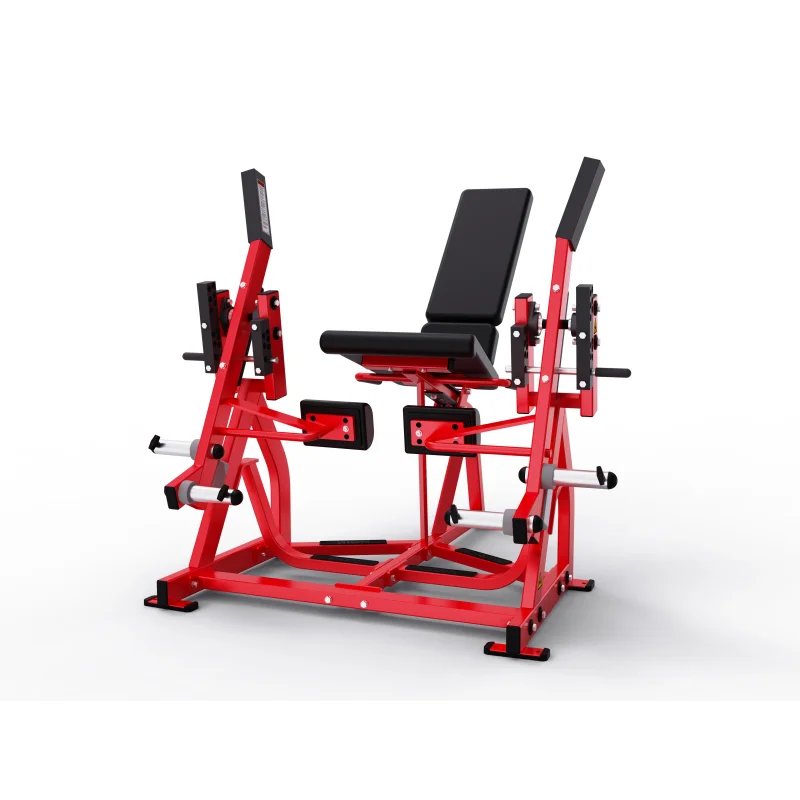
![Commercial Leg Raise Machine Gym Equipment for Fitness Center [WARN] draft identifier mismatch](https://bicksport.com/wp-content/uploads/2026/08/commercial-leg-raise-machine-gym-equipment-for-fitness-center-warn-draft-identifier-mismatch-45329b.webp)
Heavy-Duty Core Training — Reinforced steel frame and sealed pivot bearings tested for continuous high-frequency use in commercial strength zones.
Technical Specifications
| Parameter | Value |
|---|---|
| Product Type | Leg Raise Machine |
| Model NO. | 5059 |
| Exercise Part | Leg |
| Material | Steel |
| Product Dimensions | 1104×990×1730 mm |
| Net Weight | 72 kg |
| Max User Weight | 180 kg |
| Certification | ISO 9001, CE |
| Appliance | Gymnasium |
| Gender | Unisex |
| Age Group | Adult |
Application Suitability
| Deployment Scenario | Typical Use |
|---|---|
| hotel fitness center on guest room floors | Core and lower-body stations in 24-hour access cardio and strength circuits |
| chain gym cardio zone | High-traffic abdominal training anchor between functional rigs and cable machines |
| corporate wellness room | Compact strength addition for lunch-break core routines in limited square footage |
| high-end residential home gym | Dedicated hanging leg raise and knee raise station for private training spaces |
| sports performance training center | Athlete conditioning for hip flexor strength and trunk stability programming |
Why Pivot Bearing Failures Show Up in Member Complaints First
Sealed bearings and a reinforced pivot axis keep movement smooth long after light-duty alternatives develop play and wobble.
When a leg raise machine sees hundreds of repetitions daily, the pivot point absorbs cyclic lateral loads that expose every shortcut in bearing selection and welding quality. I have walked through facilities where the pivot sleeve developed visible slop within months, turning a controlled core exercise into an unsteady, unsafe movement pattern. Members stop using the equipment, and the machine becomes a dead-weight footprint on the floor [NEED_CITE: bearing service life under cyclic lateral loading in commercial strength equipment]. The commercial leg raise machine gym equipment you select must hold tolerance under continuous use, not just under a single showroom test cycle.
Where This Leg Raise Machine Sits in a Strength Circuit Layout
This unit fills the dedicated core-training slot between cable columns and functional rigs, targeting hip flexors, lower abdominals, and obliques through hanging knee raises, straight leg raises, and supported vertical raises. It complements rotary torso machines and back extension benches by covering the anterior chain that those stations leave untouched. The 1104×990 mm footprint allows placement along a wall or at the end of a machine row without disrupting traffic flow, and the 180 kg user weight capacity accommodates a broad member demographic. The commercial leg raise machine gym equipment here anchors a core zone that members can rotate through without waiting on shared stations.
Continuous Operation and Facility Environment Requirements
A leg raise station in a high-traffic gym sees use cycles that differ fundamentally from cardio machines — shorter sets, higher peak lateral forces, and frequent mounting and dismounting. The self-stabilizing base design removes the need for floor anchoring, but the subfloor must be level to prevent frame rocking under asymmetric loading. In hotel fitness centers on guest room floors, the 72 kg net weight and steel-on-rubber contact points limit structure-borne vibration transmission to occupied rooms below [NEED_CITE: vibration transfer thresholds for strength equipment on suspended floor slabs]. Adequate clearance on three sides ensures safe approach and exit, and overhead ceiling height must accommodate the 1730 mm frame plus full arm extension above the grips.
Frame Geometry and Bearing Selection Explained
The 1730 mm frame height positions the grip bars at a height that allows full leg extension without the feet contacting the floor, which is essential for proper range of motion across users of varying stature. The steel tube cross-section and wall thickness determine how much the uprights deflect under a loaded user swinging through repetitions — undersized tubing introduces oscillation that degrades exercise quality and accelerates fatigue at the weld joints. Sealed bearings at the pivot axis eliminate the need for periodic lubrication while keeping contamination from chalk dust and sweat out of the rolling elements. High-density upholstery on the back pad and arm rests must resist moisture penetration and maintain structural firmness across thousands of compression cycles, because padding that softens over time shifts the user’s center of gravity forward and places unwanted load on the shoulder girdle [NEED_CITE: upholstery density standards for commercial strength equipment contact surfaces]. The welded gusset plates at the base-to-upright junction distribute ground reaction forces across a wider area of the frame, reducing stress concentration at the highest-load node.
What Light-Duty Frame Shortcuts Cost Facilities Over Time
I have seen commercial gymnasiums replace an entire row of abdominal stations because the frames were specified for home-use load cycles. The pivot bearings wore unevenly, the back pads cracked along the stitch lines within a season, and the base tubes showed hairline fractures near the weld seams. Each replacement cycle meant downtime, member frustration, and procurement overhead that far exceeded the initial savings on lighter-gauge steel. A commercial leg raise machine gym equipment unit built for 10,000-hour durability avoids this cycle by matching material thickness and bearing specification to the actual duty environment [NEED_CITE: failure mode analysis for commercial vs. light-duty strength frames]. The cost of one mid-cycle teardown and reinstallation typically eclipses the unit price difference between commercial and light-commercial grades.
Why This Product Line for Your Strength Zone
Our Shandong facility runs the same sealed bearing specification across every pivot-equipped strength station, validated through 10,000-hour continuous cycling tests on motors and moving assemblies alike. The 1104×990 mm footprint was established through 3D layout planning that accounts for member approach paths, sightlines across the training floor, and airflow between stations. Every weld is inspected against the same quality gate regardless of whether the unit ships domestically or to one of 40+ export markets. OEM options cover frame color, upholstery material, and logo placement at flexible MOQ, so the commercial leg raise machine gym equipment you receive matches your brand standard. The documentation package includes everything your installation team needs before the container arrives.
Documentation & Test Records
- CE declaration of conformity covering mechanical safety requirements
- EN 957 test report validating static and dynamic load performance
- ISO 9001 certificate for manufacturing quality management system
- Noise and vibration level test record for structure-borne transmission
- Durability test log documenting pivot bearing cycle count and wear measurement
- Upholstery material specification sheet with density and moisture resistance data
Installation, Commissioning & Maintenance
- Verify 1104×990 mm footprint clearance with minimum 600 mm approach on all open sides
- Level the floor contact points with shims before tightening the base anchor bolts
- Inspect pivot bearing play at commissioning and recheck after the first 500 use cycles
- Wipe down back pad and arm rest upholstery with pH-neutral cleaner after each operational day
- Torque-check all frame fasteners at quarterly intervals per the installation guide
- Replace back pad upholstery when surface compression exceeds original thickness noticeably
Request a Strength Zone Equipment Assessment
Provide your strength area square footage and current equipment list to receive a 3D layout showing this leg raise station positioned for optimal member flow and safe clearance. Specify your daily usage volume so we can confirm the bearing and frame specification matches your duty cycle. Indicate the deployment floor level and adjacent occupied spaces to validate vibration transmission limits. State your target market voltage standards for any electronically integrated stations in the same order.
Frequently Asked Questions
Q: What frame specifications ensure commercial-grade durability?
A: The frame uses heavy-gauge steel tubing with reinforced gusset plates at all high-stress junctions. Weld seams are inspected for full penetration, and the sealed pivot bearings are rated for continuous high-frequency loading. The 72 kg net weight reflects material mass that resists deflection under users up to 180 kg during dynamic leg raise repetitions.
Q: How does pivot design affect exercise effectiveness and safety?
A: The pivot axis is positioned to align with the user’s natural hip rotation center, reducing shear force on the lower back during leg raises. Sealed bearings maintain consistent rotational resistance without developing lateral play, which keeps the movement path predictable and safe even after extended commercial use cycles.
Q: What padding materials resist sweat and wear in high-use environments?
A: The back pad and arm rests use high-density foam with commercial-grade vinyl upholstery that resists moisture penetration and surface cracking. Stitch patterns are reinforced at stress points to prevent seam separation, and the padding firmness is calibrated to maintain support without bottoming out across thousands of sessions.
Q: Can this machine be integrated into existing strength circuits?
A: The 1104×990 mm footprint and self-stabilizing base allow placement along walls, at row ends, or between larger stations without floor anchoring. The 1730 mm height clears standard commercial ceiling heights, and the neutral frame color options match most existing equipment lines for visual consistency across the training floor.
Q: What maintenance is required for pivot bearings and moving parts?
A: Sealed bearings require no periodic lubrication, but should be inspected for lateral play at quarterly intervals. Frame fasteners need torque verification on the same schedule, and upholstery should be cleaned daily with appropriate solutions. A full bearing replacement is only necessary after the rated service life documented in the maintenance manual.
![Hammer Strength ISO-Lateral High Row OS-H5016 Commercial Gym Equipment [WARN] draft identifier mismatch](https://bicksport.com/wp-content/uploads/2026/08/hammer-strength-iso-lateral-high-row-os-h5016-commercial-gym-equipment-warn-draft-identifier-mismatch-2fd6a5.webp)
![Commercial ISO-Lateral Front Lat Pulldown Machine for Gym Use [result]Commercial ISO-Lateral Front Lat Pulldown Machine for Gym Use[/result]](https://bicksport.com/wp-content/uploads/2026/08/commercial-iso-lateral-front-lat-pulldown-machine-for-gym-use-resultcommercial-iso-lateral-front-lat-pulldown-machine-for-gym-use-result-81571f.webp)