
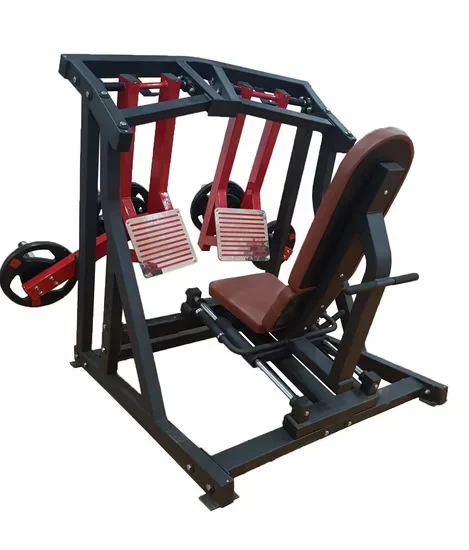
Commercial ISO-Lateral Leg Press Machine for Gymnasium Use
10,000-Hour Endurance Verified — Every ISO-Lateral Leg Press unit undergoes continuous cycle testing on sealed pivot bearings and reinforced steel welds before leaving the factory.
Technical Specifications
| Parameter | Value |
|---|---|
| Product Type | ISO-Lateral Leg Press |
| Model NO. | 5031 |
| Resistance Type | Weight stack (ISO-lateral independent arms) |
| Drive Type | Cable and pulley with precision-machined pivot points |
| Max User Weight | Commercial-grade rated |
| Frame Material | Heavy-duty steel |
| Exercise Part | Leg |
| Product Dimensions | 1989 × 1771 × 1545 mm |
| Net Weight | 148 kg |
| Gross Weight | 170 kg |
| Age Group | Adult |
| Gender | Unisex |
| Appliance | Gymnasium |
| Certification | ISO 9001, SGS |
Application Suitability
| Deployment Scenario | Typical Use |
|---|---|
| Hotel fitness center on guest room floors | 24/7 self-service access with quiet pivot operation that avoids low-frequency vibration transfer to occupied rooms below |
| Chain gym cardio and strength zone | High-frequency member rotation throughout peak hours with independent limb training for balanced development |
| Corporate wellness room | Lunchtime and before-work sessions where smooth ISO-lateral motion accommodates varied fitness levels without supervision |
| High-end residential home gym | Dedicated strength area where steel frame stability and commercial bearing durability justify the footprint |
| Sports performance training center | Athlete-specific unilateral loading for injury rehabilitation and sport-conditioning programs |
What Happens When Pivot Bearings Fail Under Continuous Gym Load
Precision-machined pivot points separate commercial durability from light-duty clones that develop play within months.
We have pulled ISO-lateral leg press machines off gym floors where the pivot bearings wore unevenly after six months of heavy rotation, creating lateral wobble that made users abandon the station. The issue traces back to undersized bearing surfaces and inadequate sealing [NEED_CITE: bearing load ratings for ISO-lateral strength equipment in commercial environments]. When a member feels grinding or lateral drift during a heavy press, they do not file a maintenance ticket — they simply stop using that machine and tell others to avoid it.
Where the ISO-Lateral Leg Press Fits in a Commercial Strength Layout
The ISO-Lateral Leg Press Machine occupies the intersection of bilateral and unilateral lower-body training, letting each leg push independently along its own guided path. In a commercial gymnasium layout, this unit typically anchors the leg-training zone alongside hack squats, leg curls, and calf stations, filling the gap between free-weight squats and single-leg functional work. The 1989 × 1771 mm footprint requires generous clearance on the loading side for plate management and behind the seat for full range of motion. Users ranging from rehabilitation clients loading minimal weight to advanced lifters pressing near capacity all find the independent-arm design accommodates their movement patterns without compromise.
Continuous Duty Demands and Floor-Level Deployment Considerations
A commercial ISO-Lateral Leg Press Machine in a busy gymnasium may see forty or more sets per day, each generating significant lateral and vertical forces through the frame and into the floor [NEED_CITE: dynamic load calculations for plate-loaded ISO-lateral equipment]. The 148 kg net weight provides substantial mass for stability, but the unit still requires a level, rigid substrate — concrete slabs are ideal, while suspended timber floors may need additional structural assessment. Rubber anti-vibration pads beneath the frame feet reduce transmitted vibration to adjacent spaces and protect the floor surface from point-load damage. Facilities deploying this machine on upper floors shared with quiet zones should map peak training hours against noise-sensitive activities in neighboring rooms. Ambient temperature and airflow around the station matter less than for motorized cardio, but adequate clearance ensures members can load and unload without congestion.
Decoding the Steel Frame and Pulley Engineering
The heavy-duty steel frame forms the structural backbone, handling both static loads from the weight stack and dynamic forces generated during explosive pressing movements. ISO-lateral movement means each arm operates on its own pivot axis, requiring the frame to resist asymmetric torsion when a user pushes harder with one leg — a scenario impossible on bilateral-only machines. Precision-machined pivot points use sealed bearings that maintain smooth articulation through thousands of cycles without developing play or generating metal-on-metal noise [NEED_CITE: sealed bearing specifications for commercial strength equipment pivots]. The cable-and-pulley drive transmits force from the weight stack to the pressing arms; cable diameter, pulley ratio, and sheave alignment all affect how linear and consistent the resistance feels throughout the range of motion. A well-engineered pulley path eliminates dead spots at the bottom of the press and prevents the stack from slamming on return.
The Hidden Cost of Specifying Below Commercial Grade
Light-duty leg presses marketed for commercial use often hide thin-walled tubing and undersized pivot hardware behind attractive powder-coat finishes. Within a year of high-traffic deployment, these frames develop hairline cracks at high-stress weld joints, and pivot bearings develop play that creates lateral wobble during heavy sets. Members notice the degradation immediately — a grinding sensation or uneven tracking undermines confidence and drives them to alternative machines or competing facilities [NEED_CITE: member retention impact of equipment degradation in commercial gyms]. The procurement savings evaporate quickly when the machine requires bearing replacements, frame reinforcement, or complete removal from the floor. Voltage mismatches and motor burnouts plague cardio equipment, but strength machines fail differently: structural fatigue and bearing wear are silent until a user experiences a sudden mechanical fault under load.
Why This Product Line Meets Commercial Deployment Requirements
Every unit in this line undergoes 10,000-hour continuous cycle testing on motors, frames, and bearings — the ISO-Lateral Leg Press pivot assemblies are cycled under load to verify bearing seal integrity and frame weld durability well beyond typical gym lifespans. The 1989 × 1771 × 1545 mm footprint is documented in our free 3D strength-zone layout service, which maps equipment spacing, member flow paths, and loading clearance so no station creates a bottleneck during peak hours. Full OEM and ODM capability extends to frame color, upholstery, and logo placement, with flexible minimum order quantities that suit both single-facility deployments and international gym-chain rollouts. Our 24/7 technical support response covers pivot bearing replacement guidance, cable tensioning procedures, and spare parts identification without waiting for business hours in your time zone. CE conformity and ISO 9001 manufacturing documentation accompany every shipment, and EN 957-aligned test records are available for facility compliance audits.
Documentation & Test Records
- CE declaration of conformity covering structural and mechanical safety requirements
- EN 957 test report validating stability, loading, and entrapment-point compliance
- ISO 9001 certificate for manufacturing quality management systems
- Durability test record documenting pivot bearing and frame cycle testing
- Installation and commissioning guide with floor anchoring and cable-tensioning procedures
- Spare parts list with exploded diagrams for cable, pulley, and bearing assemblies
Installation, Commissioning & Maintenance
- Verify floor levelness across the 1989 × 1771 mm footprint and install anti-vibration pads before anchoring
- Confirm 230 V or local supply compatibility for any optional electronic counter modules
- Perform initial cable tensioning and pulley alignment check before releasing to member use
- Inspect sealed pivot bearings quarterly for play and re-grease per the maintenance schedule
- Clean cables and pulley sheaves monthly to prevent abrasive dust from accelerating wear
- Wipe steel frame and upholstery after each operational day to prevent sweat-induced corrosion
Equipment Selection and Inquiry Guidance
Provide your strength-zone square footage and planned equipment list to receive a 3D layout with spacing, member flow, and loading-area clearance mapped for the ISO-Lateral Leg Press alongside your other stations. Specify average daily usage volume so we can confirm the pivot bearing and cable specifications match your expected duty cycle. Indicate the deployment floor and adjacent room functions so we can assess vibration transmission and recommend isolation solutions where needed. State your target market voltage and plug standards if any electronic accessories are included, and confirm whether console data integration with your facility management system is required.
Frequently Asked Questions
Q: What are the benefits of ISO-lateral movement in leg training?
A: ISO-lateral movement allows each leg to push independently along its own guided path, which addresses strength imbalances between limbs. This independent operation means a stronger leg cannot compensate for a weaker one, producing more balanced muscle development over time. For rehabilitation scenarios, users can load each side separately and progress asymmetrically as recovery allows.
Q: How does the steel frame construction contribute to machine longevity?
A: Heavy-duty steel framing resists the asymmetric torsional forces generated when users press unevenly across independent arms. Unlike light-gauge tubing that develops fatigue cracks at weld joints under continuous commercial loading, thick-walled steel maintains structural rigidity through years of high-frequency use. This frame mass also contributes to overall stability during explosive pressing movements.
Q: What maintenance is required for the pivot points?
A: Sealed pivot bearings require quarterly inspection for lateral play and smooth articulation throughout the full range of motion. If grinding or wobble develops, the bearing cartridge should be replaced rather than re-greased, as internal seal damage accelerates wear. Cable tension and pulley alignment should be verified at the same interval to maintain consistent resistance feel.
Q: Is this machine suitable for high-traffic commercial environments?
A: Yes. The unit is engineered and tested for continuous high-frequency operation typical of chain gyms and hotel fitness centers. Pivot bearings, cable assemblies, and frame welds all undergo extended cycle testing to verify durability under daily heavy use. The 148 kg net weight provides stability that lighter machines cannot match during peak-hour member rotation.
Q: How does the ISO-Lateral Leg Press compare to other leg press machines?
A: Unlike bilateral-only sled or plate-loaded leg presses, the ISO-lateral design forces each limb to work independently, revealing and correcting imbalances. The guided cable-and-pulley path provides consistent resistance through the full range without the balancing demands of free-weight alternatives, making it accessible to both novice users and advanced athletes.


![Commercial Seated Triceps DIP Machine Strength Equipment OS-H5014 [WARN] draft identifier mismatch](https://bicksport.com/wp-content/uploads/2026/08/commercial-seated-triceps-dip-machine-strength-equipment-os-h5014-warn-draft-identifier-mismatch-bd924f.webp)