
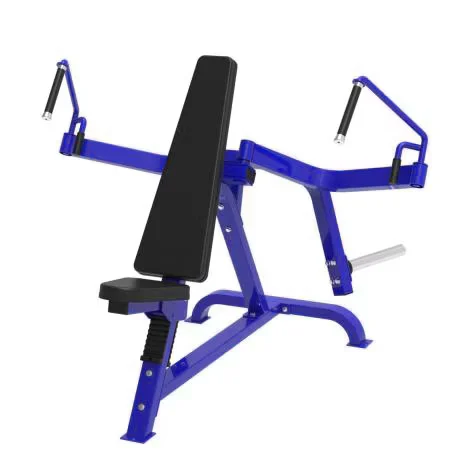
Reinforced Steel Pivot Joints — Manual plate-loaded resistance eliminates motor noise entirely, keeping shared fitness spaces free from mechanical disruption.
Technical Specifications
| Parameter | Value |
|---|---|
| Product Type | Incline Pec Fly Machine (Strength Equipment) |
| Model NO. | 5009 |
| Exercise Part | Chest |
| Power Source | Manual |
| Resistance Type | Plate-Loaded |
| Material | Steel |
| Product Dimensions | 1350 x 1650 x 1350 mm |
| Net Weight | 92 kg |
| Foldable | No |
| Max User Weight | 180 kg |
| Certification | ISO 9001, CE |
| Age Group | Adult |
| Gender | Unisex |
| Customization | Logo, color, upholstery available |
Application Suitability
| Deployment Scenario | Typical Use |
|---|---|
| Chain gym strength zone | High-frequency chest isolation during peak hours with continuous plate loading |
| Hotel fitness center on guest room floors | Zero motor noise operation avoids disturbance to adjacent rooms and corridors |
| Corporate wellness room | Diverse user populations performing upper-body strength work during lunch breaks |
| Sports performance training center | Athletes targeting upper and mid-pectoral fibers with controlled manual resistance |
Why Zero Motor Noise Matters When Equipment Sits Above Guest Rooms
Plate-loaded resistance removes every electrical failure point from the chest isolation station.
In hospitality fitness deployments, treadmill motors and electronic resistance systems generate low-frequency hum that transmits through floor slabs into occupied spaces below. Facility managers often receive noise complaints before maintenance tickets, and the root cause traces back to equipment categories that operators assumed were quiet enough [NEED_CITE: structural vibration transmission from motorized strength equipment in multi-story hospitality buildings]. The commercial incline pec fly machine sidesteps this entirely by relying on steel weight plates and sealed pivot bearings — no motor, no solenoid, no electromagnetic brake cycling on and off under load.
Positioning Within the Strength Training Floor Layout
This unit targets upper and mid-pectoral muscle groups through a fixed incline pressing arc, complementing flat bench press stations and cable crossover systems already present in most commercial strength zones. The 1350 x 1650 mm footprint fits standard spacing grids, allowing adjacent placement alongside lateral raise and shoulder press machines without sightline obstruction. Suitable for moderate-to-high traffic deployment where users cycle through in 15-20 minute strength circuits. The adjustable seat positioning accommodates a broad range of user heights, and the plate-loaded design lets each lifter select resistance independently without pin-stack wait times.
Continuous Loading Cycles and Floor-Level Deployment
Unlike motorized cardio equipment that demands dedicated electrical circuits and ventilation clearance, this manual unit requires no power supply — eliminating voltage mismatch risks when shipping to markets with different plug standards. The sealed pivot bearings operate without frequent lubrication, reducing maintenance intervals in high-traffic facilities where equipment sees use across 16-hour operating windows. Floor loading concentrates through four contact points, so deployment on suspended slabs requires confirmation of structural capacity at 92 kg static weight plus dynamic plate load. No heat output means no airflow planning conflict with adjacent machines [NEED_CITE: floor load rating requirements for commercial plate-loaded strength equipment in multi-story facilities].
Decoding the Steel Frame and Pivot Bearing Specifications
The frame uses heavy-gauge steel with reinforced welding at high-stress pivot points — the areas where repeated eccentric loading causes fatigue cracks in lighter commercial units. Sealed pivot bearings reduce rotational friction without exposed grease points that attract dust and degrade over months of use. Manual plate-loaded resistance delivers a linear load curve: the weight you load is the weight you lift, with no electronic governor altering the feel mid-repetition. The fixed incline angle positions the pressing arc to emphasize clavicular pectoral fibers, and the steel construction maintains structural rigidity even under maximum user weight plus heavy plate stacks. This simplicity means fewer warranty claims tied to electronic component failure.
The Hidden Cost of Underspecified Pivot Hardware
Facilities that procure strength machines based on upholstery aesthetics and price alone often discover pivot wear within the first year of continuous operation. Worn bearings introduce lateral play in the arm assembly, degrading the isolation quality and creating audible grinding that members notice immediately. In hotel environments, that mechanical noise transmits through shared walls just as effectively as motor hum, defeating the purpose of choosing manual equipment in the first place [NEED_CITE: bearing failure modes in plate-loaded commercial strength equipment under high-frequency use]. Units with lighter-gauge frames develop flex under heavy loads, causing weld fatigue at stress concentration points and pulling the machine out of alignment.
What This Product Line Delivers Beyond the Spec Sheet
Every unit undergoes durability verification consistent with the 10,000-hour continuous operation standard applied across our cardio range, ensuring pivot bearings and frame welds hold up under sustained commercial loading. The sub-35dB acoustic standard developed for our motorized equipment translates here as zero motor noise — only the sound of plates being loaded and the quiet rotation of sealed bearings. Full OEM and ODM customization covers logo application, frame color, and upholstery material to match facility branding requirements. The 1350 x 1650 mm footprint integrates into 3D strength zone layouts that account for user flow, plate storage proximity, and sightlines from facility entrance points. Round-the-clock technical support covers bearing replacement guidance and structural inspection protocols.
Documentation & Test Records
- CE declaration of conformity for strength equipment import compliance
- EN 957 test report covering structural integrity and safety requirements
- ISO 9001 certificate confirming manufacturing quality management systems
- Noise level test report verifying zero motor emission during operation
- Durability test record documenting pivot bearing performance under continuous loading
- Motor-free specification sheet confirming absence of electrical components
Installation, Commissioning & Maintenance
- Maintain 600 mm clearance on all sides for safe plate loading and user entry
- Level floor surface required before anchoring the 92 kg frame to prevent pivot misalignment
- No electrical circuit needed — verify structural floor capacity for combined static and dynamic loads
- Inspect sealed pivot bearings quarterly for lateral play and replace per maintenance schedule
- Wipe steel frame and upholstery after each use to prevent sweat corrosion on welded joints
Equipment Selection and Deployment Inquiry
Provide your strength zone floor plan and equipment list to receive a 3D layout covering machine spacing, plate storage positioning, and member traffic flow. Specify daily operating hours and expected user volume so we can confirm bearing service intervals match your maintenance schedule. Confirm deployment floor level and adjacent room usage to validate the zero-noise advantage for your specific building configuration.
Frequently Asked Questions
Q: What is the difference between plate-loaded and pin-loaded pec fly machines for commercial use?
A: Plate-loaded units require users to manually add weight plates, offering unlimited resistance increments and eliminating the pin-stack mechanism that wears under high-frequency use. Pin-loaded machines provide faster weight changes but introduce cable and pulley components that require regular inspection. Plate-loaded designs have fewer moving parts, reducing long-term maintenance in facilities where strength equipment operates continuously throughout extended business hours.
Q: How does manual resistance compare to motorized equipment in terms of maintenance and noise?
A: Manual plate-loaded resistance contains no motor, solenoid, or electronic governor — removing the three most common failure points in commercial gym equipment. There is no electrical noise, no motor burnout risk under continuous use, and no circuit board requiring firmware updates. Maintenance focuses entirely on mechanical components: sealed pivot bearings and structural weld inspections, which follow predictable service intervals rather than unexpected electronic failures.
Q: What frame and bearing specifications ensure long-term durability in high-traffic gyms?
A: Heavy-gauge steel frames with reinforced welding at pivot stress points prevent flex and fatigue cracking under repeated heavy loading. Sealed pivot bearings eliminate exposed lubrication points that attract dust and degrade over time. Facilities should request durability test records documenting bearing performance under continuous operation cycles and confirm the frame steel gauge matches commercial duty requirements rather than light-commercial specifications.
Q: Can this machine be customized for branding and facility color schemes?
A: Full OEM and ODM customization covers frame powder-coat color, upholstery material and stitching, logo placement on the weight shroud or frame, and custom nameplate engraving. Minimum order quantities remain flexible for facility-specific runs. Customization scoping happens during the quotation phase so branding requirements align with production timelines and do not delay shipment of the broader equipment order.
Q: What certifications are required for importing commercial strength equipment into the EU and other markets?
A: EU imports require a CE declaration of conformity and EN 957 test report covering structural safety and stability under load. ISO 9001 certification demonstrates manufacturing quality management consistency. Target markets outside the EU may require additional local compliance documentation, which should be confirmed during the inquiry stage so the correct test reports and declarations accompany the shipping documentation package.
![Commercial Plate Loaded Bench Press Gym Equipment [WARN] draft identifier mismatch](https://bicksport.com/wp-content/uploads/2026/08/commercial-plate-loaded-bench-press-gym-equipment-warn-draft-identifier-mismatch-2572b3.webp)

