
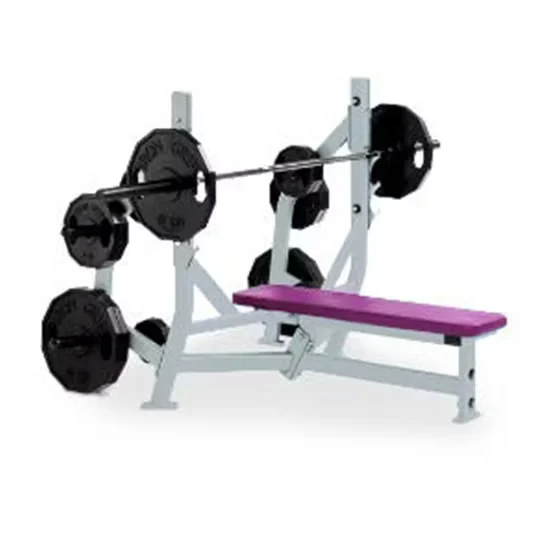
Heavy-Duty Construction — 78kg reinforced steel frame engineered to endure continuous loading cycles in high-traffic strength zones without structural fatigue.
Technical Specifications
| Parameter | Value |
|---|---|
| Product Type | Hammer Strength Bench with Weight Storage |
| Model NO. | 5049 |
| Material | Steel |
| Exercise Part | Chest |
| Age Group | Adult |
| Gender | Unisex |
| Product Dimensions | 200011501150mm |
| Net Weight | 78kg |
| Appliance | Gymnasium |
| Production Capacity | 500 pieces Per Month |
| Certification | ISO9001, CE |
Application Suitability
| Deployment Scenario | Typical Use |
|---|---|
| commercial gymnasium strength zones | Heavy compound pressing movements with immediate plate access for high-frequency member turnover. |
| hotel fitness centers with limited floor space | Consolidating bench and storage footprint to maximize functional training area in compact layouts. |
| corporate wellness facilities | Organized equipment presentation requiring minimal staff intervention for daily tidying and safety checks. |
| sports performance training centers | High-volume loading and unloading during superset protocols where plate proximity dictates workout density. |
Why Cluttered Strength Zones Drive Member Churn Before Equipment Failure Does
Integrated storage solves the most common safety hazard in commercial free weight areas.
Weight plates scattered across the floor create trip hazards and accelerate equipment damage from dropped steel. In high-traffic facilities, members navigating around stray plates develop negative associations with the training environment, often abandoning strength zones for clearer machine areas. A commercial hammer strength bench weight storage unit eliminates floor clutter by keeping loading plates within arm’s reach yet vertically secured. This organizational structure reduces maintenance staff burden and preserves the professional aesthetic that premium facilities require. [NEED_CITE: facility safety audit standards for free weight zones]
Positioning Within the Strength Training Ecosystem
This equipment occupies the intersection of pressing mechanics and logistical efficiency. It supports horizontal chest pressing patterns while serving as a centralized plate repository for adjacent equipment. In a commercial hammer strength bench weight storage configuration, the unit anchors the free weight section, providing both a training station and an organizational node. It complements squat racks and deadlift platforms by offering a dedicated pressing surface that doesn’t require members to transport plates across the facility. The 200011501150mm footprint accommodates users across a wide anthropometric range, with bench geometry supporting stable shoulder retraction during heavy loads.
Continuous Loading Cycles and Structural Demands
A commercial strength bench faces repetitive stress that differs fundamentally from cardiovascular equipment wear patterns. The storage pegs endure impact loading as members slide plates on and off dozens of times daily, requiring welded joints that resist fatigue cracking. The bench pad mounting points experience cyclic compression from users ranging from novice to elite strength levels. Floor contact points must remain stable despite lateral forces generated during uneven pressing or re-racking motions. [NEED_CITE: welded joint fatigue testing for commercial gym equipment]
Interpreting Steel Gauge and Welding Integrity
The 78kg net weight signals substantial material density throughout the frame. Commercial-grade steel construction prioritizes wall thickness in load-bearing tubes, particularly at the bench-to-storage junction where bending moments concentrate. Welding quality determines whether micro-fractures propagate under repeated loading or remain arrested by proper penetration depth and heat treatment. The unisex designation and adult age group classification indicate the structure accommodates force outputs exceeding typical recreational lifting, requiring safety margins that prevent catastrophic failure even under dropped-load scenarios. Finish durability matters equally—powder coating thickness and adhesion prevent corrosion from sweat accumulation and cleaning chemical exposure in humid gym environments.
The Hidden Cost of Specifying Residential-Grade Storage Solutions
Facilities that purchase benches without integrated storage—or with under-engineered storage pegs—discover the consequences within months. Floor damage from rolling plates requires resurfacing. Liability exposure increases when members trip over equipment left in walkways. Staff hours diverted to constant reorganization represent ongoing operational drain. More critically, cheaply welded storage pegs bend under heavy plate loads, creating unstable stacking that endangers users retrieving weights overhead. These compounding failures often prompt wholesale equipment replacement rather than addressing the root specification error. [NEED_CITE: commercial equipment failure mode analysis]
Why This Product Line Addresses Procurement Blind Spots
The reinforced steel frame underwent stress validation that mirrors durability protocols applied across the full cardio and strength catalog. The integrated storage design emerged from facility audits showing plate management as a primary pain point in strength zone layout planning. ISO 9001 manufacturing oversight ensures welding consistency across production batches, while CE marking confirms compliance with European safety directives for commercial gymnasium equipment. The 200011501150mm specification allows facility planners to model clearances and member flow paths in 3D layout software before committing to equipment orders. Technical documentation covers load ratings for storage pegs and bench surfaces, enabling procurement teams to verify capacity against their member population’s strength demographics.
Documentation & Test Records
- CE declaration of conformity confirming compliance with EU machinery safety directives for gymnasium equipment
- EN 957 test report validating structural integrity under cyclic loading conditions
- ISO 9001 certificate documenting quality management system adherence during manufacturing
- Material specification sheets detailing steel grade and welding procedure qualifications
- Load capacity test records for storage pegs and bench mounting points
- Finish durability assessment covering corrosion resistance and abrasion testing
Installation, Commissioning & Maintenance
- Verify floor levelness across the 2000*1150mm footprint and install vibration-dampening pads to prevent frame rocking during heavy presses
- Maintain 900mm clearance on all sides to allow safe plate loading and member passage without collision risk
- Inspect all welded joints and storage peg bolts during initial commissioning and at quarterly intervals thereafter
- Clean bench upholstery with pH-neutral disinfectant after each operating day to prevent material degradation from sweat salts
- Check powder coating integrity at high-contact points annually, touching up any chips to prevent substrate corrosion
- Verify storage peg alignment and tightness monthly, as vibration from plate impacts can gradually loosen fasteners
Equipment Selection and Facility Integration
Provide your strength zone square footage and adjacent equipment list to receive 3D layout recommendations that account for member flow and plate transport paths. Specify your facility’s peak usage hours to determine whether multiple units should distribute traffic across the training area. Confirm your target market’s plate specifications—Olympic diameter versus standard—to ensure storage peg compatibility. Indicate whether the bench will anchor a dedicated pressing zone or integrate into mixed-equipment circuits where spatial relationships affect exercise transition efficiency.
Frequently Asked Questions
Q: What steel grade is used for commercial durability?
A: The frame uses commercial-grade steel selected for yield strength and weldability. The 78kg net weight reflects wall thickness in load-bearing tubes, particularly at stress concentration points where the bench meets storage uprights. Material specifications are documented in the technical package, allowing structural engineers to verify adequacy for your facility’s expected loading patterns and member demographics.
Q: How much weight can the storage pegs hold?
A: Storage pegs are engineered to support fully loaded configurations typical of commercial environments. Load capacity testing validates that pegs resist bending and weld fatigue under repeated plate insertion and removal. The specific weight rating appears in the technical documentation, matched to the structural capacity of the entire frame to ensure no single component becomes the failure point.
Q: Is the bench compatible with standard Olympic plates?
A: The storage pegs accommodate Olympic-diameter plates with standard center holes. The 200011501150mm overall dimensions include peg spacing that allows plates to hang vertically without interfering with bench positioning or user movement during exercises. Facilities using non-standard plate dimensions should verify clearance requirements during the layout planning phase.
Q: What maintenance is required for commercial use?
A: Routine maintenance focuses on fastener inspection at welded joints and storage peg mounting points, where vibration from plate handling can gradually loosen connections. Upholstery requires daily cleaning with appropriate disinfectants. Powder coating should be inspected quarterly for chips that expose substrate to moisture. These procedures align with standard commercial gymnasium equipment maintenance protocols.

![H5072 Barbell Rack Integrated Gym Trainer for Commercial Gyms [WARN] draft identifier mismatch](https://bicksport.com/wp-content/uploads/2026/08/h5072-barbell-rack-integrated-gym-trainer-for-commercial-gyms-warn-draft-identifier-mismatch-398826.webp)