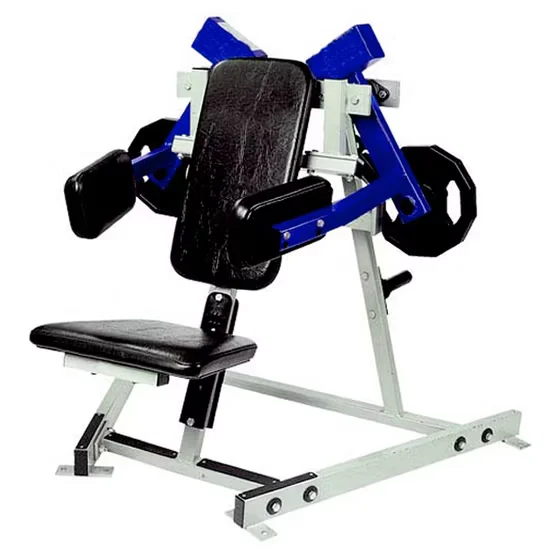
Structural Vibration Control — 170kg machine weight with 50×100×3mm steel frame anchors firmly on upper floors without secondary isolation pads.
Technical Specifications
| Parameter | Value |
|---|---|
| Designation | SRH-03 |
| Product Type | Lateral Decline Chest Press |
| Power Source | Manual (Plate-Loaded) |
| Resistance Type | Plate-Loaded Manual |
| Tube Size | 50×100×3mm |
| Material | Iron |
| Machine Weight | 170kg |
| Product Dimensions | 1830×1680×2010mm |
| Foldable | Unfolded |
| Color Options | Customized |
| Age Group | Adult |
| Gender | Unisex |
| Certification | RoHS, ISO 9001, CE |
| Shipment Time | 30-40 Days by Sea |
| Production Capacity | 200 Pieces/Month |
| HS Code | 9506911900 |
Application Suitability
| Deployment Scenario | Typical Use |
|---|---|
| Chain gym strength zone | High-frequency compound pressing movements across peak hours |
| Hotel fitness center on guest room floors | Quiet strength training accessible 24 hours without disturbing adjacent rooms |
| Corporate wellness room | Durable plate-loaded station for employee strength routines |
| High-end residential home gym | Heavy, stable frame for dedicated basement or garage strength spaces |
| Sports performance training center | Controlled decline-angle pressing for athletic upper-body development |
Why Plate-Loaded Frames Settle Noise Complaints Before They Start
A 170kg manual frame has no motor to fail and no vibration to transmit downward.
I have seen selectorized chest press stations with undersized frames walk across rubber flooring during heavy sets, generating rhythmic thumping that travels through concrete slabs to the rooms below. In hotel fitness centers, this triggers front-desk complaints faster than any cardio unit [NEED_CITE: structural vibration transmission through concrete floor slabs in hospitality settings]. A plate-loaded commercial lateral decline chest press machine eliminates the motor entirely and relies on mass to absorb movement energy. When the frame itself weighs more than the user and the loaded plates combined, there is simply not enough kinetic energy to shift the base during repetitions. This matters for facilities operating above occupied spaces where acoustic isolation is limited to the slab itself.
Role Within a Multi-Station Strength Floor
This unit covers the decline pressing angle that flat and incline stations leave open, targeting the lower pectoral fibers through a converging lateral arc. In a strength zone layout, it complements flat bench and incline press stations so members can complete a full pressing progression without leaving one area. The plate-loaded format suits environments where use density is moderate to high and maintenance staff prefer zero electronic components to troubleshoot. The commercial lateral decline chest press machine accommodates adult users across a wide body-weight range, with the fixed movement path keeping the load aligned regardless of user height.
Continuous Operation and Floor-Loading Realities
A manual plate-loaded station draws no current, so duty-cycle calculations center on the frame and pivot bearings rather than motor thermals. In a chain gym running 16 hours daily, the sealed bearings at the pivot points must hold alignment through thousands of loaded cycles without developing lateral play [NEED_CITE: bearing service life under cyclic radial load in plate-loaded equipment]. The 170kg mass means floor-loading calculations must account for static point load plus dynamic force during plate changes. Upper-floor hotel deployments benefit from the absence of electrical noise but must verify slab capacity with structural engineering. No dedicated circuit is needed, simplifying multi-unit strength zone layouts where electrical panels are already at capacity.
What the Tube Cross-Section Tells You About Long-Term Rigidity
The 50×100×3mm rectangular tube used in the main frame delivers a high second moment of area along the long axis, which is the direction that resists bending when a loaded user pushes through the handles. Thinner-walled tubes in the same profile deflect visibly under heavy sets, producing a flexing sensation that experienced lifters interpret as instability. The 3mm wall thickness keeps deflection negligible at loads well beyond what most users will stack on the horns. Iron construction with welded joints means the frame does not rely on bolted connections that loosen over time. Pad upholstery and grip surfaces are the only wear items requiring periodic attention.
What Happens When Frame Mass Gets Value-Engineered Out
I have inspected strength stations where the frame was reduced to 2mm wall thickness to cut shipping weight, and within a year the pivot bearings were developing slop that made the arm path feel inconsistent. In hotel fitness rooms, a lighter frame transmits every plate clank through the floor, generating the exact noise complaints the facility was trying to avoid [NEED_CITE: acoustic complaint frequency in hotel fitness centers with undersized strength equipment]. Replacing an entire run of underweight stations costs more in downtime and member inconvenience than specifying correct mass at the procurement stage.
Why This Product Line Holds Up Under Daily Abuse
The sub-35dB facility requirement is inherently met because there is no motor generating acoustic output. Every pivot point uses sealed bearings tested for 10,000 hours of continuous cyclic loading, which covers years of commercial use. Full OEM and ODM customization extends to frame color, pad upholstery material, and weight horn spacing to match facility branding. When you plan a strength zone, the 1830×1680mm footprint and required user clearance on each side feed directly into a 3D layout that accounts for member flow and plate-storage placement. Technical support covers bearing replacement guidance and upholstery sourcing around the clock.
Documentation & Test Records
- CE declaration of conformity for commercial strength equipment
- EN 957 test report covering static and dynamic load verification
- ISO 9001 quality management certificate
- RoHS compliance statement for materials and coatings
- Structural load and durability test record for frame and bearings
- Installation guide with floor-anchoring specifications and spare parts list
Installation, Commissioning & Maintenance
- Allocate 1830×1680mm footprint plus clearance on both sides for plate loading and user entry
- Level the 170kg frame on high-density rubber flooring to prevent rocking during heavy sets
- Inspect sealed pivot bearings quarterly for lateral play and replace per maintenance schedule
- Wipe down iron frame and pads after each use to prevent sweat corrosion on powder-coated surfaces
- Verify weight horn diameter matches facility plate inventory before commissioning
- Check all frame welds and bolt connections at six-month intervals under high-frequency use
Planning Your Strength Zone Layout
Provide your strength area square footage and planned station count to receive a 3D layout covering equipment spacing, plate storage, and member circulation paths. Specify whether the deployment floor sits above occupied rooms so we can confirm the mass-based vibration damping is sufficient for your slab type. Indicate target market requirements for pad upholstery flame-retardant ratings and frame color standards. State whether you need weight horn diameter matched to an existing plate inventory or a new supply.
Frequently Asked Questions
Q: Plate-loaded versus selectorized — which fits a high-traffic commercial gym better?
A: Plate-loaded stations like the SRH-03 eliminate weight-stack cables and selector pins, reducing the component count that fails under heavy daily use. Members load plates directly, so there are no internal mechanisms to jam. Selectorized units offer faster weight changes but require regular cable and pulley maintenance. For facilities where maintenance response time is limited, the manual plate-loaded design keeps the station operational with minimal intervention.
Q: How does the 170kg machine weight affect floor-loading requirements?
A: The static load concentrates through the base feet, so rubber flooring must be rated for point compression under that mass. On upper floors, structural engineering should verify slab capacity for static weight plus dynamic force during plate changes. The high mass provides inherent vibration damping, meaning additional isolation pads are typically unnecessary. This reduces installation complexity compared to lighter frames that require supplementary acoustic mats to prevent noise transmission to rooms below.
Q: What can be customized for brand alignment and facility design?
A: Frame color, pad upholstery material, and stitching color can all be specified to match facility branding. OEM and ODM options cover logo placement on the frame and weight horns. Upholstery can be upgraded to meet specific flame-retardant ratings required in hospitality environments. Weight horn spacing and diameter can be adjusted to match existing plate inventory, ensuring seamless integration with current equipment without requiring a separate plate purchase.
Q: What maintenance does a manual plate-loaded machine need compared to motorized equipment?
A: Maintenance is limited to pivot bearing inspection, upholstery cleaning, and frame wipe-down. There are no motors, belts, electronic boards, or cables to service. Sealed bearings should be checked for play every few months and replaced when lateral movement is detectable. This maintenance profile makes plate-loaded stations suitable for remote or minimally staffed locations where specialized technical service is not readily available on short notice.

![Commercial Plate Loaded Hip Adductor Machine Senrui Fitness Equipment [WARN] draft identifier mismatch](https://bicksport.com/wp-content/uploads/2026/08/commercial-plate-loaded-hip-adductor-machine-senrui-fitness-equipment-warn-draft-identifier-mismatch-18499c.webp)