
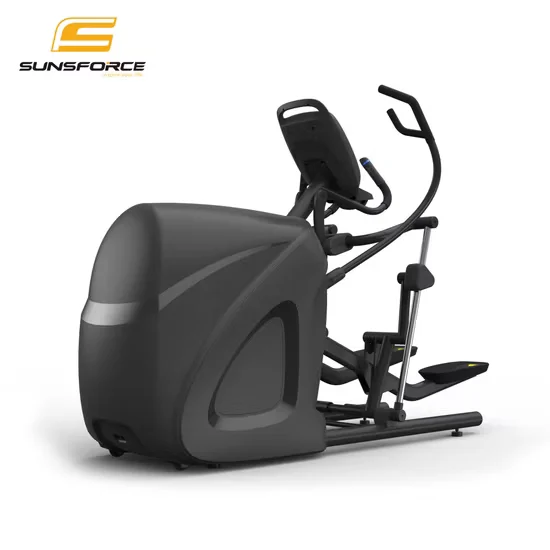
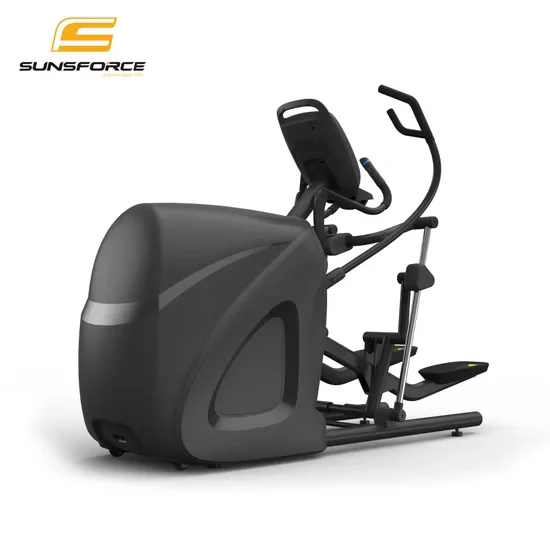
![Commercial Elliptical Machine Front Flywheel Home Fitness Cross Trainer [WARN] draft identifier mismatch](https://bicksport.com/wp-content/uploads/2026/08/commercial-elliptical-machine-front-flywheel-home-fitness-cross-trainer-warn-draft-identifier-mismatch-d21108.webp)
Whisper-Quiet Magnetic Drive — sub-35dB operation verified across hotel guest-floor deployments, enabling 24/7 cardio access without noise complaints.
Technical Specifications
| Parameter | Value |
|---|---|
| Designation | CTC60-T AI5 |
| Product Type | Elliptical Trainer |
| Resistance Type | Magnetic |
| Resistance Levels | 1–25 |
| Stride Grade | 1–10 |
| Step Depth Grade | 1–15 |
| Pedal Center Distance | 230mm |
| Max User Weight | 180kg |
| Console Type | 10.1" Touch Screen |
| Connectivity | IoT-enabled, app sync |
| Heart Rate | Contact sensors |
| Product Dimensions | 2120 × 790 × 1680mm |
| Net Weight | 240kg |
| Certification | ISO 9001, CE, EN 957, RoHS |
Application Suitability
| Deployment Scenario | Typical Use |
|---|---|
| Hotel fitness center on guest room floors | 24-hour access with sub-35dB magnetic drive preventing noise transfer to adjacent rooms |
| Chain gym cardio zone | High-frequency daily use across 25 resistance levels with IoT data sync to facility management |
| Corporate wellness room | Full user range up to 180kg with touch-screen guided programs and session tracking |
| High-end residential home gym | Whisper-quiet magnetic operation suitable for shared-wall and multi-story installations |
| Sports performance training center | Biometric data capture via IoT console for interval programming and athlete monitoring |
Why Magnetic Resistance Eliminates the Noise Complaints That Reach the Front Desk First
Magnetic resistance generates braking force without physical contact, removing the friction noise that friction-pad ellipticals transmit through floor structures.
In hotel deployments, cardio equipment sits directly above or beside occupied guest rooms. Friction-based resistance systems produce audible scraping under load, and belt-driven transmissions add whining harmonics that travel through concrete slabs. Magnetic systems eliminate both sources, keeping ambient operation below thresholds that trigger guest calls to reception [NEED_CITE: acoustic transmission thresholds for cardio equipment on suspended floor slabs]. When a commercial elliptical trainer magnetic resistance 10.1 inch touch screen configuration is specified for upper-floor hotel fitness centers, the drive system itself becomes a noise-control measure rather than an afterthought.
Positioning Within a Mixed-Modal Cardio Floor
This elliptical trainer fills the low-impact, sustained-effort slot in a commercial cardio zone, complementing treadmills for high-intensity intervals and rowing machines for full-body power work. The 1–25 resistance range combined with 10 stride grades and 15 step-depth grades accommodates users from active recovery through vigorous aerobic conditioning. A 230mm pedal center distance tracks natural hip-width alignment, reducing lateral joint strain across varying user heights. The 180kg maximum user weight covers the full commercial population without load-rating exclusions.
Continuous Duty Cycle and Deployment Environment Requirements
At 240kg net weight, this unit anchors to the floor with sufficient mass to resist oscillation during extended stride cycles, but the steel frame still requires a level substrate to prevent bearing wear from torsional stress. The magnetic drive produces minimal heat compared to friction systems, reducing ventilation requirements in enclosed hotel fitness rooms [NEED_CITE: thermal load comparison between magnetic and friction resistance cardio equipment]. IoT console connectivity demands stable Wi-Fi or Ethernet infrastructure for session data to reach facility management software without dropout. Facilities planning deployment on upper floors should confirm slab load capacity and consider vibration-isolation pads to further attenuate structure-borne transmission.
Reading the Magnetic Drive and Console Specifications
Magnetic resistance operates by varying the proximity of permanent magnets to a rotating flywheel, creating eddy-current braking without contact. This eliminates the pad wear, dust accumulation, and belt tension drift that plague friction systems in high-throughput facilities. The 1–25 level range provides granular progression for programmed interval sessions. The 10.1-inch touch-screen console handles IoT connectivity for workout analytics, app synchronization, and entertainment streaming, consolidating functions that otherwise require separate hardware. Contact heart-rate sensors on the handlebars provide continuous BPM readings, though facilities running HIIT programming should supplement with chest-strap telemetry for the accuracy demanded by interval zone transitions [NEED_CITE: heart-rate sensor accuracy requirements for commercial interval training protocols].
What Specification Shortcuts Cost After Installation
Facilities that source residential-grade ellipticals for commercial floors encounter premature bearing failure when continuous run-times exceed the duty cycle the components were designed for. Magnetic systems rated for light-commercial use may hold calibration initially but drift as magnet housings deform under sustained thermal loading, producing uneven resistance transitions that users perceive as stuttering mid-stride. Console firmware that cannot push session data to facility management software leaves operators blind to utilization patterns, preventing evidence-based equipment rotation and maintenance scheduling [NEED_CITE: facility management data integration standards for commercial cardio networks]. Voltage mismatches discovered after container arrival force re-wiring or transformer installation, delaying deployment and inflating project costs.
Why This Product Line Holds Up Under Commercial Scrutiny
Every unit undergoes 10,000-hour continuous-run durability testing on motors, frames, and sealed bearings before shipment, matching the throughput demands of chain gym cardio zones operating 16-plus hours daily. Sub-35dB acoustic performance is verified in occupied hotel-floor installations, not just laboratory benches. The IoT console supports facility management system integration, closing the data gap between individual workouts and operational dashboards. The six-series cardio family lets a facility source treadmills, bikes, ellipticals, rowers, stair climbers, and spin bikes from a single engineering platform with consistent console UI. OEM customization covers logo, color, and console interface branding at flexible minimum order quantities.
Documentation & Test Records
- CE declaration of conformity covering electromagnetic compatibility and machinery safety directives
- EN 957 test report validating structural integrity and performance under commercial loading
- ISO 9001 certificate confirming quality management system across manufacturing operations
- RoHS compliance declaration restricting hazardous substances in electrical components
- Noise level test report documenting sub-35dB operation under loaded stride conditions
- Durability test record logging 10,000-hour continuous operation of drive and bearing assemblies
Installation, Commissioning & Maintenance
- Allocate 2120 × 790mm footprint plus lateral clearance for stride overhang and user mounting
- Level substrate and install vibration-isolation pads to protect sealed bearings from torsional fatigue
- Confirm dedicated circuit with correct voltage and plug standard for target market before energizing
- Calibrate magnetic resistance gap and verify all 25 levels transition smoothly under load at commissioning
- Configure IoT console network connection and validate data push to facility management software
- Wipe touch-screen surface and pedal platforms daily to prevent sweat corrosion on contact points
Equipment Selection and Configuration Inquiry
Provide your cardio zone square footage, ceiling height, and planned unit count to receive a 3D layout with airflow and member-flow planning. Specify average daily run-time per unit so the duty-cycle rating can be matched to your operational pattern. Confirm the deployment floor and adjacent occupied spaces so acoustic requirements are validated before shipment. State the target market voltage and plug standard to eliminate electrical mismatches. Indicate whether console data must integrate with an existing facility management platform or member application.
Frequently Asked Questions
Q: How does magnetic resistance compare to friction systems in noise output and maintenance?
A: Magnetic resistance generates braking force through eddy currents without physical contact, eliminating pad wear, dust, and the scraping noise friction systems produce under load. Maintenance intervals are substantially longer because there are no consumable friction surfaces to replace. This makes magnetic-drive ellipticals the standard choice for hotel guest floors and shared-wall residential installations where noise transfer and service frequency are primary concerns.
Q: What data protocols does the 10.1-inch touch-screen console support?
A: The IoT-enabled console supports Wi-Fi and Ethernet connectivity for pushing session analytics to facility management platforms and syncing with member applications. Specific protocol compatibility depends on the facility’s existing software infrastructure. Operators should provide their system documentation during the specification phase so console firmware can be configured and validated against the target integration environment before equipment ships.
Q: What floor loading and vibration considerations apply to a 240kg net-weight elliptical?
A: The 240kg unit weight combined with dynamic stride forces requires a structurally rated slab, particularly for upper-floor hotel and residential deployments. Vibration-isolation pads are recommended to attenuate structure-borne transmission and to protect sealed bearings from torsional stress caused by minor floor irregularities. A level substrate confirmed by installer measurement prevents uneven frame loading that accelerates bearing wear over extended operation.
Q: How does stride adjustment accommodate users of different heights?
A: The 10-level stride grade and 15-level step-depth grade combine to shift the pedal arc across a range that fits users from shorter statures through taller athletes. The 230mm pedal center distance maintains natural hip-width alignment across settings, reducing lateral strain on knees and hips. Facilities serving diverse populations benefit from this adjustability because a single unit can serve members without requiring separate machine variants.
![Cardio Sport Fitness Equipment Commercial Gym Elliptical Trainer [WARN] draft identifier mismatch](https://bicksport.com/wp-content/uploads/2026/08/cardio-sport-fitness-equipment-commercial-gym-elliptical-trainer-warn-draft-identifier-mismatch-853a63.webp)
![Commercial Gym Elliptical Trainer Cross Direct Sell Equipment CTC60-T [WARN] draft identifier mismatch](https://bicksport.com/wp-content/uploads/2026/08/commercial-gym-elliptical-trainer-cross-direct-sell-equipment-ctc60-t-warn-draft-identifier-mismatch-9fc3b0.webp)