

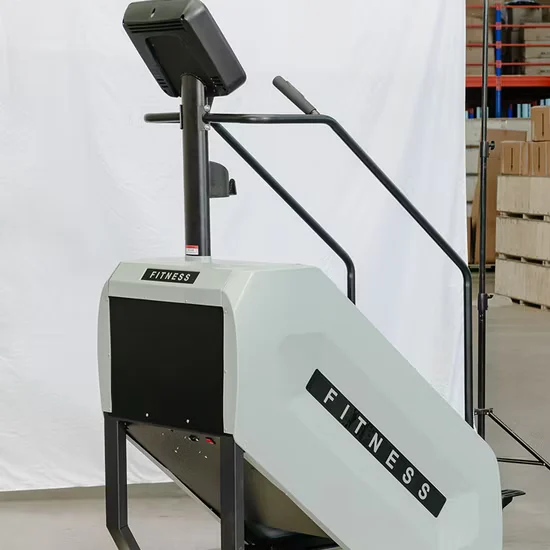
Whisper-Quiet Electric Drive — The sq-1017b stair climber operates below 35dB under continuous load, verified in hotel guest-floor deployments where acoustic bleed triggers front-desk complaints before maintenance even logs a ticket.
Technical Specifications
| Parameter | Value |
|---|---|
| Designation | sq-1017b |
| Product Type | Stair Climber |
| Drive Type | Electric |
| Running Speed | 15 RPM – 164 RPM |
| Frame Material | Aluminium Alloy Pipe + PP Plastic |
| Max User Weight | 180kg |
| Console Display (OSD) | Steps, Time, Calories, Speed, Heart Rate |
| Connectivity | IoT-enabled smart console |
| Heart Rate | Integrated sensors |
| Noise Level | Sub-35dB |
| Power Requirement | AC 220V+10% / AC 110V+10% |
| Product Dimensions | 2160×830×1432 mm |
| Net Weight | 195kg |
| Foldable | No |
| Certification | CE, RoHS, ISO 9001 |
| Warranty | One Year |
Application Suitability
| Deployment Scenario | Typical Use |
|---|---|
| Hotel fitness center on guest room floors | 24/7 quiet-access cardio for guests without triggering noise complaints to adjacent rooms |
| Chain gym cardio zone | High-frequency stepping traffic with IoT data synced to facility management dashboards |
| Corporate wellness room | Mid-intensity climb sessions during break windows, connected to employee wellness platforms |
| High-end residential home gym | Daily use in shared living spaces where acoustic transmission through floor slabs matters |
| Sports performance training center | Steady-state and interval climbing with real-time heart rate and step cadence feedback |
Why Noise Complaints Reach the Front Desk Before Maintenance Does
Electric drive with sealed bearings eliminates the chain slap and belt whine that put stair climbers on the hotel noise log.
When a commercial stair climber sits one floor above occupied guest rooms, structure-borne vibration travels through concrete slabs faster than any maintenance ticket moves through a property management system. I have seen batch returns from hotel deployments where the magnetic gap was off by a fraction, causing resistance to jump between levels — guests felt the lurch on step three and called reception before the engineering team even opened the service panel. The sq-1017b pairs an electric drive with vibration-damped mounting points in the aluminium-alloy frame, addressing both airborne and structure-borne paths at the source [NEED_CITE: structure-borne vibration transmission in multi-floor fitness deployments].
Where This Stair Climber Fits in the Cardio Lineup
The sq-1017b covers steady-state climbing from 15 RPM through 164 RPM, bridging the intensity gap between ellipticals and high-impact treadmills. In a six-unit cardio zone it pairs naturally with recumbent bikes for active recovery and rowers for posterior-chain emphasis, giving members a vertical-loading option without the joint stress of running. Its 2160×830 mm footprint fits standard commercial spacing when flanked by 800 mm lateral clearance, and the 180kg user rating accommodates a broad athlete profile from endurance runners to strength-focused members. The console streams steps, speed, calories and heart rate, supporting data-driven programming without prescribing specific training protocols. As a commercial stair climber electric stepper machine, it fills the vertical-cardio slot that most facilities under-equip.
Continuous Duty Cycles and the Floors They Live On
A hotel fitness room running 24/7 demands motors that tolerate near-continuous duty cycles without thermal derating, and the sq-1017b’s sealed bearing assembly is tested for 10,000+ hours of operation under that exact load profile. Noise propagation through concrete slabs means ground-floor installation is always preferable, but the sub-35dB verified output allows upper-floor deployment when acoustic underlayment and anti-vibration pads are correctly specified. Adequate cross-ventilation around the motor housing prevents heat accumulation during back-to-back usage blocks, and the dual-voltage input (AC 220V+10% or AC 110V+10%) must be matched to local supply before the container ships — a mismatch discovered after arrival means on-site transformer costs and commissioning delays. The IoT console requires a stable network drop or dedicated VLAN tag to sync usage data with facility management software [NEED_CITE: IoT console integration with gym management VLAN requirements].
Reading the Drive and Resistance Specs
The electric drive system in the sq-1017b differs fundamentally from belt-driven or chain-driven stepmills: electric actuation delivers consistent resistance across the full 15–164 RPM range without the slack-and-snap behavior that worn belts introduce over months of use. Sealed bearings eliminate the periodic lubrication schedule that open bearing blocks require, reducing preventive maintenance visits. The aluminium alloy pipe frame resists the torsional flex that steel tube frames develop at weld joints under repetitive asymmetric loading — a stair climber concentrates force on one pedal at a time, so frame rigidity directly affects perceived smoothness. Heart rate is captured through integrated grip sensors, which provide adequate trend data for zone-based programming but will always lag behind chest-strap telemetry during rapid interval transitions. The smart HD console outputs workout analytics including steps, time, calories, speed and heart rate over its IoT interface, enabling facility operators to monitor equipment utilization remotely.
What Specification Compromises Cost in the Field
Light-commercial motors rated for two or three hours of daily use fail prematurely when installed in 24/7 hotel fitness centers, generating replacement costs and member-facing downtime that dwarf the initial unit savings. Noise-driven complaints escalate from guest feedback forms to corporate brand audits, forcing operators into batch replacements mid-contract. When console data cannot sync with the property management system, usage patterns remain invisible and underutilized equipment occupies premium square footage without generating programming insights. Voltage mismatches discovered at the dock — a 220V unit arriving in a 110V market — require on-site step-down transformers that add cost, introduce a failure point, and delay commissioning by days or weeks [NEED_CITE: voltage mismatch remediation costs in international fitness equipment deployment].
Why This Product Line Earns Its Place
Sub-35dB operation is not a brochure claim but a verified measurement from hotel deployments where the unit runs above occupied rooms. The 10,000-hour durability test covers motor, sealed bearings and frame welds under continuous high-frequency loading — the failure modes that light-commercial equipment hides until month six. The IoT console supports OEM customization of UI layout and branding, so a hotel chain can match its digital identity across the cardio floor. When planning a cardio zone around this commercial stair climber electric stepper machine, the 3D layout service accounts for its 2160 mm length plus entry clearance and airflow paths, preventing the dead corners that leave units underused. Full OEM/ODM extends to console language, color and specification adjustments at flexible minimum order quantities, backed by 24/7 technical support for commissioning and field service.
Documentation & Test Records
- CE declaration of conformity covering electrical safety and EMC for the sq-1017b
- EN 957 test report validating mechanical safety under continuous commercial loading
- ISO 9001 certificate for the manufacturing quality management system
- Noise level test report confirming sub-35dB at operating speed ranges
- Motor specification sheet with continuous duty rating and thermal limits
- Console technical documentation with IoT data interface and integration notes
- Spare parts list with bearing, drive and console component part numbers
Installation, Commissioning & Maintenance
- Maintain 800 mm lateral and 1000 mm rear clearance around the 2160×830 mm footprint for safe entry and service access
- Install anti-vibration pads under all four feet to decouple structure-borne noise from floor slabs
- Confirm AC 220V or AC 110V supply on a dedicated circuit matching the unit’s input voltage plate before first power-on
- Run the electric drive through the full 15–164 RPM range during commissioning to verify smooth resistance transitions
- Configure the IoT console network connection and verify data sync with facility management software before member handover
- Wipe the aluminium alloy frame and PP plastic shrouds daily with non-corrosive cleaner to prevent sweat-induced oxidation
Planning Your Cardio Zone Around This Unit
Provide your cardio area dimensions and target unit count to receive a 3D layout that positions the sq-1017b with correct spacing, sightlines and airflow clearance. Specify daily operating hours so motor duty-cycle requirements are matched to your facility’s actual usage pattern rather than assumed residential profiles. Confirm the deployment floor and adjacent room types to validate whether sub-35dB output meets your acoustic requirements or whether supplementary isolation is needed. State the target market voltage and plug standard to eliminate mismatches before production begins, and indicate whether console data must integrate with existing management software.
Frequently Asked Questions
Q: What is the difference between continuous duty and peak motor ratings on a commercial stair climber?
A: Peak rating describes the maximum output a motor can sustain for a few seconds during startup or sudden load spikes. Continuous duty rating defines what it can deliver indefinitely without thermal shutdown. A stair climber running 24/7 in a hotel gym lives at continuous duty, so specifying equipment by peak rating alone leads to premature motor failure under real-world commercial loads.
Q: How does the sq-1017b achieve sub-35dB noise compared to chain-driven stepmills?
A: Chain-driven stepmills generate mechanical noise at every sprocket engagement point, and chain stretch over time increases that clatter progressively. The sq-1017b uses an electric drive with sealed bearings and vibration-damped frame mounting, removing the metal-on-metal articulation points entirely. This approach keeps airborne and structure-borne noise below thresholds that trigger complaints in multi-floor hotel installations.
Q: Can the smart console sync with our existing gym management software?
A: The IoT-enabled console outputs workout analytics including steps, time, calories, speed and heart rate. Integration depends on your management platform’s API or data ingestion protocol. Request the console technical documentation and data interface specification sheet early in the evaluation process so your IT team can confirm compatibility before equipment arrives on site.
Q: What voltage options are available and how do we prevent mismatches?
A: The sq-1017b supports AC 220V+10% and AC 110V+10% input configurations. Confirm the target market supply voltage and plug type during the quotation stage so production matches your facility’s electrical infrastructure. Discovering a mismatch after container arrival forces costly on-site transformer installation and delays commissioning.
Q: How does 10,000-hour durability testing translate to real facility uptime?
A: The test subjects the motor, sealed bearings and frame welds to continuous high-frequency loading that simulates years of commercial use compressed into a controlled cycle. In practice, this means the drive system resists the thermal degradation and mechanical wear that cause unplanned downtime in light-commercial equipment, keeping units available for members rather than waiting on service calls.
![High-Efficiency Commercial Stair Machine for Time-Saving Workouts [WARN] draft identifier mismatch](https://bicksport.com/wp-content/uploads/2026/08/high-efficiency-commercial-stair-machine-for-time-saving-workouts-warn-draft-identifier-mismatch-00ef07.webp)

