

Whisper-Qualified Frame — Alloy aluminum construction keeps resonance below audible thresholds during high-repetition carriage work.
Technical Specifications
| Parameter | Value |
|---|---|
| Product Type | Pilates Reformer |
| Designation | SRY-12B |
| Color | Black |
| Accessory | Long Box / Jump Board / Platform |
| Product Dimensions | 2570 × 730 × 270 mm |
| Net Weight | 90 kg |
| Max User Weight | Not specified |
| Frame Material | Alloy Aluminum |
| Warranty | 3 Years |
| Logo | Customized is allowed |
| Age | Adult |
| Gender | Unisex |
| Production Capacity | 80 Pieces/Month |
Application Suitability
| Deployment Scenario | Typical Use |
|---|---|
| Yoga studio | Group reformer classes with synchronized Long Box and Jump Board circuits |
| Pilates training center | One-on-one and small-group sessions using full accessory range |
| Fitness club cardio-mindfulness zone | Cross-training complement adjacent to aerobic equipment areas |
| Rehabilitation facility | Controlled resistance sessions with Platform support for stability work |
Why Structural Resonance Reaches the Studio Next Door Before Anyone Reports It
Alloy aluminum framing dampens vibration transfer that steel carriages pass straight into the floor slab.
When a Pilates studio shares walls or flooring with treatment rooms, hotel corridors, or office spaces, the low-frequency hum of a carriage under spring load becomes a recurring complaint. Facility managers often trace the issue not to the springs or cords but to the frame itself — lighter gauge steel and imprecise rail tolerances amplify every direction change into structural vibration. The commercial Pilates reformer black alloy aluminum SRY-12B addresses this at the frame level, where stiffness and mass distribution determine how much oscillation reaches the building [NEED_CITE: structural vibration transmission standards for adjacent occupied spaces].
How This Reformer Fits into a Multi-Discipline Studio Layout
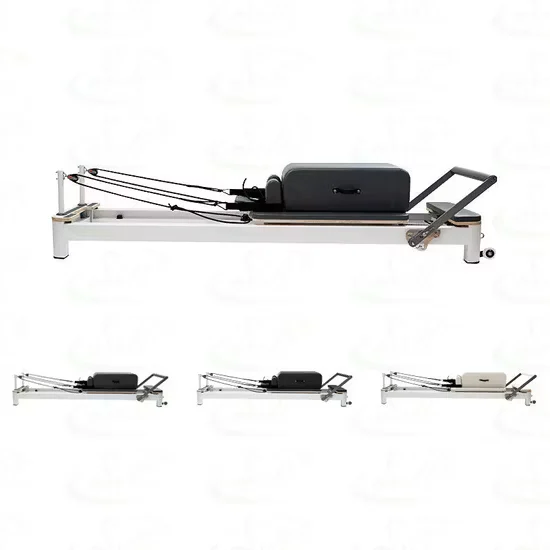
The SRY-12B covers the full range of classical and contemporary Pilates repertoire, from supine footwork through advanced Jump Board plyometrics. In a studio layout, it occupies the primary apparatus position, complemented by Cadillac and chair units for progression work. The 2570 mm footprint requires roughly one meter of clearance on each side for instructor access and safe limb extension. Its unisex design accommodates the adult population spectrum, and the commercial Pilates reformer black alloy aluminum configuration pairs logically with mat stations for warm-up sequences.
Continuous Class Scheduling and Environmental Considerations
A studio running back-to-back group sessions may see this reformer in use for eight or more hours daily. The alloy aluminum frame handles sustained loading without the thermal expansion drift that affects some composite materials. Noise transmission through the floor slab remains a planning factor — deployment above occupied levels benefits from vibration-isolating floor pads. Standard indoor climate control is sufficient; the frame does not require humidity-regulated storage. Power is not a factor, as this is a purely mechanical system, though adequate overhead lighting should cover the full 2570 mm length for safe Jump Board work. [NEED_CITE: floor load distribution requirements for dynamic exercise apparatus]
What the Alloy Frame and Modular Accessories Actually Control
The alloy aluminum frame delivers a stiffness-to-weight ratio that suppresses the mid-range resonance frequencies typical of carriage reversals under load. Where a heavier steel frame may dampen high-frequency vibration but transmit low-frequency sway, aluminum alloy targets the oscillation band most perceptible in adjacent rooms. The three included accessories — Long Box, Jump Board, and Platform — extend the training envelope without requiring separate apparatus purchases. The Long Box supports seated and prone pulling movements, the Jump Board converts the carriage into a horizontal plyometric surface, and the Platform adds a stable elevated surface for balance and stretching work. This modularity means a studio can program a complete session on a single unit rather than rotating members through multiple machines.
The Hidden Cost of Specifying Below Commercial Grade
Reformers built for home or light-studio duty cycles reveal their limits within months of group-class scheduling. Carriage wheels develop flat spots from continuous directional changes, spring tension drifts outside usable ranges, and rail surfaces wear unevenly under high-frequency use. The resulting maintenance downtime pulls units off the schedule, forcing class cancellations or overcrowding on remaining equipment [NEED_CITE: maintenance frequency comparison between commercial and light-commercial Pilates apparatus]. Studios that initially purchased on unit cost often find the replacement cycle erases any upfront savings within the first year.
Why This Product Line Earns Its Studio Placement
Sub-35 dB whisper-quiet operation verified across our cardio deployments sets the acoustic benchmark we apply to every apparatus category, including this reformer’s rail and carriage interface. Components undergo durability testing calibrated for 10,000 hours of continuous high-frequency use, which translates to years of group-class scheduling before major service intervals. Full OEM customization covers logo placement and color matching, so a chain of studios can maintain visual consistency across locations. Our 3D layout planning extends to Pilates zones, mapping carriage clearance, instructor sightlines, and airflow for rooms that also house aerobic equipment. The 24/7 technical support response covers mechanical troubleshooting with the same urgency applied to electronic console failures.
Documentation & Test Records
- CE declaration of conformity for mechanical fitness apparatus
- EN 957 test report covering static and dynamic load verification
- ISO 9001 certificate for manufacturing quality management
- Frame material composition and tensile strength documentation
- Accessory load rating sheets for Long Box, Jump Board, and Platform
- Noise level test record for carriage operation on alloy rails
Installation, Commissioning & Maintenance
- Maintain minimum 1000 mm lateral clearance around the 2570 × 730 mm footprint for instructor access
- Install vibration-isolating pads beneath all four feet when deploying above occupied floors
- Level frame on deployment surface using adjustable feet before loading the carriage
- Inspect carriage wheel bearings and rail surfaces monthly under group-class scheduling
- Verify spring tension calibration quarterly and replace springs showing visible deformation
- Clean alloy frame with pH-neutral solution to prevent sweat residue corrosion
Equipment Selection and Deployment Inquiry
Provide your studio floor area and planned reformer count to receive a 3D layout with carriage clearance mapping and airflow recommendations. Specify whether deployment is above occupied spaces so we can confirm vibration isolation requirements. Indicate if OEM logo and color customization is needed for brand consistency across multiple locations. State your target market and any regulatory documentation requirements for customs clearance.
Frequently Asked Questions
Q: How does alloy aluminum compare to steel in controlling vibration transfer?
A: Alloy aluminum frames target the mid-range resonance frequencies generated during carriage reversals, which are the frequencies most likely to transmit through floor slabs into adjacent rooms. Steel frames tend to dampen high-frequency vibration but can pass low-frequency structural sway. The SRY-12B alloy construction is engineered specifically to reduce perceptible oscillation in shared-wall and upper-floor studio deployments.
Q: What maintenance does the rail system require under daily group-class use?
A: Carriage wheels and rail surfaces should be inspected monthly for uneven wear patterns, which indicate alignment drift. Bearings require periodic cleaning to remove chalk and sweat residue that accelerates degradation. The alloy aluminum rail resists surface pitting better than mild steel, but routine wiping after class blocks extends service intervals between full bearing replacements.
Q: How do the three included accessories reduce overall studio equipment costs?
A: The Long Box, Jump Board, and Platform together cover seated pulling, horizontal plyometric, and elevated balance work that would otherwise require separate apparatus purchases. This allows a studio to program comprehensive sessions on a single reformer, reducing the total unit count needed for a full class schedule and freeing floor space for additional mat or small apparatus stations.
Q: What does OEM customization cover for multi-location studio brands?
A: Logo placement, frame color, and accessory configuration can all be specified to match a studio chain’s visual identity. Customization extends to accessory combinations, so individual locations can order the Long Box, Jump Board, or Platform in quantities that reflect their class programming. Minimum order quantities apply and vary by customization scope.
Q: What floor load and spatial requirements should be verified before installation?
A: The 90 kg unit weight plus dynamic user loading requires standard commercial floor capacity. The 2570 × 730 mm footprint plus recommended 1000 mm clearance on each side means each station occupies roughly 2770 × 2730 mm of usable floor area. Upper-floor deployments benefit from vibration-isolating pads, and ceiling height must accommodate full Jump Board extension.


![Wood Folding Pilates Reformer Portable Quality Machine [WARN] draft identifier mismatch](https://bicksport.com/wp-content/uploads/2026/08/wood-folding-pilates-reformer-portable-quality-machine-warn-draft-identifier-mismatch-ef90b8.webp)