

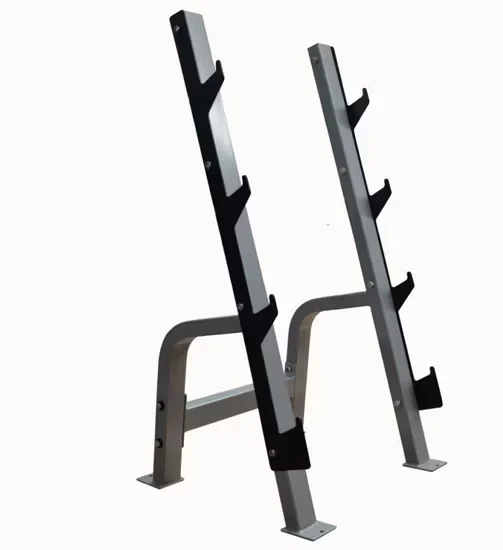
Commercial Barbell Rack OS-H5071 — Engineered steel frame validated for high-frequency commercial deployment, addressing structural fatigue that lighter storage solutions encounter under daily barbell loading.
Technical Specifications
| Parameter | Value |
|---|---|
| Designation | OS-H5071 |
| Product Type | Barbell Rack |
| Type | Integrated Gym Trainer |
| Material | Steel |
| Product Dimensions | 10505601460mm |
| Net Weight | 25kg |
| Main Frame Color | Available according to customer requirements |
| Cushion Color | Available according to customer requirements |
| OEM/ODM | Acceptable |
| Fit Area | Professional Gym and Club |
| Certification | ISO 9001, CE |
| Age Group | Adult |
| Gender | Unisex |
| Appliance | Community, Gymnasium |
| HS Code | 9506911900 |
Application Suitability
| Deployment Scenario | Typical Use |
|---|---|
| hotel fitness center on guest room floors | Centralized barbell storage for 24/7 guest access |
| chain gym cardio zone | Supplemental storage adjacent to free weight training areas |
| corporate wellness room | Organized barbell retention for employee training programs |
| high-end residential home gym | Compact storage footprint for multi-barbell collections |
| sports performance training center | High-capacity barbell organization for athlete programming |
Why Structural Failures Surface After Warranty Expires
Welded steel construction resists the cyclic fatigue that compromises bolted assemblies in commercial environments.
When a commercial barbell rack steel frame gym storage unit shifts under load or develops micro-fractures at connection points, the failure rarely occurs during initial inspection. It manifests months later, after thousands of load cycles have worked the joints loose. Facility managers then face the choice between welding repairs that void certifications or wholesale replacement during operating hours [NEED_CITE: EN 957 requirements for commercial strength equipment static load testing].
The commercial barbell rack steel frame gym storage category spans a wide performance gap. Units specified for light commercial duty often employ thinner gauge steel and spot-welded joints adequate for low-frequency home use but insufficient for the continuous barbell rotation in professional facilities. The result is equipment that passes initial quality checks yet generates member complaints and liability concerns within its first year of deployment.
Defining the Rack’s Position Within the Free Weight Zone
This commercial barbell rack steel frame gym storage unit serves as the primary retention point for Olympic and specialty bars within the free weight training area. Its 1050mm width accommodates multiple barbells in a linear arrangement, allowing athletes to select implements without navigating congested storage clusters. The unit complements plate storage trees and dumbbell racks by consolidating barbell inventory at a single, accessible location.
Deployment density depends on facility traffic patterns. High-volume facilities typically position one unit per training zone to minimize cross-floor barbell transport, while smaller installations may centralize storage near the entrance to the weight room. The 1460mm height keeps bar ends clear of overhead obstructions while maintaining accessibility for users across the height spectrum.
The commercial barbell rack steel frame gym storage design accepts standard Olympic barbell sleeves and specialty bars with varying shaft diameters. No proprietary cradles or adapter requirements limit the barbell types the facility can stock.
Continuous Use and Environmental Requirements for Structural Integrity
Commercial facilities operating 16-24 hours daily subject storage equipment to continuous load cycling as bars are removed and replaced throughout the day. The steel frame construction and welded joints are engineered to maintain dimensional stability under this duty cycle without developing play at connection points or requiring periodic bolt retightening [NEED_CITE: continuous duty cycle testing for commercial gym storage equipment].
Noise transmission from barbell contact with storage cradles affects deployment decisions in multi-floor facilities. Units positioned on guest room floors or above occupied office spaces benefit from vibration-dampening base pads and controlled-return cradle designs that prevent metal-on-metal impact during bar placement.
Environmental factors including humidity fluctuations and cleaning chemical exposure influence long-term frame integrity. Powder-coated finishes specified to customer color requirements provide corrosion resistance while maintaining visual consistency with facility design standards. Floor flatness tolerances affect unit stability; uneven surfaces create point loading that accelerates frame fatigue.
Interpreting the Frame and Load Specifications
The 25kg net weight reflects the steel mass required to anchor the unit against lateral forces when fully loaded with multiple barbells. Lighter frames in the commercial barbell rack steel frame gym storage category may reduce shipping costs but sacrifice the inertia necessary to resist tipping when users extract bars from upper positions. The 1050*560mm footprint provides a stability base proportioned to the unit’s height and anticipated eccentric loading.
Welded steel construction eliminates the loosening failure mode inherent in bolted assemblies. Each load cycle on a bolted rack applies shear forces that gradually work fasteners free, requiring maintenance intervention. Welded joints transfer these forces through continuous material bonds that do not degrade with cyclic loading, though they require proper penetration depth and quality control during fabrication.
The 1460mm height positions barbell ends above typical waist-level traffic while keeping grip points within comfortable reach. This vertical arrangement maximizes storage capacity per square meter of floor space, a critical metric in facilities balancing equipment density against member flow requirements.
ISO 9001 certification ensures manufacturing process controls are applied consistently across production runs. CE marking indicates conformity with European safety directives applicable to fitness equipment structural requirements.
The Hidden Costs of Underspecified Storage
Facilities that select storage units based primarily on purchase price often encounter downstream costs that exceed the initial savings. Frames that flex under load create extraction difficulties, leading members to drag bars across cradle surfaces and generate metal debris. Units that shift position require staff intervention to realign, consuming maintenance hours better allocated to equipment with moving components [NEED_CITE: total cost of ownership analysis for commercial gym storage].
Structural failures in storage equipment create liability exposure distinct from training equipment failures. A barbell rack that collapses under load endangers anyone in the immediate vicinity, not just the user extracting a bar. This risk profile drives insurance underwriters to scrutinize storage equipment specifications during facility audits.
Replacement cycles for underspecified units often compress to 18-24 months in high-frequency environments, versus the multi-year service life achievable with properly specified welded steel construction. The operational disruption of swapping storage units during business hours compounds the direct replacement cost.
Why This Product Line Addresses Deployment Pain Points
The commercial barbell rack steel frame gym storage solution derives from the same manufacturing discipline applied across a six-series cardio and strength equipment range. Welded steel construction techniques proven in continuous-duty cardio frames translate directly to storage equipment that resists structural fatigue under daily use.
OEM and ODM capabilities extend beyond frame color to include cradle geometry modifications for specialty barbell retention. This customization capacity allows facilities with non-standard barbell inventories to specify storage solutions matched to their actual equipment rather than adapting to off-the-shelf limitations.
Three-dimensional facility layout planning addresses storage positioning within the broader equipment ecosystem. Proper placement considers member flow patterns, sightlines for staff supervision, and proximity to training zones where specific barbell types see highest utilization.
Documentation including CE declarations of conformity and EN 957 test reports supports international procurement compliance without requiring facility managers to independently verify structural claims.
Documentation & Test Records
- CE declaration of conformity for strength equipment structural requirements
- EN 957 test report covering static and dynamic load verification
- ISO 9001 certificate demonstrating manufacturing process controls
- Welded joint inspection records and material traceability documentation
- Powder coat thickness and adhesion test specifications
- Installation guide with floor anchoring requirements and torque specifications
Installation, Commissioning & Maintenance
- Maintain 600mm clearance on all sides for safe barbell extraction and return
- Verify floor flatness within 3mm tolerance before final anchoring to prevent frame stress
- Install vibration isolation pads on upper floors to dampen barbell contact transmission
- Inspect welded joints quarterly for any surface irregularities indicating subsurface fatigue
- Clean powder-coated surfaces with pH-neutral cleaners to preserve finish integrity
- Verify anchor bolt torque annually or after any significant impact event to the unit
Sizing and Specifying for Your Facility Requirements
Provide your free weight zone dimensions and anticipated barbell inventory count to receive a three-dimensional layout showing optimal OS-H5071 placement relative to training platforms and traffic flow. Specify your facility’s daily operating hours to confirm the welded construction suits your usage intensity without premature fatigue concerns.
Identify your deployment floor and adjacent occupied spaces to determine whether supplemental vibration isolation measures are warranted. State your target market voltage and plug standards if integrating the rack with any electronic inventory tracking systems. Indicate whether console data integration is required for facility management software compatibility.
Frequently Asked Questions
Q: How does commercial barbell rack construction differ from residential-grade units?
A: Commercial units employ continuous welded joints and thicker gauge steel to withstand thousands of load cycles annually. Residential racks often use bolted connections that loosen over time and lighter frames that flex under multiple barbell loads. The mass and construction methods reflect the continuous duty environment versus intermittent home use.
Q: What prevents welded frame failure after years of high-frequency use?
A: Proper weld penetration depth and post-weld quality control ensure joints transfer loads through continuous material bonds rather than point stress concentrations. The steel gauge and frame geometry distribute barbell weight across multiple load paths, preventing any single joint from experiencing fatigue-inducing stress cycles.
Q: Does OEM color customization affect lead times or minimum order quantities?
A: Powder coat color selection from the standard palette typically maintains standard production timelines. Custom color matching requires additional time for sample approval and paint formulation. Minimum order quantities remain flexible for facilities outfitting multiple locations with consistent visual branding.
Q: How should barbell rack placement coordinate with overall facility layout?
A: Storage positioning affects member flow efficiency and staff supervision sightlines. Racks should be located adjacent to training zones where their barbell types see highest use, with adequate clearance for safe extraction without disrupting adjacent exercises. Three-dimensional layout planning optimizes these relationships.
Q: What do CE and ISO 9001 certifications mean for international facility procurement?
A: CE marking indicates conformity with European safety directives for fitness equipment structural requirements. ISO 9001 certification demonstrates that manufacturing processes maintain consistent quality controls across production runs. Both certifications support compliance documentation for international procurement and insurance underwriting requirements.


![Hammer Strength ISO-Lateral Shoulder Press Commercial Gym Equipment [WARN] draft identifier mismatch](https://bicksport.com/wp-content/uploads/2026/08/hammer-strength-iso-lateral-shoulder-press-commercial-gym-equipment-warn-draft-identifier-mismatch-843aa9.webp)