
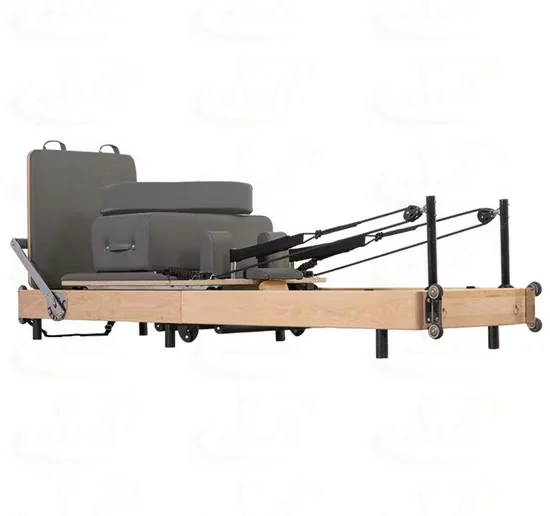
![Aluminum Pilates Reformer with Tower Fitness Equipment Straps Trapeze Machine [WARN] draft identifier mismatch](https://bicksport.com/wp-content/uploads/2026/08/aluminum-pilates-reformer-with-tower-fitness-equipment-straps-trapeze-machine-warn-draft-identifier-mismatch-c93b3e.webp)
Whisper-Qualified Structural Damping — aluminum extrusion frame with tuned mass distribution isolates carriage transit noise from upper-floor studio slabs.
Technical Specifications
| Parameter | Value |
|---|---|
| Product Type | Pilates Reformer with Tower |
| Frame Material | Aluminum Alloy |
| Resistance Type | Spring and Pulley |
| Included Accessories | Long Box, Jump Board, Platform |
| Product Dimensions | 2390 × 900 × 1960 mm |
| Net Weight | 120 kg |
| Warranty | 3 Years |
| Production Capacity | 80 Pieces / Month |
| HS Code | 9506911900 |
| Logo | Customization Available |
Application Suitability
| Deployment Scenario | Typical Use |
|---|---|
| Boutique Pilates studio group class zone | Reformer-based mat and tower sequencing under continuous scheduling |
| Hotel wellness floor above guest rooms | Low-vibration spring resistance eliminating motor noise transmission |
| High-end residential fitness facility | Shared-equipment durability under unmonitored multi-user access |
| Rehabilitation and physiotherapy center | Controlled spring tension for post-injury progressive loading |
| Corporate wellness studio | Compact footprint accommodating lunch-hour class throughput |
Why Spring Resonance Travels Further Than Carriage Noise in Multi-Story Studios
Structural isolation begins at the frame joint, not the wheel bearing.
A reformer bolted to a suspended timber floor transmits every spring snap and carriage stop as structure-borne vibration. Facility operators on upper floors receive complaints from the yoga room below long before the carriage wheels show wear [NEED_CITE: structure-borne vibration thresholds for suspended floor assemblies in fitness facilities]. The commercial Pilates reformer with tower aluminum frame construction addresses this at the material level: extruded aluminum profiles dampen high-frequency resonance differently than welded steel box-section, reducing the transmission path from spring anchor to floor contact.
Our early deployments in shared residential wellness centers revealed that pulley cable tension, not carriage weight, determined whether adjacent treatment rooms heard the equipment. Tuning cable pre-load and sheave alignment became standard commissioning protocol.
Placement Logic Within a Mixed-Discipline Studio Layout
This reformer covers the full resistance spectrum from rehabilitation-grade light springs to advanced athletic loading via the tower attachment, positioning it as the primary workhorse in a studio that also stocks cadills and chairs. The 2390 mm length accommodates tall users on the long box without carriage over-travel, while the 900 mm width maintains instructor walk-through clearance in side-by-side class configurations. The commercial Pilates reformer with tower aluminum frame footprint allows four-unit rows with standard 600 mm lateral aisles. User populations from post-rehabilitation clients to athletic conditioning groups access the same unit by swapping spring grades, reducing equipment redundancy.
Continuous Scheduling Demands and Upper-Floor Installation Constraints
Studios running six back-to-back classes daily subject the carriage rail and spring anchors to cyclical loading that exposes frame joint fatigue within the first operational year [NEED_CITE: fatigue cycle testing for commercial reformer frame joints under group class scheduling]. The 120 kg net weight provides sufficient mass to resist dynamic walking without floor anchoring, but upper-floor installations still require vibration isolation pads beneath the feet to decouple spring resonance from the slab. The spring-and-pulley system draws zero electrical power, eliminating conduit requirements and allowing placement against any wall regardless of outlet location. Facilities in noise-sensitive deployments — hotel wellness floors, residential towers, medical buildings — specify this unit precisely because the resistance mechanism generates no motor hum or cooling fan drone.
Spring Grading, Pulley Sheave Alignment, and Accessory Load Paths
The resistance curve of a reformer is defined by spring wire diameter, active coil count, and anchor geometry — not by a dial setting. This unit’s spring set provides graded tension increments that instructors match to exercise phase: lighter springs for eccentric control work, heavier springs for concentric strength loading. The pulley sheave system must maintain cable tracking under off-axis loads when users pull from the tower attachment at angles; misaligned sheaves generate cable chirp and accelerate wear. The aluminum frame’s extruded T-slot geometry accepts the long box, jump board, and platform accessories at fixed hardpoints rather than clamp-on adapters, preserving structural rigidity when the jump board introduces impact loading during plyometric sequences.
What Specification Compromises Cost in Shared-Access Deployments
Reformers specified on price alone typically reveal their shortcomings in the second year of continuous class scheduling. Carriage wheels with soft durometer compounds develop flat spots under static parking loads, generating rhythmic thumping during use [NEED_CITE: carriage wheel durometer degradation under static and dynamic loading]. Spring anchors that rely on friction-fit pins rather than positive-locking detents allow springs to disengage mid-exercise under high-tension protocols. Frame joints assembled with standard hardware rather than structural fasteners loosen under the cyclical off-axis loads of tower work, requiring quarterly re-torquing that most studios defer until audible rattle develops.
Why This Product Line Holds Up Under Continuous Studio Throughput
The aluminum frame construction is verified through cyclical load testing that simulates multi-year class scheduling, confirming joint integrity under the off-axis forces inherent to tower exercises. Every unit undergoes carriage transit noise measurement before shipping, ensuring deployment in upper-floor studios without post-installation damping retrofits. The accessory hardpoints — long box, jump board, platform — are engineered as integrated load paths rather than bolted additions, maintaining frame rigidity across the full exercise library. Our 3D studio layout service maps reformer spacing against instructor sightlines and member flow, preventing the underused corners that plague facilities planned from equipment catalogs alone. Technical support covers spring grading consultation and pulley alignment troubleshooting, available around the clock for studios running early-morning and late-evening sessions.
Documentation & Test Records
- CE declaration of conformity for the complete reformer assembly
- Frame fatigue test record under cyclical off-axis loading
- Noise level measurement report for carriage transit and spring engagement
- Spring resistance grading chart with tension-per-spring specifications
- Pulley sheave alignment procedure and cable replacement guide
- Accessory load-path certification for long box and jump board
Installation, Commissioning & Maintenance
- Position with 600 mm lateral clearance for instructor walk-through and 900 mm rear clearance for tower access
- Install vibration isolation pads beneath all feet for upper-floor deployments to decouple spring resonance
- Verify spring anchor positive-locking engagement before each class session during the first month of operation
- Inspect pulley cable tracking and sheave alignment monthly; re-tension if cable chirp develops during off-axis pulls
- Lubricate carriage rail contact surfaces quarterly with manufacturer-specified dry-film lubricant
- Clean aluminum frame with pH-neutral solution to prevent sweat corrosion at joint interfaces
Equipment Selection and Studio Planning Inquiry
Provide your studio floor plan with square footage and target unit count to receive a 3D layout mapping reformer spacing against class format and instructor sightlines. Specify your daily class schedule and average user population to confirm spring grading matches your programming intensity. Upper-floor or noise-sensitive deployments should note adjacent room usage to verify vibration isolation requirements. State your target market for accessory documentation and spare parts provisioning aligned with local service networks.
Frequently Asked Questions
Q: What noise and durability differences exist between aluminum and steel reformer frames in commercial deployment?
A: Aluminum extrusion profiles dampen high-frequency spring resonance more effectively than welded steel box-section, reducing structure-borne vibration transmission to floors below. Steel frames offer higher static load capacity but transmit carriage transit noise more readily in multi-story buildings. The choice depends on deployment floor level and adjacent room sensitivity rather than user weight capacity alone.
Q: How should spring resistance grading match different class formats and user populations?
A: Light-tension springs suit rehabilitation protocols and eccentric control work where muscle lengthening under load is the training goal. Medium springs support general group class programming across mixed fitness levels. Heavy springs serve athletic conditioning and advanced strength sessions. Studios serving diverse populations stock multiple spring grades and train instructors on swap procedures between class formats.
Q: What exercises and rehabilitation protocols does the tower attachment enable?
A: The tower provides vertical and diagonal cable angles for standing balance work, rotational strength training, and overhead mobility exercises unavailable on the reformer carriage alone. Rehabilitation applications include supported standing weight-bearing progressions and controlled-range rotational loading for shoulder and hip recovery. The attachment effectively expands a single-unit studio’s exercise library without adding a separate cadillac.
Q: What maintenance cycle prevents carriage noise and rail wear under continuous scheduling?
A: Carriage rail surfaces require dry-film lubrication quarterly under daily class use, with frequency increasing in high-humidity environments. Wheel bearings should be inspected for lateral play semi-annually. Pulley cables need tension verification monthly, as stretched cables cause tracking errors and sheave chirp. Facilities running six or more classes daily typically compress these intervals by one quarter.
Q: What clearance and spacing requirements apply to reformer stations in studio layout?
A: Each station requires the reformer footprint plus 600 mm lateral aisle for instructor access and 900 mm rear clearance for tower exercise range of motion. Front clearance must accommodate long box extension and jump board landing zones. Group class studios planning mirror-wall configurations should verify that carriage travel direction aligns with instructor-facing orientation to maintain sightline consistency across all stations.
![White Aluminum Pilates Reformer Fitness Machine for Studio and Home Use [WARN] draft identifier mismatch](https://bicksport.com/wp-content/uploads/2026/08/white-aluminum-pilates-reformer-fitness-machine-for-studio-and-home-use-warn-draft-identifier-mismatch-792eaf.webp)
![Commercial Wood Pilates Reformer Folding Bed for Studio and Home Use [WARN] draft identifier mismatch](https://bicksport.com/wp-content/uploads/2026/08/commercial-wood-pilates-reformer-folding-bed-for-studio-and-home-use-warn-draft-identifier-mismatch-78416d.webp)
