
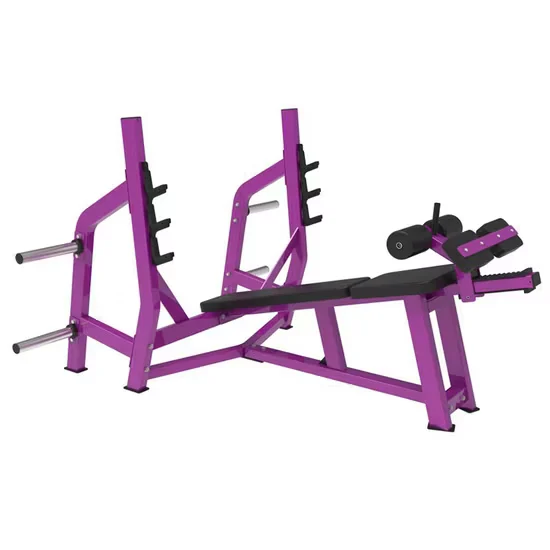
Heavy-Duty Frame Build — Steel-reinforced Decline Bench engineered for sustained high-load chest training in professional facilities.
Technical Specifications
| Parameter | Value |
|---|---|
| Designation | 5052 |
| Product Type | Decline Bench |
| Exercise Part | Chest |
| Material | Steel |
| Power Source | Manual |
| Product Dimensions | 1500 × 1150 × 1280 mm |
| Net Weight | 65 kg |
| Folded | Unfolded |
| Customization | Available |
| OEM/ODM | Available |
| Age Group | Adult |
| Gender | Unisex |
| Certification | ISO 9001, CE |
Application Suitability
| Deployment Scenario | Typical Use |
|---|---|
| Chain gym strength zone | Daily high-frequency chest and core training by members across varied fitness levels |
| Corporate wellness room | Compact decline training station complementing limited free-weight selections |
| Community fitness center | Durable bench accommodating multi-user turnover with minimal maintenance |
| Sports performance training center | Heavy-load decline pressing and weighted sit-up work for athlete programs |
| Hotel fitness center on guest room floors | Quiet manual bench avoiding motor noise in acoustically sensitive environments |
Why Frame Fatigue Reaches the Floor Before Maintenance Does
Reinforced steel welding and load distribution determine whether a commercial decline bench survives its first year.
I have seen benches in busy gym chains develop hairline cracks near the rear upright within months, usually where the seat rail meets the frame gusset. The problem is not user weight alone — it is the repetitive off-axis loading when members adjust position mid-set or drop plates against the uprights. A commercial decline bench steel frame gym operators trust must distribute these forces through triangulated welds rather than relying on a single butt joint [NEED_CITE: structural fatigue patterns in commercial strength equipment frames]. When a bench fails, it rarely gives advance warning. The first sign is often a complaint about wobble, followed by the bench being pulled from the floor and a replacement order that was never budgeted.
Positioning Within the Strength Training Zone
The 5052 occupies the targeted lower-chest and decline-pressing niche in a commercial layout, complementing flat and incline benches that handle the majority of pressing volume. Its 1500 × 1150 mm footprint allows placement against a wall or at the end of a dumbbell row without disrupting traffic flow between rack stations. Users ranging from lighter members performing bodyweight decline sit-ups to heavier athletes loading barbells for decline presses will find the steel frame and wide-base geometry stable under asymmetric loads. As a commercial decline bench steel frame gym facilities deploy for dedicated chest work, it pairs naturally with a nearby dumbbell rack and a spotter-accessible bench arrangement.
Continuous Deployment Without Motor or Power Concerns
Since the 5052 is entirely manual, there is no motor duty cycle to calculate and no electrical circuit to provision — a genuine advantage in facilities where every outlet is already allocated to cardio units or HVAC. The absence of powered components means zero standby energy draw and no console firmware to update, which matters when a gym runs sixteen hours daily and cannot schedule downtime for software patches [NEED_CITE: maintenance interval differences between manual and motorized commercial gym equipment]. Noise generation is limited to plates being loaded and the pad contacting the frame, keeping the strength zone acoustically predictable. Floor leveling and a rubber mat beneath the base remain important to prevent micro-shift during heavy sets.
Reading the Steel and Pad Specifications That Matter
The 65 kg net weight of the 5052 reflects the steel mass distributed through its frame and uprights — lighter benches in this category often sacrifice gusset thickness or tube wall gauge to hit a shipping-weight target. High-density foam padding with a vinyl cover resists compression set far longer than low-density alternatives, which visibly flatten within months of commercial use and expose users to the hard frame beneath [NEED_CITE: foam density standards for commercial gym bench upholstery]. The unfolded configuration eliminates the hinge-and-latch failure point common in folding benches, a trade-off that costs floor space but gains structural rigidity. ISO 9001 and CE certification confirm the manufacturing process and safety testing meet recognized commercial equipment standards.
The Cost of Underspecifying a Decline Bench
Facilities that procure benches based on lowest unit price frequently discover that thin-wall tubing bends under repeated heavy loading, creating a wobble that members notice immediately and report to staff. Padding that compresses within weeks forces either reupholstering at recurring cost or member attrition as users avoid the uncomfortable station. A bench pulled from the floor for repair generates no member value and occupies technician hours better spent on revenue-critical cardio and rack equipment [NEED_CITE: total cost of ownership comparison for commercial strength benches]. When an entire order of underspecified benches is deployed across multiple locations, the replacement cycle compounds into a significant unbudgeted capital expense.
Why This Product Line Earns Its Place on the Floor
The 5052 is built within a six-series cardio and strength family, meaning a facility sourcing treadmills and ellipticals from the same line can consolidate decline bench procurement without adding a new vendor relationship. The 10,000-hour durability testing protocol applied to powered units also governs frame fatigue assessment on manual benches, ensuring weld and tubing specifications are validated under simulated continuous use. OEM and ODM customization extends to frame color, pad material, and logo placement, allowing gym chains to maintain brand consistency across locations. Free 3D layout planning covers the 1500 × 1150 mm footprint alongside surrounding rack and dumbbell stations, confirming safe spotting clearance and member flow before any unit ships.
Documentation & Test Records
- CE declaration of conformity for the 5052 decline bench
- EN 957 test report covering static and dynamic load performance
- ISO 9001 certificate for the manufacturing quality system
- Steel frame material specification and weld inspection record
- Padding density and abrasion resistance test documentation
- Installation guide with floor anchoring and spacing recommendations
Installation, Commissioning & Maintenance
- Allow minimum 600 mm clearance on each side of the 1500 × 1150 mm base for safe loading and spotting access
- Place on a level surface with a rubber mat to dampen plate contact noise and prevent frame micro-shift
- Inspect all bolt connections after the first 30 days of use, then quarterly under commercial turnover
- Wipe vinyl padding after each use with a pH-neutral cleaner to prevent sweat-induced cover degradation
- Check foot roller adjustment mechanism monthly and lubricate pivot points as needed
- Verify frame welds visually during annual facility safety audits
Planning Your Strength Zone Procurement
Share your strength area square footage and existing equipment list so we can produce a 3D layout confirming the 5052 fits with proper spotting clearance and member flow. Indicate your expected daily user volume to help us recommend pad density and frame finish options. Specify your target market so we can align documentation and labeling requirements before production begins.
Frequently Asked Questions
Q: What load rating should a commercial decline bench meet for gym deployment?
A: Commercial benches should withstand repeated dynamic loading well above typical user weight, with frame and weld testing conducted per EN 957 requirements. The 5052 steel frame is engineered for high-frequency use in professional gym environments, and load test documentation is provided with each shipment to verify structural performance under sustained commercial demand.
Q: How does decline angle affect training safety and equipment design?
A: A steeper decline angle increases the gravitational load on the user during pressing movements and places greater demand on the foot roller retention system. The 5052 angle is set to target lower-chest musculature effectively while keeping the foot roller adjustment range compatible with varied user heights, reducing the risk of slipping during heavy sets.
Q: What padding specifications matter most for high-turnover gym benches?
A: High-density foam resists compression set that causes the hard frame to become palpable beneath the cover, a common complaint in commercial settings. The 5052 uses padding selected for durability under continuous daily use, with a vinyl cover rated for repeated cleaning and sweat exposure without cracking or delaminating.
Q: How should a strength zone layout accommodate decline benches safely?
A: Decline benches require additional length clearance compared to flat benches due to the angled frame and the user’s extended range of motion during decline presses. A 3D layout plan accounts for the 5052 footprint, adjacent rack spacing, and spotter access paths to ensure safe operation within the overall strength zone configuration.
Q: What OEM customization is available for gym chain branding?
A: The 5052 supports OEM and ODM customization including frame color, padding material selection, and logo placement on the frame or pad surface. Production lead times and minimum order quantities are confirmed during the quotation stage, allowing chain operators to standardize branding across multiple facility locations.
![Hammer Strength ISO-Lateral Shoulder Press Commercial Gym Equipment [WARN] draft identifier mismatch](https://bicksport.com/wp-content/uploads/2026/08/hammer-strength-iso-lateral-shoulder-press-commercial-gym-equipment-warn-draft-identifier-mismatch-843aa9.webp)


![ISO-Lateral Incline Press 18 Commercial Gym Equipment [WARN] draft identifier mismatch](https://bicksport.com/wp-content/uploads/2026/08/iso-lateral-incline-press-18-commercial-gym-equipment-warn-draft-identifier-mismatch-568aee.webp)