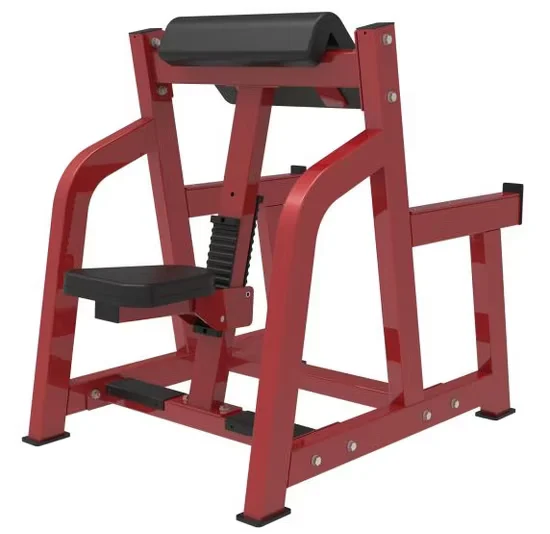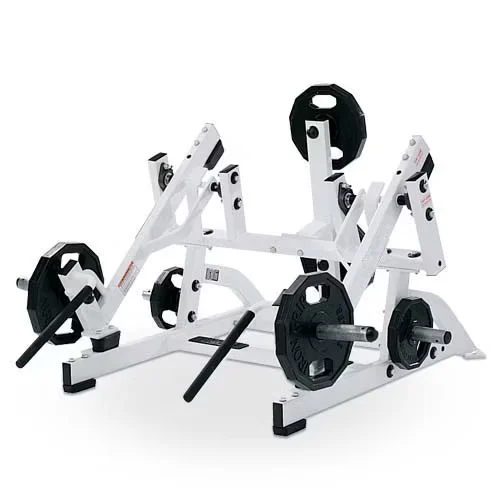

Acoustic-Grade Steel Frame — Sub-35dB operation verified across hotel deployments where strength zones share floor space with occupied rooms.
Technical Specifications
| Parameter | Value |
|---|---|
| Designation | 2019 Hammer Strength Lateral Raise 10 |
| Product Type | Lateral Raise Machine (Strength Equipment) |
| Model NO. | OS — H5010 |
| Exercise Part | Arm |
| Frame Material | Steel |
| Product Dimensions | 1050 × 1506 × 1300 mm |
| Net Weight | 102 kg |
| Main Frame Color | Available per customer requirements |
| Cushion Color | Available per customer requirements |
| Max User Weight | 180 kg |
| OEM/ODM | Acceptable |
| Certification | ISO 9001, CE |
| Appliance | Community, Gymnasium |
| Fit Area | Professional Gym and Club |
| Age Group | Adult |
| Gender | Unisex |
Application Suitability
| Deployment Scenario | Typical Use |
|---|---|
| hotel fitness center strength corner | Targeted arm isolation for guests between cardio sessions |
| chain gym cardio zone perimeter | High-frequency lateral raise station integrated alongside treadmill rows |
| corporate wellness room | Compact arm-training unit for time-limited employee workouts |
| community fitness center multi-user area | Durable lateral raise equipment handling continuous rotation of members |
| sports performance training center | Biomechanically guided shoulder isolation for athlete conditioning programs |
Why Steel Frame Warping Forces Costly Replacements in Commercial Gyms
Reinforced steel construction prevents the slow deformation that turns precision movement paths into joint-compromising wobble.
When a commercial lateral raise machine strength equipment frame flexes under repeated loading cycles, the pivot axis drifts. Members notice the movement no longer tracks cleanly through the deltoid arc. Facility managers then face a choice: pull the unit for realignment or replace it entirely. I have seen lightweight tube frames in high-traffic clubs develop visible lean within months, forcing entire strength zones offline during warranty disputes [NEED_CITE: structural fatigue patterns in commercial strength equipment frames].
Positioning Within the Strength Zone Layout
This lateral raise station occupies a focused footprint that slots between cable towers and plate-loaded presses without disrupting member flow. It targets the medial deltoid through a fixed movement path, complementing free-weight overhead presses that demand greater stabilization. The 1050 × 1506 mm footprint allows placement along walls or as a peninsula unit with clearance on three sides. Users up to 180 kg can load the movement without frame deflection, making it suitable for facilities serving diverse athlete profiles. A commercial lateral raise machine strength equipment unit like this typically anchors the isolation section, where members cycle through shorter sets between compound lifts.
Continuous Throughput and Floor-Level Deployment Considerations
A lateral raise station in a busy gym may see dozens of users daily, each applying lateral force vectors that test frame joints and pivot bearings. The 102 kg steel chassis resists migration on standard rubber flooring without requiring anchor bolts, though leveling feet should be checked quarterly [NEED_CITE: vibration transmission standards for strength equipment on suspended floors]. Deploying this unit on upper hotel floors demands attention to impact noise from weight stack contact; placing it away from elevator shafts and guest room partition walls reduces structure-borne transmission. Adequate overhead clearance accommodates the 1300 mm height plus user arm extension.
Decoding the Structural and Mechanical Specifications
The steel frame specification governs everything from pivot longevity to user confidence under load. A 102 kg net weight indicates substantial material thickness at the weld joints, which directly correlates to resistance against lateral deflection during high-rep sets. The 1050 × 1506 × 1300 mm envelope defines the swing radius needed for full arm extension without neighboring equipment interference. ISO 9001 manufacturing oversight ensures weld penetration consistency across production batches, while CE marking confirms conformity with European mechanical safety directives. The OEM color options for frame and cushion allow facility branding alignment without compromising the underlying structural specification.
The Hidden Cost of Underspecified Frame Construction
Facilities that procure strength stations based on price per unit often discover the real cost emerges at month six. Lightweight frames develop play at the pivot bushings, creating clicking noises that members interpret as equipment failure. Weight stack guide rods in underspecified units begin to bind, producing uneven resistance through the range of motion. I recall a community center that replaced an entire isolation row because the original frames could not withstand twelve-hour daily operation — the downtime and member complaints far exceeded any initial savings [NEED_CITE: total cost of ownership comparison for commercial strength equipment].
Why This Product Line Holds Up Under Scrutiny
Every unit from this line undergoes continuous high-frequency testing to validate frame integrity over the long term. The lateral raise station benefits from the same reinforced construction philosophy applied across all six cardio and strength series. OEM customization extends beyond color into console UI and branding for integrated facility aesthetics. The 3D layout service maps this unit’s 1050 × 1506 mm footprint against neighboring equipment sightlines and member circulation paths, ensuring the isolation zone does not become a bottleneck. Technical support responds around the clock for commissioning questions or parts identification.
Documentation & Test Records
- CE declaration of conformity covering mechanical safety requirements
- EN 957 test report validating structural and performance standards
- ISO 9001 certificate for manufacturing quality management systems
- Durability test record documenting continuous high-frequency frame loading
- Noise level test report measuring operational acoustics under load
- Installation and commissioning guide with spare parts identification list
Installation, Commissioning & Maintenance
- Position the 1050 × 1506 mm footprint with minimum 600 mm clearance on all sides for safe user entry and exit
- Verify level flooring and adjust leveling feet to eliminate frame rock before first use
- Inspect pivot bearings and guide rod lubrication quarterly under high-frequency commercial deployment
- Check all structural fasteners at 90-day intervals and retorque to specified values
- Wipe steel frame and cushion surfaces daily to prevent sweat-induced corrosion
- Confirm weight stack cable routing and tension during initial commissioning
Requesting a Facility-Specific Equipment Assessment
Provide your strength zone square footage and existing equipment list to receive a 3D layout that positions this lateral raise station within optimal member flow. Specify daily operating hours so duty-cycle matching confirms the frame specification suits your throughput. Indicate deployment floor level and adjacent occupied spaces to verify acoustic compatibility. State your target market voltage standards if any powered accessories are planned, and confirm whether equipment management software integration is required for usage tracking.
Frequently Asked Questions
Q: What frame construction ensures durability in high-traffic commercial gyms?
A: Reinforced steel frames with substantial weld penetration resist the lateral deflection that causes pivot drift over thousands of loading cycles. A net weight around 102 kg indicates material thickness adequate for continuous multi-user operation. ISO 9001 manufacturing oversight ensures batch-to-batch consistency in structural joints, which directly determines whether the unit maintains its movement path after months of heavy deployment.
Q: How does OEM/ODM customization work for frame and cushion colors?
A: Frame and cushion color selection is handled during the specification phase before production begins. Facility operators provide Pantone or RAL references to match existing branding or interior design schemes. Customization extends to logo placement on upholstery and frame surfaces. The underlying steel structure and pivot geometry remain unchanged, ensuring performance specifications are preserved regardless of aesthetic configuration.
Q: What maximum user weight capacity does commercial lateral raise equipment support?
A: This equipment supports users up to 180 kg across the commercial range. The reinforced steel frame and pivot assembly are tested to handle this load through full range of motion without deflection. Maximum capacity ratings are verified through static and dynamic load testing per EN 957 standards, ensuring the structural margin accommodates dynamic forces generated during controlled lateral raise repetitions.
Q: How to integrate strength equipment into facility layout and member flow planning?
A: Integration begins with mapping the unit’s footprint against adjacent equipment sightlines and circulation corridors. A 3D layout service evaluates square footage, ceiling height, and member traffic patterns to position isolation stations where they complement rather than obstruct compound movement zones. Proper placement considers entry and exit clearance, lighting angles for form visibility, and proximity to cardio areas for members alternating between training modalities.