
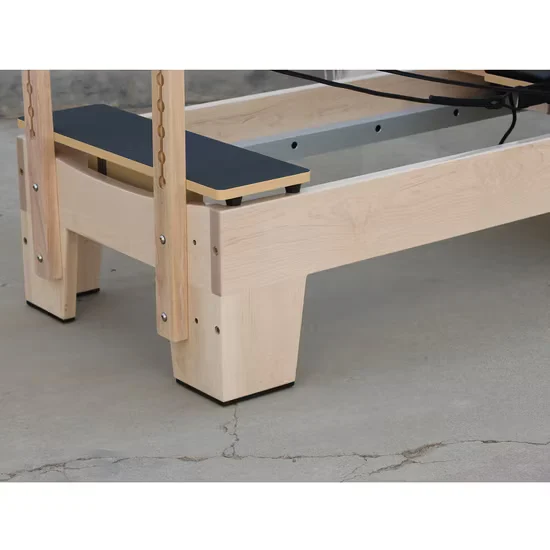
Inherent Acoustic Isolation — Solid wood construction naturally dampens vibration transmission, eliminating motor noise at the source for shared residential floors.
Technical Specifications
| Parameter | Value |
|---|---|
| Product Type | Pilates Reformer |
| Material | Wood |
| Color | Solid Color (Customizable) |
| Accessory Options | Long Box / Jump Board / Platform |
| Product Dimensions | 2460730680mm |
| Net Weight | 100kgs |
| Max User Weight | Not specified |
| Warranty | 3 Years |
| Production Capacity | 80 Pieces/Month |
| Age Group | Adult |
| Gender | Unisex |
| Customization | Logo, Color, Finish |
Application Suitability
| Deployment Scenario | Typical Use |
|---|---|
| Boutique Pilates studio | Brand-matched reformer deployment across multiple studio locations |
| Hotel wellness floor on guest room levels | Acoustic-sensitive environments where mechanical drive noise is unacceptable |
| High-end residential home gym | Furniture-grade aesthetics blending with interior design |
| Rehabilitation center | Low-impact movement programming with accessory-supported exercise variety |
| Corporate wellness room | Compact footprint supporting full reformer repertoire in limited square footage |
Why Acoustic Performance Defines Equipment Selection on Hotel Wellness Floors
Wood-body construction eliminates the motor and spring resonance that triggers noise complaints from occupied rooms below.
In my years doing on-site technical support across Southeast Asian hospitality projects, I’ve seen entire batches of steel-frame reformers returned after guests reported low-frequency vibration through ceiling structures. The wood pilates reformer bed machine commercial operators choose must address acoustic transmission at the material level — not through aftermarket dampening pads applied too late. Wood naturally absorbs the carriage movement energy that steel reflects downward into floor slabs [NEED_CITE: acoustic transmission characteristics of wood vs steel in fitness equipment frames].
Positioning Within a Mixed-Modality Studio Layout
This wood pilates reformer bed machine commercial studios deploy anchors the movement programming zone, covering full-range resistance work from rehabilitation-grade gentle loading through athletic jump board plyometrics. The unit complements cardio equipment by offering horizontal-plane strength work that treadmills and climbers cannot replicate.
The 2460mm length accommodates users across height ranges while the accessory ecosystem — long box for seated work, jump board for dynamic loading, platform for standing balance — enables complete session programming without additional equipment footprint. Studios maximize revenue per square meter when one reformer supports the full discipline repertoire. The wood pilates reformer bed machine commercial environments select should integrate visually with adjacent apparatus without dominating the visual field.
Continuous Session Turnover and Environmental Demands
Boutique studios running back-to-back classes from early morning through evening require equipment that maintains carriage smoothness across dozens of daily sessions. The solid wood frame handles continuous loading cycles while resisting the humidity fluctuations common in tropical deployments where air conditioning cycles create condensation risks [NEED_CITE: wood treatment requirements for fitness equipment in high-humidity environments].
Floor-level vibration transmission becomes critical when reformers sit above occupied spaces — guest rooms, offices, or residential units. Wood’s inherent dampening properties reduce structure-borne noise compared to steel frames that conduct carriage impact directly into concrete slabs. Deployment planning must account for ceiling height clearance during jump board work and adequate lateral spacing for instructor movement during group sessions.
Wood Frame Engineering and Spring Resistance Mechanics
The solid wood construction serves dual purposes: structural load-bearing across the 2460mm span and acoustic isolation through material density. Unlike steel that requires additional dampening layers, wood absorbs vibration energy internally, preventing resonance amplification during dynamic movements like jump board repetitions.
Spring-based resistance provides progressive loading that increases with carriage displacement — fundamentally different from magnetic or friction systems. This progression matches human force curves during pushing and pulling movements, requiring less adjustment during programming transitions. The carriage rail material directly impacts long-term smoothness; repeated high-frequency use demands rail surfaces that resist wear grooves which develop under continuous commercial session volumes.
Accessory attachment mechanisms — long box mounting points, jump board brackets, platform interfaces — must maintain structural integrity through thousands of attachment and removal cycles without developing play that compromises exercise precision.
The Hidden Costs of Specification Compromise
Steel-frame reformers marketed at commercial price points often reveal their true duty classification only after deployment, when spring anchor points develop fatigue cracks under continuous class turnover [NEED_CITE: structural fatigue patterns in commercial Pilates equipment under high-frequency use].
Noise complaints from occupied floors below wellness centers force operators into reactive replacement cycles — removing equipment, installing aftermarket isolation systems, and absorbing revenue loss during retrofit periods. Carriage rails that lack adequate hardness specifications develop wear patterns within months, creating the grinding sensations that signal premature equipment failure to experienced practitioners.
Accessory attachment points designed for light commercial volumes fail under studio scheduling that books sessions consecutively throughout operating hours, leaving operators with reformers that cannot safely support the full exercise repertoire.
Why This Product Line Addresses Deployment Pain Points
Sub-35dB acoustic performance verified across hospitality deployments means this reformer integrates into noise-sensitive environments without triggering guest complaints or residential disputes. The wood construction inherently achieves what steel frames require expensive aftermarket solutions to approximate.
Three-year warranty coverage on a 100kg solid wood unit signals confidence in structural durability under continuous commercial-class session volumes — operators need equipment that survives years of daily use without frame compromise. Full OEM customization including logo placement, color matching, and finish options enables brand-consistent deployment across multi-location studio chains where visual identity matters.
The complete accessory ecosystem ships from one source, eliminating compatibility questions between reformer frames and third-party attachments. Free 3D studio layout planning accounts for this unit’s footprint alongside complementary equipment, ensuring adequate spacing for instructor circulation and participant safety during dynamic movements.
Documentation & Test Records
- CE declaration of conformity for European market compliance
- EN 957 test report covering structural load and safety requirements
- ISO 9001 certificate verifying manufacturing quality management systems
- Wood material specification sheet with moisture resistance and load-bearing data
- Spring tension range documentation for programming consistency verification
- Accessory attachment mechanism durability test records under commercial volumes
Installation, Commissioning & Maintenance
- Confirm 2460*730mm footprint with adequate lateral clearance for instructor movement during group sessions
- Level floor surface before placement; wood frame requires even support across full length to prevent stress concentration
- Verify ceiling height clearance accommodates jump board exercises with participant arm extension overhead
- Inspect carriage rail smoothness upon delivery and establish monthly wear assessment schedule
- Lubricate carriage wheels and spring attachment points per manufacturer interval specifications
- Clean wood surfaces with pH-neutral products only; avoid moisture accumulation in humid environments
Equipment Selection and Deployment Planning
Provide your studio square footage and target equipment count to receive a 3D layout incorporating this reformer’s dimensions alongside complementary apparatus. Specify your deployment environment — hotel wellness floor, standalone studio, residential integration — to confirm acoustic isolation requirements match your adjacent occupied spaces.
Indicate your target market for wood treatment specifications addressing local humidity conditions and your brand requirements for OEM customization scope including logo placement and finish matching.
Frequently Asked Questions
Q: How does wood frame construction compare to steel for long-term durability in commercial settings?
A: Solid wood frames naturally dampen vibration and resist the resonance amplification that steel transmits to floor structures. For environments where equipment sits above occupied spaces — hotel guest rooms, office floors, residential units — wood’s acoustic properties eliminate the low-frequency complaints that force reactive equipment replacement. The three-year warranty on this 100kg unit reflects structural confidence under continuous commercial session turnover.
Q: What maintenance does the carriage rail system require under high-frequency studio use?
A: Carriage rails develop wear patterns based on material hardness and wheel composition. Monthly inspection identifies groove formation before it creates the grinding sensations practitioners notice immediately. Lubrication intervals depend on session volume; studios running consecutive classes daily need more frequent attention than lower-volume deployments. Rail replacement represents significant downtime, making initial material specification critical.
Q: Can the reformer support the complete accessory set without structural compromise?
A: The wood frame accommodates long box, jump board, and platform attachments simultaneously without requiring disassembly between programming transitions. Attachment mechanisms are engineered for repeated mounting cycles — essential when studios schedule diverse class formats throughout operating hours. The frame’s load distribution maintains stability during dynamic jump board work while supporting static long box positions.
Q: What wood treatment addresses humid environments or high-traffic studio conditions?
A: Tropical deployments and facilities with aggressive HVAC cycling create condensation risks that compromise untreated wood. Specify moisture-resistant treatment during ordering for environments where humidity fluctuates significantly. Surface finish selection also impacts daily cleaning protocols — studios need products that maintain appearance despite frequent sanitization between sessions without degrading the protective coating.
Q: What customization scope is available for multi-location studio chains requiring brand consistency?
A: Logo placement, color matching, and finish options enable visual identity maintenance across locations. Production capacity of 80 pieces monthly supports multi-unit orders without extended lead times. Specify your brand requirements during inquiry to confirm customization feasibility and receive samples verifying finish accuracy before committing to full deployment orders.
![Reformer Pilates Equipment Fitness White Pilates Reformer MachineCommercial Pilates Reformer Machine for Studio Use [WARN] draft identifier mismatch](https://bicksport.com/wp-content/uploads/2026/08/reformer-pilates-equipment-fitness-white-pilates-reformer-machinecommercial-pilates-reformer-machine-for-studio-use-warn-draft-identifier-mismatch-4815c3.webp)


