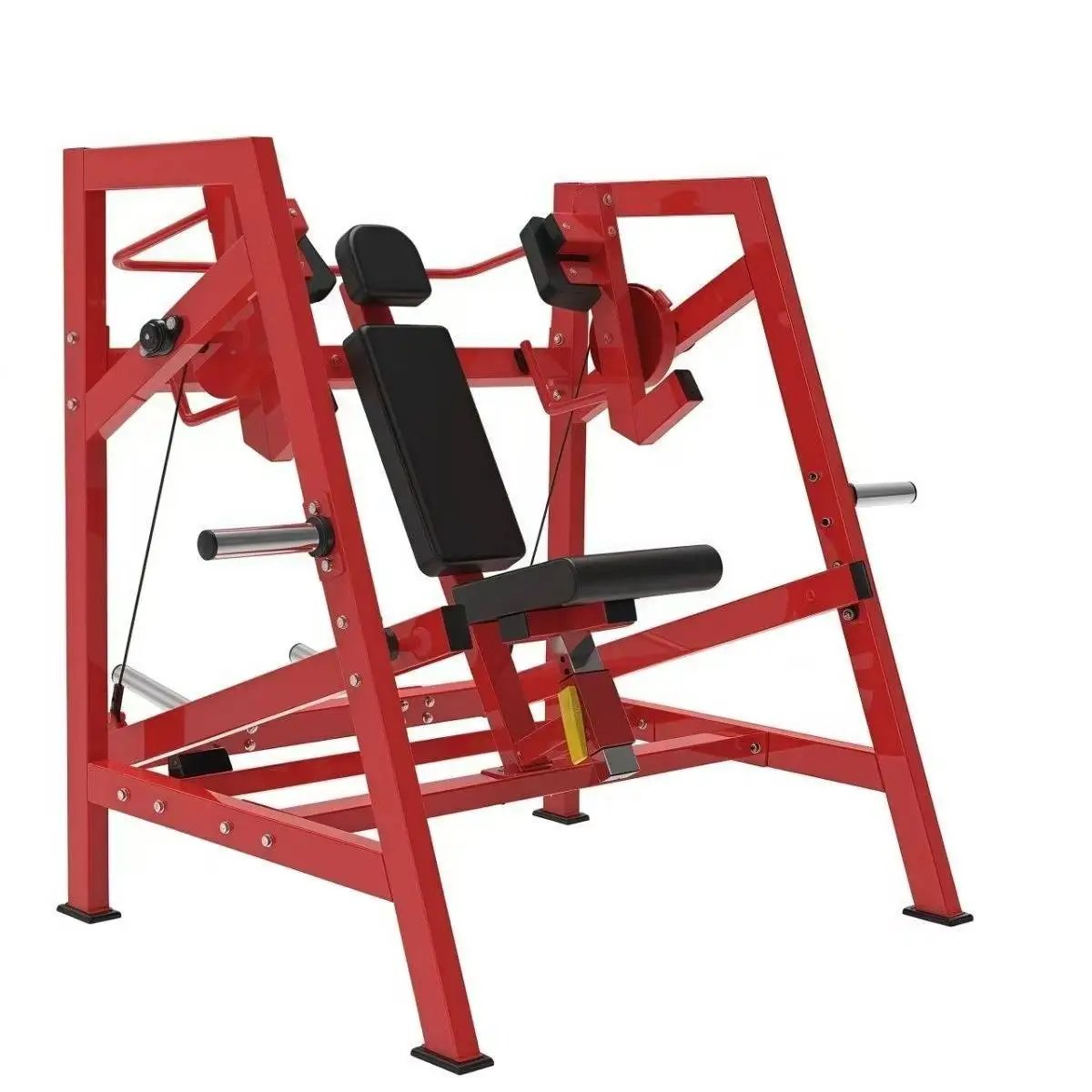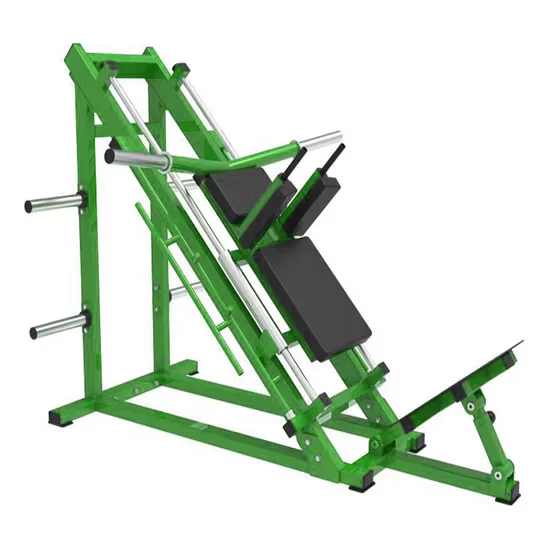
Heavy-Duty Linear Motion — The 250kg steel frame and sealed bearing linear track system maintain structural rigidity and smooth barbell path under maximum plate-loaded stress.
Technical Specifications
| Parameter | Value |
|---|---|
| Designation | H5038 |
| Product Name | Linear Hack Press Machine |
| Power Source | Manual (Plate Loaded) |
| Exercise Part | Leg |
| Frame Material | Steel |
| Product Dimensions | 2375 × 1500 × 1475 mm |
| Net Weight | 250 kg |
| Foldable | No (Unfolded) |
| Target User | Adult, Unisex |
| Certification | ISO 9001, CE |
| Production Capacity | 500 PCS/Month |
Application Suitability
| Deployment Scenario | Typical Use |
|---|---|
| Chain gym strength zone | High-frequency leg training integrated with squat racks and leg press units |
| Community fitness center | Low-maintenance plate loaded operation for unsupervised or minimal-staff environments |
| Corporate wellness room | Quiet manual loading suitable for shared commercial floors with adjacent office spaces |
| High-end residential home gym | Zero electrical noise for sound-sensitive multi-unit residential buildings |
| Sports performance training center | Athlete-grade linear resistance for controlled compound leg development |
Why Plate Loaded Beats Motorized for Strength Equipment Longevity
Manual plate loaded design eliminates the single largest failure point in commercial strength equipment: electrical components.
In facilities running sixteen-hour days, motorized resistance systems accumulate heat and wear that compound into premature failures. A burned-out motor on a leg press does not just mean one machine down — it means member complaints, emergency service calls, and revenue loss across the entire strength zone. The commercial linear hack press machine plate loaded architecture sidesteps this entirely. There is no motor to overheat, no circuit board to short, no software to crash during peak hours [NEED_CITE: failure rate comparison between plate loaded and motorized commercial strength equipment]. The H5038 relies on gravity and physics, which do not require firmware updates or replacement parts on a maintenance schedule.
Where the H5038 Fits in a Commercial Strength Zone
This linear hack press machine targets the compound leg training segment, bridging the gap between free-weight squats and machine-isolated leg presses. It complements squat racks by offering a guided linear path that reduces stabilizer demand, making it appropriate for members working through rehabilitation or learning proper pressing mechanics. In a typical facility layout, the H5038 occupies a position between free-weight stations and cable machines, fitting into the heavy-load training corridor. The 2375 × 1500 mm footprint requires adequate clearance on all sides for plate loading and safe exit. The commercial linear hack press machine plate loaded configuration suits users across a broad anthropometric range thanks to adjustable shoulder pad positioning and the open-entry sled design.
Continuous Operation and Facility Environment Requirements
Because this unit runs entirely on manual plate loading, daily throughput is limited only by member traffic flow rather than motor duty cycles or thermal thresholds. The 250 kg steel frame anchors the machine firmly, but the linear track system still demands a level floor to prevent binding under asymmetric loads. Facilities deploying the H5038 on upper floors benefit from the absence of motor vibration, though impact from dropped plates on the sled still requires rubber flooring or vibration-dampening mats beneath the unit [NEED_CITE: structural vibration transmission standards for plate loaded equipment on elevated floors]. Adequate overhead clearance must account for the 1475 mm frame height plus user range of motion at full extension. The machine produces no electrical heat output, simplifying HVAC calculations in enclosed strength rooms.
Decoding the Steel Frame and Linear Track Engineering
The 250 kg net weight of the H5038 is not merely a shipping figure — it reflects the mass of reinforced steel tubing required to resist lateral deflection when users load heavy plates on one side of the sled. A lighter frame would introduce torsional flex during off-center pressing, accelerating bearing wear and creating an unsafe bar path. The linear track and sealed bearing system replaces traditional pivot-arm hack press geometry with a straight-line sled motion, reducing shear forces on the knee joint by maintaining a consistent angle of resistance throughout the range of motion. Sealed bearings eliminate the need for periodic lubrication that open bushings demand, which matters in high-throughput commercial gyms where maintenance windows are tight. The manual plate loaded interface accepts standard Olympic plates, ensuring compatibility with existing gym inventory without requiring proprietary weight stacks or selectorized mechanisms.
What Cutting Corners on Frame Mass Actually Costs
Facilities that purchase lighter plate loaded machines to save on upfront cost and shipping weight frequently encounter frame resonance under heavy loads — a harmonic vibration that travels through the floor and into adjacent spaces. Over months, this vibration loosens weld joints and accelerates bearing degradation, turning a capital investment into a recurring repair line item [NEED_CITE: structural fatigue patterns in lightweight commercial strength frames under cyclic loading]. Insufficient frame mass also means the machine shifts slightly during aggressive pressing sets, forcing members to compensate for movement that should be impossible on properly engineered equipment. The resulting loss of confidence in the machine leads to underutilization, and an underused machine occupies premium floor space that could serve higher-traffic equipment.
Why This Product Line Delivers for Commercial Operators
Every H5038 frame undergoes load testing that verifies structural integrity under continuous high-frequency use, matching the 10,000-hour durability standard applied across the Biketon Sport commercial range. The linear track and sealed bearing assembly is validated for smooth operation through thousands of cycles, ensuring the commercial linear hack press machine plate loaded maintains its bar path accuracy long after initial deployment. The manual design means zero electrical components to source, stock, or replace — a meaningful reduction in spare parts inventory for facility managers. Biketon Sport provides 3D strength zone layouts that account for the H5038 footprint, plate loading clearance, and member traffic flow between adjacent equipment. Full OEM customization covers frame color, logo placement, and pad upholstery to match facility branding. Technical support responds around the clock for commissioning questions or maintenance guidance.
Documentation & Test Records
- CE declaration of conformity for the H5038 plate loaded linear hack press
- EN 957 test report verifying structural safety under maximum rated load
- ISO 9001 certificate covering manufacturing quality management systems
- Noise level test report confirming zero electrical noise output during operation
- Durability test record documenting linear track and bearing cycle validation
- Installation and commissioning guide with spare parts list
Installation, Commissioning & Maintenance
- Maintain minimum 800 mm clearance on all sides of the 2375 × 1500 mm footprint for safe plate loading and member passage
- Install on a level reinforced floor with rubber vibration mats beneath the 250 kg frame to dampen plate impact transmission
- Inspect sealed bearings quarterly for smooth sled travel and replace only if grit ingress is detected
- Verify all frame bolts and weld joints after the first 500 cycles of use, then at standard six-month intervals
- Wipe down shoulder pads and back rest after each use to prevent sweat corrosion on upholstery and steel contact points
Planning Your Strength Zone Equipment Selection
Provide your strength zone square footage and target equipment list to receive a 3D layout plan that accounts for H5038 clearance requirements and member traffic flow. Specify daily operating hours and expected peak-hour member count so we can confirm this plate loaded unit suits your throughput demands. Identify the deployment floor and adjacent occupied spaces to verify acoustic compatibility with the manual loading design. State your target market to ensure all labeling and documentation meets local regulatory requirements.
Frequently Asked Questions
Q: Why choose plate loaded over selectorized pin-loaded resistance for a hack press?
A: Plate loaded systems eliminate cables, pulleys, and weight stack guide rods that wear under commercial use. Maintenance reduces to periodic bearing inspection and bolt torque checks. Operators avoid the cost and downtime of replacing snapped cables or worn selector pins, and members can load exact weights without being limited by fixed stack increments.
Q: What maintenance does the linear track and sealed bearing system require?
A: Sealed bearings are designed to run without periodic lubrication, unlike open bushings that need regular greasing. Quarterly visual inspection for smooth sled travel and absence of grit or corrosion is sufficient. If bearing roughness is detected during inspection, replacement cartridges are standard industrial sizes available through common supply channels.
Q: How does the 250 kg frame weight contribute to training safety?
A: Frame mass directly resists torsional flex and lateral shift during loaded pressing sets. A lighter frame can resonate or rock under heavy asymmetric loads, compromising the linear bar path and forcing the user to stabilize the machine instead of focusing on the movement. The H5038 mass keeps the sled path consistent throughout every repetition.
Q: How should the H5038 be positioned relative to cardio and free-weight zones?
A: Place the H5038 in the dedicated strength corridor, separated from cardio equipment by a buffer zone to prevent plate noise from disturbing treadmill and bike users. Ensure the loading side faces away from high-traffic walkways so members can load and unload Olympic plates without obstructing the primary member circulation path.
Q: What does ISO 9001 and CE certification actually verify for this machine?
A: ISO 9001 confirms that the manufacturing process — from steel cutting through welding, assembly, and testing — follows documented quality management procedures with traceable inspection records. CE marking demonstrates conformity with European health, safety, and environmental protection requirements, including EN 957 structural testing for commercial fitness equipment load capacity and stability.