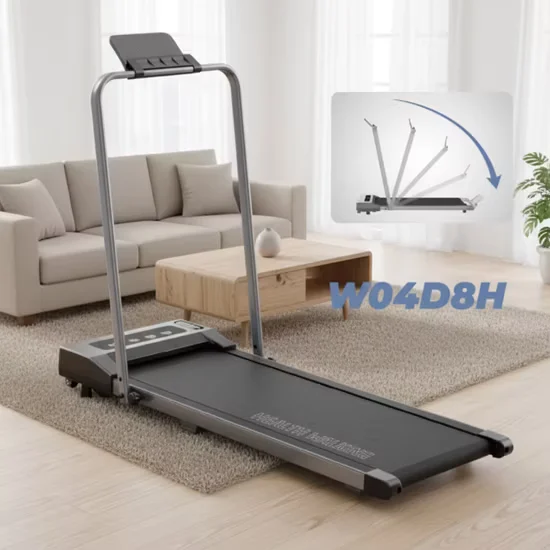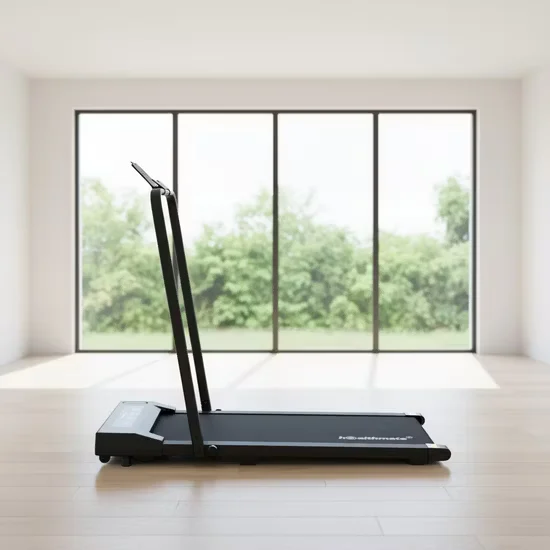
Quiet Operation — Compact foldable treadmill tested for continuous home use with verified low-decibel output and full CE compliance.
Technical Specifications
| Parameter | Value |
|---|---|
| Designation | W04D8H |
| Product Type | Foldable Treadmill |
| Motor Type | DC Motor |
| Speed Range | 1–12 km/h |
| Running Surface | 1000 × 400 mm |
| Console Type | LED Screen |
| Console Display | Speed / Distance / Time / Calories |
| Preset Programs | 6 |
| Product Dimensions | 1250 × 590 × 1080 mm |
| Foldable | Yes |
| Maximum Speed | <15 km/h |
| Certification | CE, RoHS |
| Condition | New |
Application Suitability
| Deployment Scenario | Typical Use |
|---|---|
| High-end residential home gym | Daily walking and jogging routines in private fitness spaces |
| Compact apartment workout area | Space-saving cardio sessions with fold-away storage between uses |
| Corporate wellness room | Light-to-moderate walking and jogging for employee fitness breaks |
| Shared residential fitness space | Multi-user walking and light jogging with quiet operation for communal areas |
Why Noise Complaints Reach the Front Desk Before Maintenance Does
Acoustic performance determines whether a home treadmill stays in daily rotation or gets abandoned.
When cardio equipment runs above or beside living spaces, low-frequency vibration travels through floor slabs faster than airborne sound. I have pulled entire batches back from hotel guest floors because the damping layer was insufficient for overnight use — residents hear the rhythmic thump before they hear the motor. A foldable treadmill home use LED console setup must address structure-borne noise at the deck and frame junction, not just motor acoustics. The W04D8H targets apartment and residential deployments where a neighbor’s ceiling is your running surface’s floor [NEED_CITE: structural vibration transmission thresholds for residential cardio equipment deployment].
Walking and Light Jogging Coverage in Compact Spaces
This unit covers steady-state walking through moderate jogging at speeds up to 12 km/h, fitting the most common home cardio zone. In a small residential gym, it pairs with a stationary bike or resistance station so users alternate impact modalities without leaving the room. The 1000 × 400 mm running surface accommodates walking and light jogging for average-build adults, while the foldable frame allows the footprint to collapse when the space serves other functions. The LED console tracks speed, distance, time, and calorie estimates across six preset programs, giving users structured variety without external device dependency. This foldable treadmill home use LED console configuration suits daily routines rather than high-intensity interval work.
Continuous Run-Time and Room-Level Deployment Constraints
A home-grade DC motor in this class is rated for intermittent sessions rather than back-to-back commercial shifts; plan deployment around individual or family usage patterns of one to two hours per day. Place the unit on a level surface with a vibration-damping mat beneath the frame to limit structure-borne transmission to rooms below or adjacent. Adequate clearance on all sides supports passive cooling around the motor housing during extended walks. Standard household voltage powers the unit, but confirm the plug type matches the target market before the shipment leaves the warehouse [NEED_CITE: voltage and plug standard variations across export markets for home fitness equipment]. Ensure the room has basic airflow — a closed apartment bedroom with windows sealed will trap heat around the motor and shorten component life.
Decoding the Drive and Control Specifications
The DC motor driving this foldable treadmill home use LED console unit delivers adequate torque for walking and jogging within the 1–12 km/h envelope. DC motors in home-class treadmills offer smooth speed ramp-up and lower idle noise compared to AC induction motors, though they carry lower continuous duty ratings — a trade-off that aligns with residential usage patterns. The LED console prioritizes readability and reliability over feature density: speed, distance, time, and calorie figures are displayed without touchscreen complexity that can fail in humid environments. Six preset programs introduce pace variation, preventing the monotony that leads users to abandon home equipment within months. The 1000 × 400 mm belt provides sufficient length for walking strides; taller users approaching jogging speeds may notice the surface limit. Folding the deck vertically reclaims floor area — a mechanical joint that must be inspected periodically for wear [NEED_CITE: folding mechanism durability standards for residential treadmills].
What Spec-Sheet Compromise Costs After Month Six
Specifying a treadmill purely on price and foldable convenience invites predictable failures. A motor undersized for even moderate daily sessions will overheat, its insulation degrading until the unit trips thermal protection mid-run. Insufficient deck cushioning transmits repetitive impact to ankles and knees, and users who feel joint discomfort simply stop using the machine — the most expensive treadmill is the one gathering dust. When the console cannot display meaningful feedback or the data it shows drifts from actual output, users lose confidence and revert to outdoor routes. Voltage mismatches discovered after delivery mean containers sit at port while adapters are sourced, delaying deployment and eroding buyer trust [NEED_CITE: common import compliance failures for fitness equipment in residential markets].
Why This Product Line Fits the Brief
The W04D8H foldable treadmill home use LED console model is positioned where acoustic discretion and space efficiency matter most. Each unit passes the factory’s durability and noise verification protocols before shipping. The complete cardio family — treadmills, bikes, ellipticals, rowers, stair climbers, and spin bikes — means a residential gym or apartment fitness room sources every discipline from one engineering line, simplifying spare-parts logistics. OEM customization covers color, branding, and console UI adjustments at flexible minimums. The facility planning team provides 3D layout renderings that account for this unit’s folded and unfolded footprint, sightlines, and user flow within compact rooms. Post-delivery, the technical support team responds around the clock for commissioning questions and spare-parts coordination.
Documentation & Test Records
- CE declaration of conformity confirming European safety compliance for the W04D8H
- RoHS compliance certificate verifying restricted substance limits in electronic components
- Noise level test record documenting acoustic output under loaded running conditions
- Motor specification sheet detailing rated output and thermal protection thresholds
- LED console technical documentation covering display parameters and program logic
- Installation and commissioning guide with foldable mechanism inspection checklist
Installation, Commissioning & Maintenance
- Allow clearance around the 1250 × 590 mm footprint for safe mounting and dismounting on all sides
- Place a vibration-damping mat beneath the frame to reduce structure-borne transmission to floors below
- Confirm household voltage and plug type match the unit’s power requirement before first energization
- Run the belt at low speed for initial alignment check and verify LED console displays all data fields
- Inspect the folding mechanism pivot points and lubricate per the maintenance schedule in the commissioning guide
- Wipe the running surface and console housing after each session to prevent sweat corrosion on metal and electronic contacts
Planning Your Equipment Inquiry
Provide the room dimensions and intended unit count so the planning team can generate a 3D layout showing this foldable model’s footprint in both stored and deployed positions. State the expected daily session length and number of users to confirm the motor duty cycle matches the deployment. Specify the floor level and adjacent room types — a unit above a bedroom demands stricter acoustic attention than one in a basement gym. Confirm the target market’s voltage and plug standard to avoid post-shipment rework. Indicate whether the LED console data needs to interface with any facility management or wellness tracking system.
Frequently Asked Questions
Q: How does a foldable treadmill compare to a fixed-frame model for home deployment?
A: A foldable treadmill reclaims floor area when not in use, which matters in apartments and multi-purpose rooms. Fixed-frame models generally offer larger running surfaces and heavier frames suited to daily high-intensity training. The foldable design suits walking and light jogging routines where space efficiency is the priority and usage intensity stays within the motor’s continuous rating.
Q: Can the LED console connect to external fitness apps or facility systems?
A: The LED console on this model displays speed, distance, time, and calorie data locally without wireless connectivity. Facilities requiring app sync or data export should explore the commercial console options in the broader product line, which offer IoT-enabled touchscreens with workout analytics and management software integration.
Q: What is the difference between peak and continuous motor output on a home treadmill?
A: Peak output describes the maximum power the motor can deliver in short bursts, such as during acceleration. Continuous output reflects the sustained power available during extended sessions. For daily home use, continuous output is the relevant figure — a motor rated only by peak power may overheat during longer walks or jogs.
Q: Is the 1000 × 400 mm running surface adequate for adult users?
A: This surface accommodates walking and light jogging for most adults comfortably. Users taller than average or those preferring sprint-style running may find the length and width restrictive. For dedicated running programs, a larger commercial-class belt surface is recommended to support longer stride patterns safely.
Q: What maintenance does the foldable mechanism require over time?
A: The folding pivot points should be inspected periodically for looseness and lubricated according to the schedule in the commissioning guide. The running belt requires periodic tension checks and surface lubrication. Keeping the motor housing free of dust buildup supports thermal performance and extends the interval between service calls.
![Hsm Motorized Treadmill for Elderly Use [WARN] draft identifier mismatch](https://bicksport.com/wp-content/uploads/2026/08/hsm-motorized-treadmill-for-elderly-use-warn-draft-identifier-mismatch-8bee3e.webp)
![Healthmate Electric Walking Treadmill for Home Gym Use [WARN] draft identifier mismatch](https://bicksport.com/wp-content/uploads/2026/08/healthmate-electric-walking-treadmill-for-home-gym-use-warn-draft-identifier-mismatch-ef17bb.webp)
![MT296 Electric Home Gym Treadmill with Low Noise DC Motor for Fitness Training [WARN] draft identifier mismatch](https://bicksport.com/wp-content/uploads/2026/08/mt296-electric-home-gym-treadmill-with-low-noise-dc-motor-for-fitness-training-warn-draft-identifier-mismatch-0cf462.webp)