
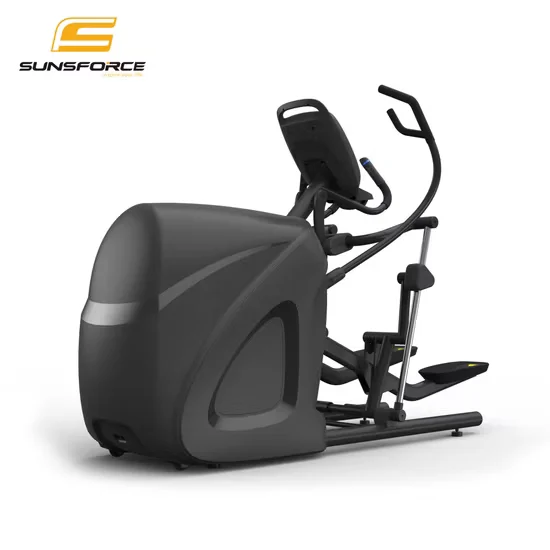
Whisper-Quiet Magnetic Resistance — 25-level magnetic system with 240kg reinforced frame verified for sub-35dB operation across noise-sensitive hotel and residential deployments.
Technical Specifications
| Parameter | Value |
|---|---|
| Designation | CTC60-T |
| Product Type | Elliptical Trainer |
| Resistance Type | Magnetic |
| Resistance Levels | 1-25 |
| Stride Grade | 1-10 |
| Step Depth Grade | 1-15 |
| Pedal Center Distance | 230mm |
| Max User Weight | 180kg |
| Console Type | 10.1" Touch Screen |
| Product Dimensions | 2120 x 790 x 1680mm |
| Net Weight | 240kg |
| Foldable | Unfolded |
| Certification | ISO 9001, CE, EN 957, RoHS |
Application Suitability
| Deployment Scenario | Typical Use |
|---|---|
| Hotel fitness center on guest room floors | 24-hour guest access with minimal noise transmission to adjacent rooms |
| Chain gym cardio zone | High-frequency member use with smart console data integration |
| Corporate wellness room | Employee fitness sessions during break periods with app-synced tracking |
| High-end residential home gym | Shared household use where acoustic performance is a priority |
| Sports performance training center | Athlete conditioning with precise resistance gradation and biometric feedback |
Why Acoustic Performance Dictates Equipment Placement in Commercial Floors
Magnetic resistance eliminates mechanical contact noise at the source, keeping output below thresholds that trigger guest complaints.
When cardio zones sit directly above or beside occupied hotel rooms, low-frequency vibration from friction-based and belt-driven systems transmits through floor slabs and registers as persistent hum during nighttime hours. Front desk teams log these complaints before maintenance even notices the fault, and the typical resolution is a full equipment swap to magnetic alternatives. The CTC60-T commercial magnetic elliptical trainer 10.1 inch touch screen console model addresses this by removing physical contact from the resistance mechanism entirely. Facility operators who have experienced batch replacements understand that acoustic specifications on paper must match real-world deployment conditions under continuous load [NEED_CITE: structural vibration transmission from cardio equipment through concrete floor slabs].
Cardio Zone Positioning and Member Flow Integration
This elliptical trainer covers low-impact steady-state and high-intensity interval modalities across 25 resistance levels, fitting between treadmill banks and strength areas where joint-friendly options anchor the cardio sequence. The 10.1" touchscreen delivers workout analytics and entertainment streaming, keeping users engaged without requiring external device mounting. At 2120mm length and 790mm width, the unit fits standard commercial spacing grids with adequate clearance for ingress and egress. The 180kg maximum user weight and 230mm pedal center distance accommodate a broad range of body types, while the step depth and stride grade adjustments allow users to shift emphasis across lower-body muscle groups. The commercial magnetic elliptical trainer 10.1 inch touch screen console configuration supports facility management software sync so usage data feeds directly into operational dashboards.
Continuous Duty Cycles and Environmental Requirements
A 24-hour hotel fitness center demands equipment that sustains operation across overlapping guest usage windows without thermal degradation or acoustic drift. The 240kg reinforced steel frame anchors the unit against resonant oscillation during high-cadence intervals, while sealed bearings maintain rotational consistency over extended run-times. Deployment on upper floors requires verified sub-35dB performance under load, not just idle readings, because structural coupling amplifies low-frequency harmonics that lighter frames produce. Adequate clearance around the rear and sides supports passive airflow for motor cooling, and the designated circuit must match regional voltage standards before the container ships [NEED_CITE: continuous duty cycle classification for commercial cardio motors in high-frequency facilities]. Ground leveling and isolation pads further decouple the frame from slab transmission, particularly in timber-frame residential conversions.
Magnetic Drive Engineering and Console Data Architecture
Magnetic resistance operates through adjustable proximity between magnets and a flywheel, generating opposing force without physical contact or friction material wear. This absence of contact eliminates the belt replacement cycles and pad adjustments that friction systems require, reducing scheduled maintenance to periodic bearing inspection. The 25-level resistance range provides fine gradation for progressive overload programming, while the 1-10 stride grade and 1-15 step depth grade allow biomechanical variation without mechanical reconfiguration. The 10.1" touchscreen console integrates IoT connectivity for real-time workout analytics, virtual coaching prompts, and entertainment streaming, with API-level data output available for facility management platforms. Heart rate monitoring feeds into the console for interval programming, though chest strap pairing offers higher fidelity than grip sensors during high-sweat sessions. The 230mm pedal center distance maintains natural hip alignment, reducing lateral stress that narrower stances impose on the knee joint over sustained sessions.
The Operational Cost of Underspecified Equipment
Facilities that specify light-commercial equipment for high-traffic environments encounter premature motor winding failure when duty cycles exceed design tolerances, leading to replacement costs and member attrition during downtime. Noise complaints in hotel deployments frequently trace back to friction-based resistance systems installed on guest room floors, where low-frequency transmission becomes audible in adjacent rooms during early morning and late night hours. Console systems lacking API integration strand usage data on local storage, preventing operators from tracking utilization patterns or scheduling preventive maintenance based on actual run-hours. Voltage and plug mismatches discovered after container arrival delay commissioning and incur rewiring expenses that cascade across multi-unit orders [NEED_CITE: voltage standard mismatches in international fitness equipment deployment].
Engineering Verification Across the Product Line
Every unit undergoes sub-35dB acoustic verification under loaded operation, not idle bench tests, ensuring that hotel and residential deployments meet acoustic thresholds before commissioning. The 10,000-hour durability protocol cycles the magnetic resistance system, frame joints, and bearing assemblies through continuous high-frequency use profiles representative of commercial gym and hotel fitness center environments. The 10.1" IoT console supports OEM customization of user interface layouts, branding elements, and color schemes so that international gym chains can maintain visual consistency across locations. Full six-series cardio coverage allows facilities to source treadmills, bikes, rowers, and climbers from one engineering platform, simplifying spare parts inventory and maintenance training. The free 3D cardio-zone layout service addresses CTC60-T placement alongside adjacent units with airflow corridors and sightline considerations factored into the floor plan. Technical support responds around the clock to commissioning queries and operational troubleshooting across export markets.
Documentation & Test Records
- CE declaration of conformity covering electrical safety and electromagnetic compatibility
- EN 957 test report validating structural integrity and performance under commercial load profiles
- ISO 9001 certificate covering manufacturing quality management systems
- RoHS compliance documentation confirming restriction of hazardous substances
- Noise level test report recording acoustic output under loaded continuous operation
- Durability test record documenting 10,000-hour motor, frame, and bearing performance
Installation, Commissioning & Maintenance
- Maintain minimum clearance per product dimensions for safe ingress, egress, and rear airflow
- Level the 240kg frame on isolation pads to decouple vibration from floor slab transmission
- Verify voltage and plug configuration against regional standards before energizing the motor
- Calibrate magnetic resistance gradation and stride adjustment during initial commissioning sequence
- Inspect sealed bearings and pedal fasteners per scheduled maintenance intervals
- Configure 10.1" console firmware and API endpoints for facility management system integration
Equipment Selection and Deployment Planning
Provide your cardio zone square footage and planned unit count to receive a 3D layout addressing CTC60-T spacing, airflow corridors, and member traffic flow. Specify average daily operating hours so that motor duty-cycle requirements align with your facility’s usage patterns. Identify the deployment floor and adjacent occupied spaces to confirm that acoustic performance meets local thresholds. State your target market voltage and plug standard so that electrical configuration is validated before production. Indicate whether the 10.1" console must integrate with existing facility management software or member-facing applications for data synchronization.
Frequently Asked Questions
Q: How does magnetic resistance compare to friction systems in noise output and maintenance requirements?
A: Magnetic resistance generates opposing force through adjustable magnet proximity to the flywheel without physical contact, eliminating belt wear, pad replacement, and friction-induced noise. This produces noticeably quieter operation suitable for noise-sensitive environments like hotel guest floors and shared residential spaces. Maintenance reduces to periodic sealed bearing inspection rather than the recurring friction material adjustments that contact-based systems demand under continuous commercial use.
Q: Can the 10.1" touchscreen console integrate with third-party facility management software?
A: The IoT-enabled console supports API-level data output for workout analytics, usage tracking, and member app synchronization. Compatibility with specific facility management platforms depends on interface protocol alignment, so we provide console technical documentation detailing data structure and connection requirements. Operators should verify integration parameters during the specification phase before production commences to ensure seamless operational data flow.
Q: What is the difference between continuous duty and peak power ratings for commercial deployment?
A: Peak power ratings describe maximum instantaneous output during brief demand spikes, while continuous duty ratings reflect sustained thermal and mechanical performance under prolonged operation. Commercial gym and hotel fitness center environments demand equipment rated for continuous duty because overlapping user sessions prevent motor cooling intervals. Specifying based on peak ratings alone risks premature winding failure when actual run-hours exceed design tolerances [NEED_CITE: motor duty cycle standards for commercial cardiovascular equipment].
Q: How does the 240kg frame weight affect stability during high-intensity interval training?
A: The reinforced steel frame mass anchors the unit against resonant oscillation that lighter constructions produce during rapid cadence changes and high-resistance intervals. This inertia dampens low-frequency vibration before it transmits through the floor structure, which is particularly relevant for upper-floor hotel deployments where slab coupling amplifies harmonic transfer. The sealed bearing system maintains rotational consistency across the 180kg user weight capacity without mechanical play developing over sustained high-frequency use.
Q: What customization options are available under OEM and ODM programs?
A: Customization extends to console user interface layouts, branding elements, color schemes, and hardware specification adjustments to meet specific market requirements. The 10.1" touchscreen supports branded splash screens, customized workout program menus, and localized language configurations. Minimum order quantities remain flexible, and the OEM scoping phase addresses logo placement, finish selection, and electrical configuration before proforma invoice generation.
![Elliptical Gym Commercial Fitness Equipment Cross Trainer 10.1" Touch Screen [WARN] draft identifier mismatch](https://bicksport.com/wp-content/uploads/2026/08/elliptical-gym-commercial-fitness-equipment-cross-trainer-10-1-touch-screen-warn-draft-identifier-mismatch-7ec675.webp)
![Commercial Elliptical Walker for Cardio Training Fitness Equipment [WARN] draft identifier mismatch](https://bicksport.com/wp-content/uploads/2026/08/commercial-elliptical-walker-for-cardio-training-fitness-equipment-warn-draft-identifier-mismatch-a76814.webp)
