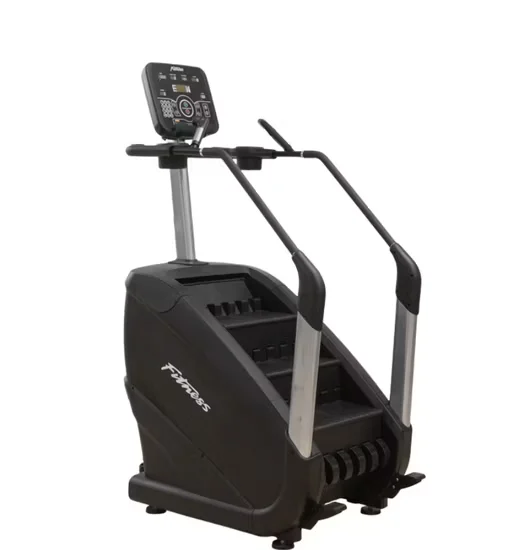
Continuous Motor-Driven Operation — SQ-1017 motor-driven stair climber engineered for 10,000-hour durability testing on motors, frames, and drive components.
Technical Specifications
| Parameter | Value |
|---|---|
| Designation | SQ-1017 |
| Product Type | Stair Climber |
| Drive Method | Motor Driven |
| Function | Electric |
| Speed Range | 15–164 Steps/Minute |
| Step Size | 560 × 235 × 220 mm |
| Maximum Load Capacity | 180 kg |
| Input Power Voltage | AC220V ±10% or AC110V ±10% |
| Screen Display | Time, Climb, Calories, Steps, Heart Rate |
| Material | Aluminium Alloy Pipe + PP Plastic |
| Product Dimensions | 1450 × 820 × 2080 mm |
| Net Weight | 206 kg |
| Gross Weight | 226 kg |
| Foldable | Unfolded |
| Certification | CE, RoHS, ISO |
Application Suitability
| Deployment Scenario | Typical Use |
|---|---|
| Hotel fitness center on guest room floors | 24-hour guest access with low-noise motor operation for rooms above and beside |
| Chain gym cardio zone | High-frequency daily sessions across interval and steady-state climbing programs |
| Corporate wellness room | Employee climbing sessions during shift breaks with heart rate tracking on console |
| High-end residential home gym | Personal climbing workouts in shared residential spaces requiring quiet operation |
| Sports performance training center | Athlete biometric sessions using real-time heart rate and step count metrics |
Why Motor Burnout Happens Before the First Warranty Claim Reaches Your Desk
SQ-1017 commercial stair climber motor driven design targets continuous duty cycles that outlast facility maintenance intervals.
Motors pulled from light-commercial treadmill or elliptical lines get dropped into stair climbers and run until thermal shutdown becomes a nightly event. Guests complain about grinding noises before maintenance staff ever see the work order. The root cause is duty cycle mismatch — a motor rated for intermittent home use cannot sustain the thermal load of eighteen-hour hotel gym operation [NEED_CITE: motor duty cycle classification for continuous commercial operation]. This commercial stair climber motor driven system addresses that failure point with electric step control rated for sustained high-frequency use across gym and hotel deployments.
Where This Stair Climber Fits in a Mixed Cardio Layout
The SQ-1017 covers continuous climbing motion across low-intensity warm-ups and high-cadence interval work from 15 to 164 steps per minute, filling the vertical-load gap that treadmills and ellipticals leave open in a commercial stair climber motor driven cardio zone. It complements steady-state machines by delivering sustained glute and quad activation without impact loading, suited to high-density placement along perimeter walls where ceiling height accommodates the 2080 mm frame. The 180 kg maximum user weight and aluminium alloy frame support the full demographic range of hotel guests and gym members without structural compromise.
Continuous Duty Expectations and What the Deployment Site Must Provide
Facilities running this unit sixteen or more hours daily should plan for dedicated circuit isolation at the specified AC220V or AC110V input, preventing voltage sag from adjacent equipment on shared lines [NEED_CITE: EN 957 requirements for commercial cardio equipment]. The 206 kg net mass requires level flooring with vibration-dampening pads to prevent resonance transfer to occupied rooms below. Adequate lateral clearance supports airflow around the motor housing during sustained high-cadence sessions, and console data output should be evaluated against existing facility management software before deployment to confirm integration pathways.
Reading the Motor and Drive Specs Without Getting Misled
Motor-driven electric step control eliminates the resistance drift that mechanical friction systems develop as components wear across thousands of cycles. The speed range of 15 to 164 steps per minute covers both rehabilitation-paced climbing and athletic interval programming without requiring mechanical gear changes mid-session. Dual-voltage input at AC220V or AC110V removes the post-shipment discovery of incompatible power standards — a deployment in North America runs on 110V while Middle East and European sites use 220V without unit modification. The console displays time, climb count, calories, steps, and heart rate, providing session analytics without relying on third-party wearable pairing. Aluminium alloy pipe construction with PP plastic shrouding keeps the 206 kg unit rigid under 180 kg user loads without the corrosion issues that mild steel frames develop in humid gym environments.
What Cutting Motor Specs Costs a Facility Within the First Year
Units specified on price alone arrive with motors rated for intermittent home duty, burning out under continuous commercial run-times and triggering batch replacement orders that exceed the original purchase savings [NEED_CITE: commercial cardio motor failure rates under continuous duty]. Noise complaints from occupied rooms directly above the cardio zone escalate into guest compensation and eventual equipment relocation. Voltage mismatches discovered after container arrival force transformer installations or return shipments that delay facility opening by weeks. Console units lacking data output leave usage metrics stranded, preventing operators from tracking equipment utilization across the cardio floor.
Why This Product Line Supports the Decision You Already Made
Sub-35dB operation verified in hotel deployments means this unit sits on guest room floors without generating noise complaints. Motors and drive components carry 10,000-hour durability test records confirming suitability for continuous commercial run-times. The six-series cardio family lets a facility source treadmills, bikes, ellipticals, rowers, and climbers from one manufacturing line with consistent console interfaces. Free 3D cardio zone layout and airflow planning accounts for the SQ-1017 footprint and spacing requirements alongside adjacent equipment. OEM customization covers console UI, color, and logo to match brand identity across franchise locations.
Documentation & Test Records
- CE declaration of conformity covering electrical safety and commercial fitness equipment directives
- EN 957 test report validating structural and mechanical performance under load
- ISO 9001 certificate confirming quality management across manufacturing processes
- RoHS compliance documentation for restricted substance limits in electrical components
- Motor specification sheet detailing continuous duty rating and thermal management design
- Console technical documentation with display parameter definitions and data output capabilities
Installation, Commissioning & Maintenance
- Position with minimum clearance around the 1450 × 820 mm footprint for safe user entry and exit
- Install vibration-dampening pads beneath the 206 kg frame to isolate resonance from floors below
- Connect to dedicated AC220V or AC110V circuit matching the specified ±10% voltage tolerance
- Verify step speed calibration across the 15–164 steps/minute range during first commissioning
- Inspect motor housing ventilation monthly to prevent thermal accumulation in high-humidity environments
- Clean console display and handrails daily with non-corrosive solution to prevent sweat damage
Request Equipment Selection Support
Provide your cardio zone square footage and planned unit count to receive a 3D layout and airflow plan covering equipment spacing and ventilation requirements. Specify expected daily operating hours so motor duty cycle can be matched to your facility’s traffic profile. Confirm target deployment country and voltage standard to ensure AC110V or AC220V configuration ships correctly. State whether console data must integrate with existing facility management software.
Frequently Asked Questions
Q: What is the practical difference between motor-driven and manual stair climbers in a commercial setting?
A: Motor-driven systems like the SQ-1017 use electric step control to maintain consistent speed regardless of user weight or fatigue, supporting interval programming with reliable cadence targets. Manual units rely on user momentum, which causes resistance drift and uneven loading across the step mechanism. For high-frequency commercial deployment, motor-driven designs deliver predictable maintenance intervals and consistent user experience across varying fitness levels.
Q: How do I confirm whether a motor rating reflects continuous output or just peak output?
A: Request the motor specification sheet from the manufacturer, which should list continuous duty rating separately from peak rating. Continuous rating reflects sustained thermal performance under load, while peak rating indicates short-burst capacity. For facilities operating sixteen or more hours daily, only the continuous rating matters for predicting motor lifespan and maintenance scheduling.
Q: Does the AC110V and AC220V dual specification mean the unit auto-switches between voltages?
A: The SQ-1017 ships configured for the target market voltage specified at order — AC220V for most European and Middle Eastern deployments, AC110V for North American sites. Confirm your facility voltage standard before shipment to avoid transformer requirements or return logistics after the container arrives at destination.
Q: What data does the console display, and can it connect to gym management systems?
A: The console displays time, climb count, calories, steps, and heart rate during sessions. For facilities requiring integration with management software, request console technical documentation to review available data output interfaces and confirm compatibility with your existing member tracking or usage analytics platform before finalizing equipment selection.
Q: Is this stair climber suitable for deployment on hotel floors with occupied rooms below?
A: Motor-driven electric step control operates at noise levels consistent with commercial cardio equipment tested for shared-space deployment. Facilities should install vibration-dampening pads beneath the frame and confirm floor structural capacity for the 206 kg unit weight plus 180 kg user load. Request the noise level test report to verify compliance with your property’s acoustic requirements.
![SQ1017 Commercial Stair Climber – Motor-Driven Stepmill for Gyms [WARN] draft identifier mismatch](https://bicksport.com/wp-content/uploads/2026/08/sq1017-commercial-stair-climber-motor-driven-stepmill-for-gyms-warn-draft-identifier-mismatch-340321.webp)
![SQ-1017 Stair Machine Climbing Stepper Fitness Equipment [WARN] draft identifier mismatch](https://bicksport.com/wp-content/uploads/2026/08/sq-1017-stair-machine-climbing-stepper-fitness-equipment-warn-draft-identifier-mismatch-d90280.webp)
![SQ1017 Commercial Stair Machine for Fitness Center Use [WARN] draft identifier mismatch](https://bicksport.com/wp-content/uploads/2026/08/sq1017-commercial-stair-machine-for-fitness-center-use-warn-draft-identifier-mismatch-ddfb48.webp)