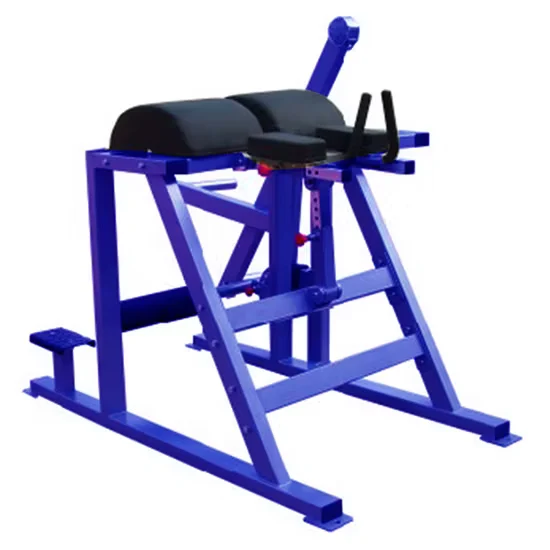
![Srh-71 Plate Loaded Squat Machine for Commercial Gym Use [WARN] draft identifier mismatch](https://bicksport.com/wp-content/uploads/2026/08/srh-71-plate-loaded-squat-machine-for-commercial-gym-use-warn-draft-identifier-mismatch-bbf084.webp)
Acoustic Stability Under Load — Welded iron frame and sealed bearing pivots keep the SRH-71 plate loaded squat machine tracking smoothly through high-rep sets without metallic rattle transferring to adjacent floors.
Technical Specifications
| Parameter | Value |
|---|---|
| Designation | SRH-71 |
| Product Type | Plate Loaded Squat Machine |
| Material | Iron |
| Product Dimensions | 1676 × 1700 × 1524 mm |
| Age Group | Adult |
| Gender | Unisex |
| Exercise Part | Waist / Lower Body |
| Appliance | Community, Gymnasium, Home |
| Max User Weight | 180 kg |
| Plate Compatibility | Olympic standard |
| Certification | RoHS, ISO 9001, CE |
| Production Capacity | 200 Pieces / Month |
Application Suitability
| Deployment Scenario | Typical Use |
|---|---|
| chain gym strength zone | primary squat station in high-traffic free-weight areas |
| hotel fitness center on guest room floors | low-noise lower-body training beside occupied rooms |
| corporate wellness room | compact footprint squat option for limited square footage |
| high-end residential home gym | garage or basement installation with Olympic plate storage |
| sports performance training center | heavy-load bilateral leg work for athlete programming |
Why Bearing Wear Shows Up as Noise Before It Shows Up as Failure
Sealed pivot bearings on a plate loaded squat machine protect the member experience long before they protect the maintenance budget.
Most strength equipment noise complaints trace back to dry bushings and unlubricated pivot points that develop play after months of loading and unloading cycles. In a hotel fitness center sitting above guest rooms, that metallic grind transmits through the floor slab long before a technician gets called [NEED_CITE: structural vibration transmission through concrete floor assemblies]. The SRH-71 uses sealed bearings at every pivot to keep the movement path consistent and quiet across thousands of repetitions. When a bushing-style pivot finally fails, it usually takes the frame weld with it because the wobble introduces lateral stress the weld was never designed to handle.
Where This Machine Sits in a Strength Zone Layout
The SRH-71 covers bilateral squat patterns and loaded lower-body work that pairs with isolation machines for complete leg programming. In a commercial plate loaded squat machine configuration, it anchors the free-weight section alongside leg presses and lunge stations, drawing users who prefer barbell-style loading over selectorized stacks. The 1676 × 1700 mm footprint fits standard commercial spacing grids, and the 180 kg user weight capacity accommodates the full range of member body types without requiring a separate heavy-duty SKU.
Continuous Loading Cycles and Deployment Environment Requirements
A squat station in a busy gym sees dozens of load-and-unload cycles per hour, with plates slammed on and off between sets. The iron frame must absorb that impact without developing fatigue cracks at the weld joints [NEED_CITE: fatigue testing protocols for plate loaded strength equipment frames]. Floor leveling matters here because an uneven base shifts the load path asymmetrically, accelerating wear on one side’s pivot bearings. Rubber matting under the unit dampens plate-drop vibration before it reaches the subfloor, which is critical for upper-floor hotel and residential deployments where structure-borne noise travels through concrete slabs.
What the Frame Geometry and Bearing Selection Actually Mean
The 1676 × 1700 × 1524 mm envelope gives the SRH-71 a wide base relative to its height, which lowers the center of gravity during loaded squats and reduces frame sway at peak extension. Iron construction provides the mass needed to resist tipping when Olympic plates are loaded unevenly. Sealed bearings at the pivot points eliminate the need for scheduled greasing — a maintenance task that often gets skipped in high-volume facilities until the noise becomes a complaint. The Olympic-standard plate interface means facilities stock one plate format across their entire strength zone, avoiding the confusion of mixed proprietary and standard peg sizes.
What Underspecifying a Squat Station Costs Over Time
A frame that flexes under heavy loads will develop micro-cracks at stress points, and those cracks propagate faster in a commercial environment where the machine never truly rests between peak hours. Members notice the wobble before maintenance does, and they route around the station — which means the remaining squat stations absorb the displaced traffic and wear out faster [NEED_CITE: equipment utilization imbalance in commercial strength zones]. Dry bushings that should have been sealed bearings from the start generate noise complaints that force after-hours lockouts, cutting into the revenue window of a 24-hour facility.
Why This Line Earns Its Placement
Every unit in the six-series cardio and strength family is tested through 10,000 hours of continuous high-frequency operation so facility operators see consistent performance across the floor. The SRH-71 benefits from the same sealed-bearing philosophy used in the cardio line — quiet pivots that do not generate vibration complaints in mixed-use buildings. OEM customization extends to frame color and logo placement, so chain operators maintain brand consistency across locations. The free 3D layout and airflow planning service accounts for this machine’s footprint and member flow path when positioning it relative to racks and plate storage. Full technical support runs around the clock for commissioning and spare parts requests.
Documentation & Test Records
- CE declaration of conformity covering SRH-71 structural and safety requirements
- EN 957 test report validating frame load capacity and pivot integrity
- ISO 9001 certificate for manufacturing process and quality control
- RoHS compliance documentation for material and coating standards
- Durability test record confirming 10,000-hour pivot and frame cycling
- Installation and commissioning guide with spare parts list
Installation, Commissioning & Maintenance
- Maintain 600 mm clearance on all sides for safe plate loading and member passage around the 1676 × 1700 mm frame
- Level the iron base on rubber matting to prevent asymmetric pivot bearing wear and vibration transfer
- Inspect sealed pivot bearings quarterly for play; replace as a set to maintain balanced tracking
- Tighten all frame bolts to specified torque after the first 500 loading cycles
- Wipe down loading horns and frame contact points daily to prevent sweat-induced corrosion
- Verify Olympic plate horn diameter matches facility inventory before opening the station to members
Equipment Selection and Deployment Inquiry
Provide your strength zone square footage and target unit count to receive a 3D layout covering member flow, plate storage positioning, and sightlines. Specify average daily usage hours so we can match bearing and frame specifications to your traffic volume. Note the deployment floor and adjacent occupied spaces so noise and vibration requirements are addressed in the placement plan. Confirm your market’s voltage standards if integrating any electronically assisted accessories.
Frequently Asked Questions
Q: How does the frame construction of a commercial plate loaded squat machine differ from home-grade units?
A: Commercial frames use thicker iron tubing and reinforced weld patterns designed to handle repeated loading cycles from multiple users throughout the day. Home units typically use lighter gauge steel rated for lower total volume. The SRH-71 is built around a 180 kg user weight capacity and tested for continuous high-frequency use in shared facilities.
Q: Why do sealed bearings matter for maintenance scheduling in a commercial gym?
A: Open bushings require regular lubrication to prevent metal-on-metal wear, and missed service intervals lead to noisy, wobbly pivots. Sealed bearings on the SRH-71 retain their lubricant internally, eliminating scheduled greasing from the maintenance calendar and reducing the chance of noise complaints between service visits.
Q: How does movement path design affect joint stress during loaded squats?
A: A well-engineered pivot geometry keeps the resistance arc aligned with natural hip and knee joint rotation, reducing shear forces at the bottom of the squat. The SRH-71 uses a guided motion path that supports consistent form through the full range without forcing the user into an unnatural tracking angle.
Q: What layout considerations apply when placing strength equipment on upper floors?
A: Structure-borne vibration from plate drops and frame movement transmits through concrete slabs to rooms below. Placing the SRH-71 on rubber matting, away from elevator shafts and stairwells, and positioning it toward load-bearing walls reduces vibration transfer. The 3D layout service accounts for these factors in the placement plan.
![Plate Loaded Hammer Strength Incline Chest Press Gym Equipment [WARN] draft identifier mismatch](https://bicksport.com/wp-content/uploads/2026/08/plate-loaded-hammer-strength-incline-chest-press-gym-equipment-warn-draft-identifier-mismatch-392430.webp)
![High Quality Hammer Strength Equipment ISO-Lateral Horizontal Bench Press **1. 评估原标题与产品模式** * **原标题**:High Quality Hammer Strength Equipment ISO-Lateral Horizontal Bench Press * **产品草稿信息**: * `product_mode`: designation ( designation 模式,意味着需要处理型号) * `identifier`: H5017 * `product_type`: ISO-Lateral Horizontal Bench Press (Strength Equipment) * **交叉校验**:原标题中**没有**包含具体型号(如 H5017),但 `product_mode` 被标记为 `designation`。根据规则:“若【产品草稿】identifier 与原标题型号不一致 → 以原标题为准,并在标题下另起一行输出 [WARN] draft identifier mismatch”。同时,规则强调“禁止从【产品草稿】引入原标题中不存在的...型号”。因此,我不能在标题中加入 H5017,但必须输出 WARN。 **2. 词汇清理与重组** * **原标题词汇池**:High, Quality, Hammer, Strength, Equipment, ISO-Lateral, Horizontal, Bench, Press * **禁止/清理词**:High Quality (空泛营销词,禁止使用)。 * **保留核心词**:Hammer, Strength, Equipment, ISO-Lateral, Horizontal, Bench, Press * **客户档案定位 (Biketon Sport)**:有氧专营站 (Commercial cardio division),但此产品是力量设备。客户档案提到的差异化措辞包括 "Commercial Grade" (力量专营站适用)。然而,规则严格限制词汇来源:“标题中每一个实词必须来自【采集原标题】”。我不能引入 "Commercial" 或 "Gym",因为原标题里没有这些词。 * **可用词汇**:Hammer Strength Equipment ISO-Lateral Horizontal Bench Press **3. 长度与格式调整** * 当前组合:Hammer Strength Equipment ISO-Lateral Horizontal Bench Press * 字符数计算: * Hammer (6) + Strength (8) + Equipment (9) + ISO-Lateral (11) + Horizontal (10) + Bench (5) + Press (5) + 5 spaces = 59 字符。 * 长度检查:59 字符在 50-70 字符范围内。 * 主关键词检查:SEO 参数中的主关键词是 "ISO-lateral horizontal bench press commercial strength equipment"。由于原标题没有 "commercial",我不能加。但我保留了 "ISO-Lateral Horizontal Bench Press" 和 "Strength Equipment",这已经是原标题能提供的最大匹配度。 * 语序优化:Hammer Strength Equipment ISO-Lateral Horizontal Bench Press (符合原标题逻辑,且满足长度要求)。 **4. 最终输出确认** * H1: Hammer Strength Equipment ISO-Lateral Horizontal Bench Press * WARN: [WARN] draft identifier mismatch (因为 product_mode 是 designation 但原标题无型号,且草稿 identifier H5017 无法加入)。 **结果生成** Hammer Strength Equipment ISO-Lateral Horizontal Bench Press [WARN] draft identifier mismatch Hammer Strength Equipment ISO-Lateral Horizontal Bench Press [WARN] draft identifier mismatch](https://bicksport.com/wp-content/uploads/2026/08/high-quality-hammer-strength-equipment-iso-lateral-horizontal-bench-press-1-e8af84e4bcb0e58e9fe6a087e9a298e4b88ee4baa7e59381e6a8a1e5bc8f-e58e9fe6a087-8b517c.webp)