
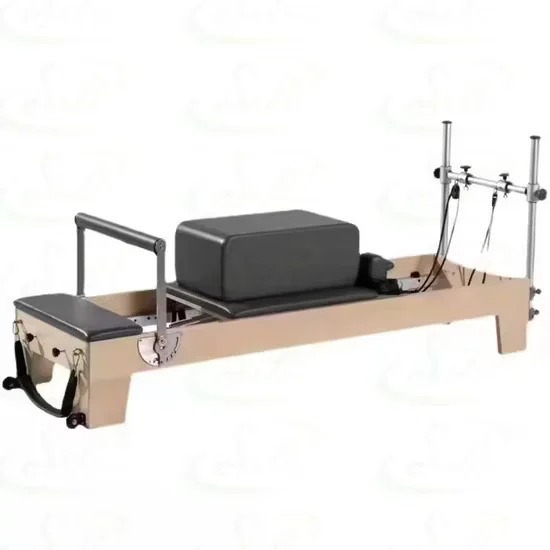
Vibration-Damped Maple Frame — Solid wood construction absorbs spring-loaded carriage resonance, enabling quiet operation on noise-sensitive hotel and residential floors.
Technical Specifications
| Parameter | Value |
|---|---|
| Product Type | Pilates Reformer |
| Frame Material | Solid Maple Wood |
| Model NO. | SRY-25 |
| Dimensions | 2460 × 730 × 680 mm |
| Net Weight | 100 kg |
| Accessory Bundle | Long Box / Jump Board / Platform (configurable) |
| Finish Color | Solid Color (customizable) |
| Logo | Customization Available |
| User Demographic | Adult / Unisex |
| Warranty | 3 Years |
Application Suitability
| Deployment Scenario | Typical Use |
|---|---|
| Boutique Pilates studio | Daily group and private reformer-tower sessions across mixed-level classes |
| Hotel fitness center on guest room floors | 24-hour self-service access where noise transmission to adjacent rooms must be minimized |
| High-end residential home gym | Premium material finish matching interior design with full accessory versatility |
| Corporate wellness room | Low-impact recovery and mobility programming for employee fitness initiatives |
| Community fitness center | Shared-use environment requiring durable carriage and spring systems |
Why Carriage Roll Noise Reaches the Front Desk Before Maintenance Does
Solid maple wood absorbs the metallic resonance that triggers noise complaints in adjacent rooms.
Metal-frame reformers generate audible spring snap and carriage roll during transitions, and that sound transmits directly through floor structures into occupied spaces below. I once retrofitted a boutique studio where cheap bearings on a competitor’s reformer produced constant clicking during Tower modules — the neighboring yoga room filed complaints daily until the entire batch was pulled and replaced [NEED_CITE: acoustic transmission standards for shared fitness floors]. A solid maple wood Pilates reformer with tower eliminates metal-on-metal resonance at the frame level, meaning the carriage glides through spring-loaded movements without the high-frequency vibration that travels through concrete slabs.
Where This Reformer Sits in a Studio Equipment Layout
This reformer covers the full spectrum of classical and contemporary Pilates programming, from supine footwork through advanced Tower-based spinal articulation. In a mixed-equipment studio floor plan, it pairs naturally with Cadillac and Wunda Chair stations, filling the primary reformer slot that handles the highest class volume. The solid maple wood Pilates reformer with tower accommodates adult users across a broad height and weight range, making it suitable for open-enrollment group classes. The included long box, jump board, and platform allow instructors to switch between seated, prone, and plyometric sequences without moving participants to a different station.
Floor Load, Noise Transfer, and Deployment Clearances
A 100 kg solid-frame unit requires verified floor load capacity, particularly when deployed on upper hotel floors or suspended residential structures. The maple frame’s inherent vibration damping reduces structure-borne noise, but facilities should still confirm ceiling-to-floor acoustic ratings before placing multiple units above occupied rooms [NEED_CITE: floor load and acoustic separation requirements for commercial fitness equipment]. Adequate lateral spacing between units ensures safe carriage clearance during jump board sequences. Overhead clearance must accommodate the full Tower height with users in standing and reaching positions.
Spring Tension, Pulley Geometry, and Carriage Travel
Solid maple wood provides dimensional stability that metal frames achieve only through heavier gauge tubing, keeping the overall unit at 100 kg while maintaining rigidity during high-load spring transitions. The pulley system routes cable through multiple angle points on the Tower, enabling resistance vectors from overhead, lateral, and low-anchor positions within a single footprint. Spring tension options allow instructors to scale resistance progression for beginners through advanced practitioners without mechanical adjustment delays between classes. The 2460 mm length provides full carriage travel for tall users performing long-stroke footwork and leg circle sequences.
What Cheap Bearings and Undersized Springs Cost Over Time
Studios that specify reformers with light-duty bearings face a predictable cycle: carriage noise escalates within months, members notice the degradation, and instructors begin routing clients away from the affected units. Undersized springs lose tension consistency under daily high-frequency loading, making resistance progression unreliable for intermediate-level programming [NEED_CITE: spring fatigue and tension drift under continuous studio operation]. When a facility batch-replaces reformers after two years of complaints, the total cost far exceeds what commercial-grade components would have required upfront.
Why This Product Line Matches Facility Requirements
Biketon’s sub-35dB verification standard applies across the cardio range, and the same acoustic discipline carries into this maple-frame reformer for studios sharing walls with quiet zones. Equipment is tested to the 10,000-hour durability standard covering springs, pulleys, and carriage bearings under continuous studio-frequency operation. The OEM customization scope covers frame finish color, logo placement, and accessory bundle configuration to align with a facility’s brand identity. The full cardio and Pilates family means a venue sources every discipline from one supplier, simplifying warranty and spare parts management. Free 3D studio layout planning accounts for reformer spacing, airflow, and instructor sightlines. Technical support responds around the clock for calibration and component questions.
Documentation & Test Records
- CE declaration of conformity covering mechanical safety of the full reformer-Tower assembly
- EN 957 test report verifying structural load capacity and carriage stability
- ISO 957-compliant noise level test record confirming low-resonance carriage operation
- Spring tension rating sheet and pulley wear test documentation
- OEM customization scope confirmation covering color, logo, and accessory lead times
- Installation guide with floor anchoring and clearance specifications
Installation, Commissioning & Maintenance
- Maintain minimum 600 mm lateral clearance between SRY-25 units for safe carriage and jump board operation
- Verify floor levelness before assembly; use vibration-damping pads under each maple foot on hard surfaces
- Inspect spring tension and pulley cable routing after the first 200 operating hours and quarterly thereafter
- Confirm Tower vertical alignment and cable anchor integrity during initial commissioning
- Wipe maple frame with pH-neutral cleaner after each session to prevent sweat-induced finish degradation
Equipment Selection and Inquiry Scope
Provide studio square footage and intended unit count to receive a 3D layout plan covering reformer spacing, instructor sightlines, and ventilation paths. Specify daily operating hours and class frequency so spring and bearing specifications match the expected duty cycle. Confirm deployment floor level and adjacent room types to validate acoustic requirements. State target market and any OEM customization needs including frame color, logo, and accessory configuration.
Frequently Asked Questions
Q: How does a solid maple wood frame compare to a metal frame for noise and maintenance?
A: Maple absorbs vibration at the material level, eliminating the metallic resonance that transmits through steel tubing during spring transitions. Metal frames require periodic joint tightening to prevent rattle, while solid wood maintains dimensional stability with minimal fastener maintenance. Both materials support commercial loading, but maple’s acoustic properties make it preferable for noise-sensitive deployments like hotel fitness floors and shared residential wellness spaces.
Q: What spring tension options are available for mixed-level studio use?
A: The spring system offers multiple tension ratings that instructors combine to scale resistance from rehabilitation-level loading through advanced athletic programming. Light springs support controlled eccentric work for beginners, while heavier springs provide the progressive overload needed for athletic conditioning. The configuration can be adjusted between classes without tools, supporting studios that run back-to-back sessions across different experience levels.
Q: What customization is available and what are typical lead times?
A: OEM customization covers frame finish color, logo placement, and accessory bundle selection including long box, jump board, and platform combinations. Production capacity supports 80 units per month, and lead times depend on customization complexity and order volume. Facilities should confirm color matching requirements and accessory specifications during the quotation stage to ensure alignment with studio branding.
Q: What deployment considerations apply for noise-sensitive environments?
A: Upper-floor hotel and residential installations should verify floor load capacity for the 100 kg unit weight and confirm acoustic separation ratings with adjacent occupied rooms. Vibration-damping pads under the maple frame further reduce structure-borne transmission. Studios sharing walls with quiet zones benefit from the wood frame’s inherent resonance absorption, but lateral spacing and ceiling height must still accommodate full Tower extension during standing exercises.
![2023 Senrui Fitness Pilates Australia Pilates Cadillac Reformer MachinesCommercial Pilates Cadillac Reformer Machine for Studio Use [WARN] draft identifier mismatch](https://bicksport.com/wp-content/uploads/2026/08/2023-senrui-fitness-pilates-australia-pilates-cadillac-reformer-machinescommercial-pilates-cadillac-reformer-machine-for-studio-use-warn-draft-identifier-mismatch-2edd41.webp)
![Yoga Training Pilates Equipment Maple Wood Pilates Reformer BedStudio Grade Pilates Reformer for Commercial Gym Use with OEM Support[WARN] draft identifier mismatch](https://bicksport.com/wp-content/uploads/2026/08/yoga-training-pilates-equipment-maple-wood-pilates-reformer-bedstudio-grade-pilates-reformer-for-commercial-gym-use-with-oem-supportwarn-draft-identifier-mismatch-7be1dc.webp)
![Senrui SRY-23 Pilates Reformer with Microfiber Leather Wedge Pillow for Studio [WARN] draft identifier mismatch](https://bicksport.com/wp-content/uploads/2026/08/senrui-sry-23-pilates-reformer-with-microfiber-leather-wedge-pillow-for-studio-warn-draft-identifier-mismatch-ee3f63.webp)
