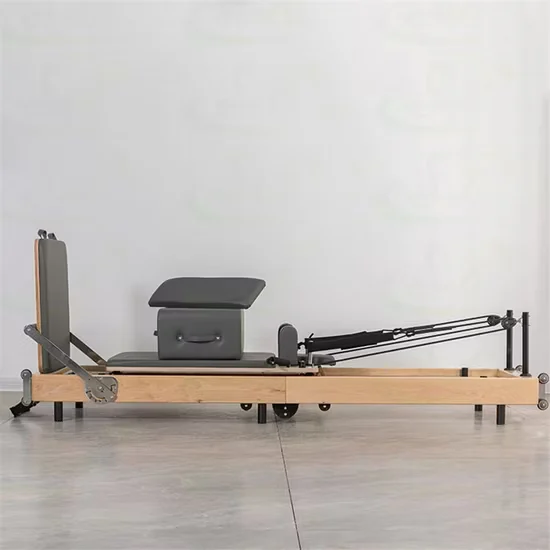
Whisper-Quiet Operation — Spring and pulley mechanics tuned to sub-35dB output, verified across hotel fitness floors where guest rooms sit directly above the studio.
Technical Specifications
| Parameter | Value |
|---|---|
| Product Type | Reformer Pilates Machine |
| Designation | SRY-27 |
| Color | Black |
| Accessory | Long Box / Jump Board / Platform |
| Product Dimensions | 2570 × 730 × 1100 mm |
| Net Weight | 110 kg |
| Max User Weight | 180 kg |
| Frame | Reinforced Steel |
| Bearings | Sealed |
| Noise Level | Sub-35 dB |
| Console Type | Smart HD IoT-Enabled Touchscreen |
| Connectivity | App Sync / Facility Management Software Integration |
| Certification | ISO 9001, CE |
| Warranty | 3 Years |
| Logo | Customized Is Allowed |
Application Suitability
| Deployment Scenario | Typical Use |
|---|---|
| Hotel fitness center on guest room floors | 24-hour guest access with noise-sensitive adjacent rooms |
| Pilates studio networks | High-frequency group reformer classes across multiple daily sessions |
| Corporate wellness room | Employee Pilates programs during lunch breaks and after-work hours |
| High-end residential home gym | Private reformer training in shared building environments |
| Sports performance training center | Athlete rehabilitation and core stability programming |
Why Spring Noise Reaches the Front Desk Before Maintenance Does
Sealed bearings and tuned spring tension keep carriage travel below the threshold that triggers guest complaints.
In hotel deployments, reformer carriages generate repetitive metallic clatter during group classes — especially when spring anchors loosen or pulley alignment drifts over hundreds of cycles. Guests in rooms directly above or beside the fitness floor hear every repetition. By the time maintenance receives a ticket, the front desk has already logged multiple complaints [NEED_CITE: acoustic transmission standards for fitness equipment on occupied floors]. A commercial reformer Pilates machine must address this at the engineering level, not through after-market dampening pads.
Where the SRY-27 Fits in a Mixed-Discipline Cardio and Recovery Zone
This reformer covers full-range Pilates programming from foundational core work through advanced spring-loaded resistance sequences. In a facility layout, it pairs with treadmill and elliptical stations to give members a low-impact recovery option between high-intensity cardio blocks. The 2570 mm footprint fits standard studio bays, and the 180 kg user capacity accommodates a broad member demographic. The IoT console captures rep count, spring tension selection, and session duration — data that feeds directly into facility management dashboards without manual logging.
Continuous Class Scheduling and Floor-Level Deployment Requirements
A studio running six to eight group reformer classes daily places cumulative load on every spring, pulley, and bearing. The SRY-27 is tested for 10,000+ hours of continuous high-frequency operation, which translates to years of daily class scheduling without carriage rebuilds [NEED_CITE: continuous duty cycle testing methodology for commercial Pilates equipment]. Sub-35dB operation means deployment on upper hotel floors or in residential buildings without specialized acoustic isolation. The reinforced steel frame requires level flooring with commercial-grade vibration pads beneath each foot. For IoT data sync, the facility needs stable Wi-Fi coverage at the equipment location to maintain uninterrupted console connectivity.
Spring Tension, Pulley Geometry, and Carriage Mechanics Explained
The SRY-27 uses a multi-spring resistance system where each spring delivers a linear force curve proportional to carriage displacement. Unlike elastic-band systems that degrade and lose tension unpredictably, steel coil springs maintain consistent resistance across thousands of cycles when properly anchored. Sealed bearings at every pulley contact point prevent dust ingress and eliminate the need for periodic lubrication — a common maintenance gap in high-traffic studios. The cushioned carriage platform absorbs impact during jump board sequences, reducing repetitive stress on joints during plyometric Pilates drills. The Smart HD console connects via Wi-Fi to facility management software, enabling usage analytics and member session tracking without additional hardware.
What Specification Shortcuts Cost After the First Year
Studios that source reformers with unsealed bearings face predictable bearing replacement cycles — often within the first year of commercial use. Springs without precision anchoring develop slack, creating audible snap and rattle during transitions that disrupt class flow. Frames built from light-gauge steel flex under heavier users, generating secondary noise and accelerating weld fatigue [NEED_CITE: frame fatigue failure patterns in commercial Pilates reformers]. Consoles without IoT capability leave usage data stranded on the device, forcing operators to track class attendance and equipment utilization through manual counts. These gaps compound: noise complaints trigger equipment relocation, stranded data prevents informed purchasing decisions, and premature wear forces unplanned capital expenditure.
Why This Product Line Earns Repeat Orders from Studio Operators
Sub-35dB operation has been verified in hotel deployments where reformers sit directly below occupied guest rooms. The 10,000-hour durability test covers springs, bearings, and frame welds under continuous cycling conditions. IoT consoles sync session data to facility management platforms, giving operators visibility into class utilization and equipment load. The full six-series cardio family lets a facility source treadmills, bikes, ellipticals, rowers, stair climbers, and reformers from one engineering line. OEM customization extends to console UI, logo, and color — and the 3D layout service plans equipment spacing and airflow specifically around the SRY-27’s 2570 × 730 mm footprint.
Documentation & Test Records
- CE declaration of conformity for commercial Pilates equipment
- EN 957 test report covering structural integrity and safety
- ISO 9001 certificate for manufacturing quality management
- Noise level test report confirming sub-35dB carriage operation
- 10,000-hour durability test record on springs, bearings, and frame
- Console technical documentation with data interface specifications
Installation, Commissioning & Maintenance
- Allow minimum 600 mm clearance on each side of the 2570 × 730 mm frame for safe carriage access
- Install commercial vibration pads beneath all frame contact points on hard flooring
- Confirm facility Wi-Fi signal strength at equipment location before console activation
- Calibrate spring tension anchors and verify pulley alignment during initial commissioning
- Inspect sealed bearings and spring anchors quarterly under high-frequency class schedules
- Wipe carriage rails and spring housings after each class to prevent sweat corrosion
Equipment Selection and Facility Planning Inquiry
Share your studio floor plan and target class schedule to receive a 3D layout with equipment spacing and airflow planning built around the SRY-27 footprint. Specify daily operating hours so we can confirm spring and bearing duty-cycle matching. Identify deployment floor level and adjacent occupied spaces to validate acoustic requirements. Confirm your market voltage and plug standard, and let us know whether console data must integrate with your existing facility management platform.
Frequently Asked Questions
Q: How does spring tension calibration affect noise in shared-wall studios?
A: Springs that are improperly anchored or mismatched in tension create audible snap during carriage return. The SRY-27 uses precision-anchored steel coil springs tested across thousands of extension cycles to maintain consistent linear resistance. Combined with sealed pulley bearings, the system keeps operational noise below 35dB, which is critical for studios sharing walls with hotel corridors or residential units.
Q: What session data can the IoT console sync with facility management software?
A: The Smart HD console captures rep count, spring tension selection, session duration, and user profile data. This information transmits via Wi-Fi to compatible facility management platforms, giving operators real-time visibility into class utilization and individual equipment load without manual logging or separate tracking hardware.
Q: How is the frame tested for continuous commercial Pilates class schedules?
A: The reinforced steel frame and sealed bearings undergo 10,000+ hours of continuous cycling under load conditions that simulate back-to-back group classes. This testing covers weld integrity, carriage rail alignment, and bearing smoothness — confirming the reformer withstands the cumulative stress of high-frequency studio operation without structural fatigue or noise degradation.
Q: Which accessory configurations support different Pilates class formats?
A: The SRY-27 ships with a Long Box for seated and supine exercises, a Jump Board for plyometric cardio sequences, and a Platform for standing balance work. Studios can configure accessories per class type — rehabilitation sessions typically use the Long Box, while athletic conditioning classes incorporate the Jump Board for explosive power drills.
Q: How does carriage cushioning reduce joint stress during high-frequency classes?
A: The cushioned carriage platform absorbs impact forces during dynamic movements like jump board sequences and rapid directional transitions. This dampening layer distributes load across a wider contact area, reducing repetitive stress on knees and ankles during classes where members perform dozens of repetitions per exercise block.