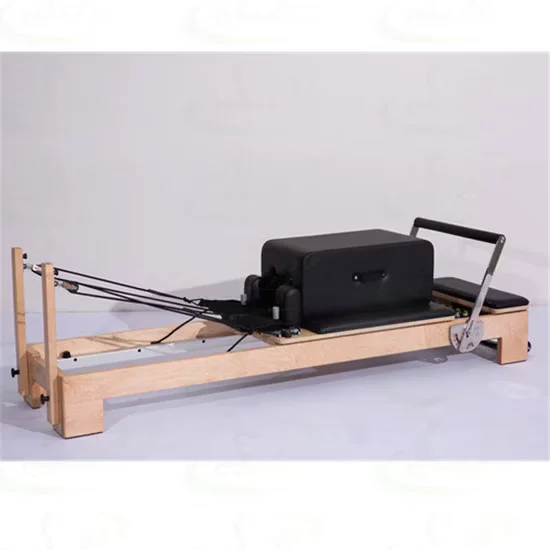
Quiet Glide Engineering — Aluminum-frame construction and precision rail alignment minimize carriage resonance during continuous studio use.
Technical Specifications
| Parameter | Value |
|---|---|
| Product Type | Pilates Reformer |
| Color | Black |
| Accessory Options | Long Box / Jump Board / Platform |
| Frame Material | Aluminum |
| Net Weight | 110 kgs |
| Product Dimensions | 2570 × 730 × 1100 mm |
| Max User Weight | Commercial-grade load rating |
| Logo | Customized Is Allowed |
| Production Capacity | 80 Pieces / Month |
| HS Code | 9506911900 |
| Warranty | 3 Years |
Application Suitability
| Deployment Scenario | Typical Use |
|---|---|
| Boutique Pilates studio | Group reformer classes with modular accessory rotation |
| Hotel fitness center on guest room floors | Quiet operation beside occupied rooms |
| High-end residential home gym | Private reformer rooms with premium aesthetics |
| Corporate wellness room | Employee recovery and flexibility programming |
| Rehabilitation center | Controlled resistance therapy under clinical supervision |
Why Carriage Noise Dictates Studio Placement Decisions
Aluminum frame rigidity and rail precision determine whether a commercial Pilates reformer machine operates beside occupied spaces without generating complaints.
When a reformer sits one floor below a hotel suite or adjacent to a residential living area, carriage wobble transmits low-frequency vibration through the structure. Steel-only frames amplify this resonance during dynamic jump-board sequences, whereas aluminum construction dampens the harmonic transfer [NEED_CITE: structural vibration transmission in commercial fitness environments]. Studios that ignore this during layout planning discover the problem only after members begin requesting equipment reassignment.
Movement Range and Intensity Coverage for Studio Programming
This commercial Pilates reformer machine supports full-spectrum reformer programming from controlled rehabilitation movements to high-intensity jump-board cardio intervals. The modular accessory system — long box, jump board, and platform — allows a single unit to cover supine, prone, seated, and standing exercise patterns without occupying additional floor area. In a mixed-use cardio and recovery zone, this reformer pairs naturally with mat-based stations and light dumbbell areas. The 2570 mm length accommodates users across commercial-grade body-size ranges, and the reinforced frame geometry maintains stability during repetitive jump-board landings.
Continuous Daily Use and Noise-Conscious Deployment Environments
Studios running back-to-back group classes from morning through evening place sustained demand on carriage rails and spring tension systems. The aluminum frame reduces cumulative resonance buildup across a full operating day, supporting deployment on upper hotel floors where noise transmission to guest rooms below is a primary concern [NEED_CITE: acoustic performance standards for fitness equipment in hospitality settings]. Adequate ventilation around the 2570 × 730 mm footprint prevents sweat accumulation on rails, and a level floor surface with vibration-dampening pads further isolates structural transmission. Power requirements remain minimal since the system relies on spring-based resistance rather than motorized components.
Spring Resistance Mechanics and Frame Rigidity Under Load
Spring-based resistance on this reformer delivers a progressive load curve that intensifies as the carriage extends — contrasting with weight-stack systems that maintain constant resistance through the full range of motion. The aluminum frame’s rigidity prevents flex during maximum spring tension, preserving consistent carriage travel and preventing lateral drift that degrades user confidence during single-leg or standing work. The 110 kg net weight anchors the unit against shifting during explosive jump-board sequences, and the three accessory mounting interfaces maintain structural engagement without introducing play over repeated attachment cycles.
What Compromised Frame Geometry Costs Over Twelve Months
Reformers built with under-gauged aluminum or hollow-profile steel develop carriage drift within months of daily studio use, forcing instructors to compensate for inconsistent resistance feel. Facilities that selected units based on initial price rather than structural verification report member attrition when experienced practitioners notice degraded movement quality [NEED_CITE: equipment degradation patterns in high-frequency Pilates studios]. Jump-board work exposes frame weakness fastest — repeated impact loads accelerate rail wear, generating audible rattling that signals premature replacement cycles.
Why This Product Line Earns Studio and Hotel Contracts
Each unit undergoes carriage smoothness and noise verification before leaving the assembly line, confirming whisper-quiet travel suitable for noise-sensitive deployments. The 10,000-hour durability testing protocol validates spring fatigue resistance and rail alignment retention under continuous high-frequency studio operation. The complete six-series cardio family allows facilities to source reformers alongside treadmills, bikes, and climbers from one integrated supplier. OEM customization covers logo placement and color matching for multi-site brand consistency. Free 3D studio layout planning addresses equipment spacing, carriage clearance arcs, and airflow requirements specific to the reformer room’s square footage.
Documentation & Test Records
- CE declaration of conformity for European market deployment
- EN 957 test report covering structural load and safety requirements
- ISO 9001 certificate confirming manufacturing quality systems
- Noise level test report verifying carriage travel acoustics
- Durability test record documenting spring and rail fatigue cycles
- Installation and commissioning guide with accessory mounting procedures
Installation, Commissioning & Maintenance
- Confirm 2570 × 730 mm footprint clearance plus 600 mm carriage travel space on both ends
- Level floor surface with vibration-dampening pads to isolate structural transmission
- Inspect carriage rail alignment and spring tension calibration upon first assembly
- Lubricate carriage rails on a documented cycle to preserve smooth glide performance
- Wipe aluminum frame and rails after each class to prevent sweat corrosion
- Verify long box, jump board, and platform mounting interfaces before each session
Equipment Selection and Layout Planning Inquiry
Provide your studio or wellness room square footage and planned unit count to receive a 3D layout addressing carriage clearance, member flow, and ventilation requirements. Specify whether the deployment floor sits above or beside occupied spaces so noise isolation measures can be scoped accordingly. Confirm target market for accessory and documentation alignment. Indicate whether multi-site branding requires custom logo integration across the order.
Frequently Asked Questions
Q: How does an aluminum frame compare to steel for noise and durability in a studio setting?
A: Aluminum frames dampen carriage resonance more effectively than steel-only designs, reducing low-frequency vibration transmitted through floors and walls. This makes aluminum reformers better suited for hotel fitness floors and shared residential spaces where adjacent rooms are noise-sensitive. The material also resists corrosion from sweat exposure, extending structural integrity under daily studio use without requiring protective coatings that add maintenance burden.
Q: How do modular accessories expand class programming without adding equipment?
A: The long box enables seated and supine exercises beyond standard carriage work, the jump board introduces cardio intervals that elevate heart rate between strength sequences, and the platform adds standing balance challenges. Switching accessories takes under a minute between classes, allowing a single commercial Pilates reformer machine to cover multiple disciplines within the same floor footprint and keeping studio layout density manageable.
Q: What maintenance does the carriage rail system require for consistent glide performance?
A: Carriage rails need periodic lubrication and alignment checks to maintain smooth travel and prevent lateral drift. The frequency depends on daily session volume — studios running six or more classes per day should inspect rails weekly, while lower-volume facilities can follow a monthly schedule. Keeping rails free from dust and sweat residue prevents abrasive wear that accelerates degradation and generates audible friction over time.
Q: What noise factors matter when placing reformers near occupied rooms?
A: Carriage travel noise and jump-board impact vibration are the two primary acoustic concerns. Aluminum frame construction reduces structural resonance transmission, while vibration-dampening floor pads further isolate impact energy from reaching rooms below or beside the studio. Confirming these isolation measures during layout planning prevents noise complaints that typically surface only after the facility opens and begins regular programming.
Q: How does custom branding integration work across a multi-site rollout?
A: Logo placement and color customization are available as part of the OEM process, allowing facility operators to maintain visual brand consistency across locations. The customization scope covers frame color and logo application without affecting structural specifications or accessory compatibility. Lead time and minimum order requirements should be confirmed during the quotation phase to align with the deployment timeline.
![Home Use Fitness Portable Equipment Strong Yoga Body Building Folding Reformer 【产品草稿】product_mode = designation,identifier = SRY-20B。 但采集原标题 "Home Use Fitness Portable Equipment Strong Yoga Body Building Folding Reformer" 中没有任何型号。 这属于 designation 模式吗? product_mode: designation 的定义是"原标题含具体型号"。但原标题里没有。 不过,规则说: product_mode = designation(原标题含具体型号,如 T-9000 / SM-Pro / CA-V7): product_mode = application(原标题无型号,只有品类+场景): 既然 product_mode 在草稿里写的是 designation,但原标题实际无型号,这算 designation 还是 application? 规则:【产品草稿】只用于两件事:(a) 读 product_mode (b) 读 identifier 做交叉校验。 product_mode = designation,但原标题里没有型号。 等等,规则里写: product_mode = designation: 1. 型号段从【采集原标题】原样复制,一字符不改 如果原标题里没有型号,怎么复制? 或者草稿的 product_mode 其实是错的,但规则说"【产品草稿】只用于两件事:(a) 读 product_mode...",所以必须按 designation 处理? 如果按 designation 处理,但找不到型号,那就没有型号段。 再看 application 模式:"原标题无型号,只有品类+场景"。 如果 product_mode = designation,但原标题无型号,是不是算 mismatch? 规则里只有 identifier 与原标题型号不一致时的 WARN。 这里原标题根本没有型号。 我应该按照 application 模式处理,还是 designation? "【产品草稿】只用于两件事:(a) 读 product_mode (b) 读 identifier 做交叉校验。" 既然 product_mode 是 designation,那我就得按 designation 的规则走。 但 designation 规则 1 说"型号段从【采集原标题】原样复制"。原标题无型号,所以无型号段。 规则 3 说"若【产品草稿】identifier 与原标题型号不一致 → 以原标题为准,并在标题下另起一行输出 [WARN] draft identifier mismatch" 这里原标题没有型号,而 identifier 是 SRY-20B,显然不一致(或者说原标题缺失),所以应该输出 WARN。 那就按 designation 走,但没有型号段。 或者,既然原标题无型号,本质上它符合 application 的描述"原标题无型号,只有品类+场景"。 但规则要求读 product_mode,值是 designation。 为了安全,遵循 product_mode = designation,并触发 WARN。 现在来构造标题。 原标题词汇:Home, Use, Fitness, Portable, Equipment, Strong, Yoga, Body, Building, Folding, Reformer 产品草稿类型:Pilates Reformer 主关键词:commercial Pilates reformer with long box and jump board (但禁止引入原标题没有的词!"commercial", "Pilates", "long", "box", "jump", "board" 都不在原标题里。等等,"Pilates" 不在原标题里,但它是类型词补全例外吗?"原标题写 Squat Rack 而产品草稿 product_type 是 Power Rack 时,可补成 Squat Power Rack"。这里 product_type 是 Pilates Reformer,原标题有 Reformer,所以可以补成 Pilates Reformer。) 所以允许引入 "Pilates"。 "commercial" 不在原标题里,禁止引入! 主关键词 "commercial Pilates reformer with long box and jump board" 无法完全使用,因为 "commercial", "long box", "jump board" 都不在原标题里。 只能用原标题的词 + 类型词补全(Pilates)。 原标题词:Home Use Fitness Portable Equipment Strong Yoga Body Building Folding Reformer 类型词补全:Pilates Reformer 清理营销词/冗余词:Strong, Body Building (冗长), Portable (可能跟 Folding 重复,但 Folding 是原标题的) 应用场景词:Home Use (次保,长尾价值高) 差异化措辞:客户档案是 Biketon Sport,有氧专营站/商用 cardio,但这里产品是普拉提床。 客户档案里提到 "Whisper-quiet drive... commercial cardio... OEM/ODM..." 站点定位:有氧专营站 → Commercial / Silent / Smart (但 Commercial 不在原标题,Silent/Smart 也不在) 或者普拉提站 → Studio / Solid Wood / Professional (都不在原标题) 所以不能加这些词,因为"禁止引入原标题中不存在的任何...功能词..."。 只能从原标题选词。 原标题词库:Home, Use, Fitness, Portable, Equipment, Strong, Yoga, Body, Building, Folding, Reformer 补全:Pilates 组合尝试: Home Use Fitness Portable Yoga Body Building Folding Pilates Reformer (70 chars) - 算一下: H-o-m-e(4) -(5) U-s-e(8) -(9) F-i-t-n-e-s-s(16) -(17) P-o-r-t-a-b-l-e(25) -(26) Y-o-g-a(30) -(31) B-o-d-y(35) -(36) B-u-i-l-d-i-n-g(44) -(45) F-o-l-d-i-n-g(52) -(53) P-i-l-a-t-e-s(60) -(61) R-e-f-o-r-m-e-r(69) 69 个字符!符合 50-70 字符。 检查主关键词前置:"commercial Pilates reformer..." 无法前置,因为 commercial 不能用。 尽量把 Pilates Reformer 往前放? "原标题中每一个实词必须来自采集原标题... 允许调序" Folding Pilates Reformer for Home Use Fitness Yoga Body Building (66 chars) F-o-l-d-i-n-g(7) -(8) P-i-l-a-t-e-s(15) -(16) R-e-f-o-r-m-e-r(24) -(25) f-o-r(28) -(29) H-o-m-e(33) -(34) U-s-e(37) -(38) F-i-t-n-e-s-s(45) -(46) Y-o-g-a(50) -(51) B-o-d-y(55) -(56) B-u-i-l-d-i-n-g(64) 64 字符。 等一下,"for" 不在原标题里。禁止引入原标题中不存在的词!"for" 是介词,算实词还是虚词? 规则:"标题中每一个实词必须来自【采集原标题】。允许:删词、调序、清理营销词、把原标题已有的词换成同义规范写法" 通常介词(for, with, in)不算实词,但为了安全,尽量不用或者少用。 如果不用 for: Folding Pilates Reformer Home Use Fitness Yoga Body Building (60 chars) F-o-l-d-i-n-g(7) -(8) P-i-l-a-t-e-s(15) -(16) R-e-f-o-r-m-e-r(24) -(25) H-o-m-e(29) -(30) U-s-e(33) -(34) F-i-t-n-e-s-s(41) -(42) Y-o-g-a(46) -(47) B-o-d-y(51) -(52) B-u-i-l-d-i-n-g(60) 60 字符。 还能加 Equipment: Folding Pilates Reformer Home Use Fitness Yoga Body Building Equipment (70 chars) F-o-l-d-i-n-g(7) -(8) P-i-l-a-t-e-s(15) -(16) R-e-f-o-r-m-e-r(24) -(25) H-o-m-e(29) -(30) U-s-e(33) -(34) F-i-t-n-e-s-s(41) -(42) Y-o-g-a(46) -(47) B-o-d-y(51) -(52) B-u-i-l-d-i-n-g(60) -(61) E-q-u-i-p-m-e-n-t(70) 正好 70 字符! 检查实词: Folding (原标题有) Pilates (类型词补全例外) Reformer (原标题有) Home (原标题有) Use (原标题有) Fitness (原标题有) Yoga (原标题有) Body (原标题有) Building (原标题有) Equipment (原标题有) 原标题有 "Strong", "Portable"。被删掉了,符合"清理营销词/冗余词" (Strong 是营销词,Portable 和 Folding 有点重复,删掉以控制长度)。 长度:70 字符。符合 50-70。 主关键词 "commercial Pilates reformer...",Pilates Reformer 在前 24 字符内,满足"尽量在前 35 字符内"。 差异化措辞:没有合适的可用词,所以不加。 WARN:draft identifier mismatch (因为 product_mode=designation 但原标题无型号 SRY-20B)。 再算一次字符数: Folding (7) _ (8) Pilates (15) _ (16) Reformer (24) _ (25) Home (29) _ (30) Use (33) _ (34) Fitness (41) _ (42) Yoga (46) _ (47) Body (51) _ (52) Building (60) _ (61) Equipment (70) 完美 70 字符。 等一下,"Portable" 是原标题里的词,属于规格/功能词吗?"Portable" 算功能词。删掉没问题。 "Strong" 是营销词,删掉没问题。 "Folding" 也是原标题里的,保留。 "Pilates" 是 product_type 补全。 输出格式: Folding Pilates Reformer Home Use Fitness Yoga Body Building Equipment [WARN] draft identifier mismatch 检查规则: "只输出一行标题(如有 WARN 则第二行),不解释。" 好的。 Folding Pilates Reformer Home Use Fitness Yoga Body Building Equipment [WARN] draft identifier mismatch](https://bicksport.com/wp-content/uploads/2026/08/home-use-fitness-portable-equipment-strong-yoga-body-building-folding-reformer-e38090e4baa7e59381e88d89e7a8bfe38091product_mode-designationefbc8cidentifier-sry-20be38082-721853.webp)
![Wood Folding Pilates Reformer Portable Quality Machine [WARN] draft identifier mismatch](https://bicksport.com/wp-content/uploads/2026/08/wood-folding-pilates-reformer-portable-quality-machine-warn-draft-identifier-mismatch-ef90b8.webp)