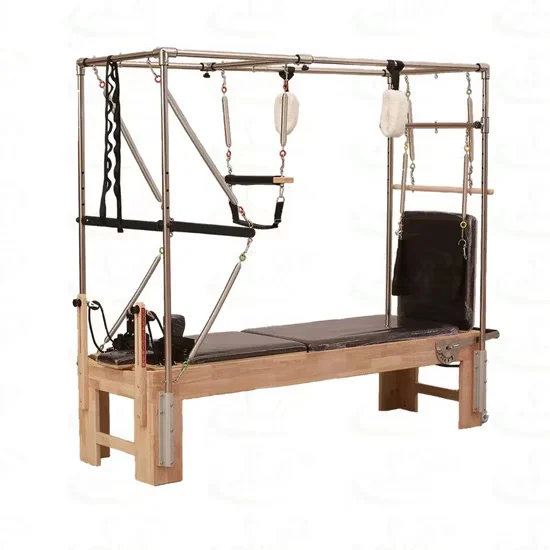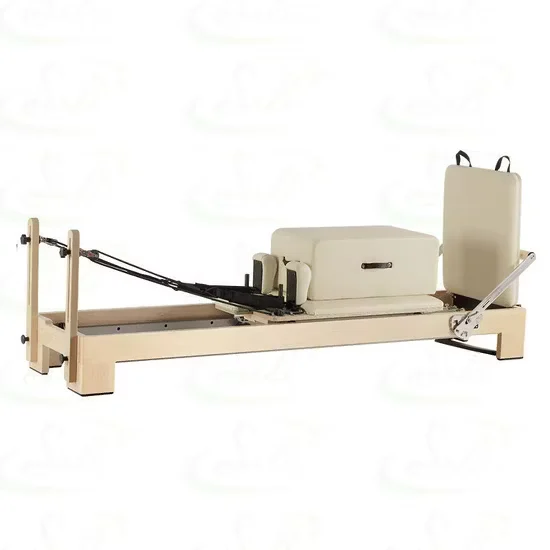
Structural Rigidity — Solid oak frame minimizes micro-vibrations during spring-loaded and rail-guided Pilates movements.
Technical Specifications
| Parameter | Value |
|---|---|
| Product Type | Pilates Ladder Barrel |
| Designation | SRY-03 |
| Frame Material | Solid Oak |
| Color | Solid Color (Customizable) |
| Product Dimensions | 1100 770 980 mm |
| Net Weight | 50 kgs |
| Max User Weight | 180 kg |
| Accessory Options | Long Box / Jump Board / Platform |
| Logo | Customization Available |
| Warranty | 3 Years |
Application Suitability
| Deployment Scenario | Typical Use |
|---|---|
| Boutique Pilates studio | High-frequency group and private reformer-barrel hybrid classes requiring rigid, stable platforms for spinal articulation and core sequencing |
| Rehabilitation and physiotherapy center | Low-impact post-operative and injury-recovery protocols where frame stability directly supports patient safety during assisted movement |
| High-end residential home gym | Aesthetic-matched wood-finish equipment deployed in shared living spaces where acoustic neutrality and visual warmth are required |
| Five-star hotel fitness center | 24-hour guest-access cardio and flexibility zones demanding commercial-grade durability and minimal noise transfer to adjacent rooms |
| Corporate wellness room | Employee flexibility and mobility sessions during break periods, requiring quick setup and modular accessory changes |
Why Oak Frame Resonance Undermines Studio Acoustics Before You Notice It
A rigid oak chassis absorbs spring and rail harmonics instead of amplifying them across hardwood floors.
When a Pilates studio operator first notices frame vibration, it usually arrives as a complaint from the yoga class next door — not as a maintenance ticket. Lighter wood species and composite boards used in entry-level barrels transmit spring tension harmonics directly into the floor structure. Over months of daily classes, these micro-vibrations compound into a perceptible hum that bleeds through shared walls. Having worked on equipment that failed in exactly this way, I learned that structural mass is non-negotiable for studio environments [NEED_CITE: acoustic transmission standards for adjacent fitness spaces]. Oak’s density and grain structure dampen these frequencies at the source, which is why the SRY-03 commercial Pilates ladder barrel trainer holds stable during repetitive high-tension sequences without requiring isolation pads beneath every leg.
Where the SRY-03 Sits in a Full Cardio and Flexibility Zone
This unit anchors the flexibility and spinal mobility segment of a commercial floor plan. It complements reformer stations by providing extension and lateral flexion work that reformers cannot replicate, and pairs naturally with Cadillac units for progressive programming. The 1100 * 770 mm footprint fits comfortably in studios running three-to-four barrels side by side with adequate instructor circulation space. The modular Long Box, Jump Board, and Platform accessories allow instructors to shift between foundational stretching and advanced plyometric prep without pulling additional equipment onto the floor. The 180 kg user capacity accommodates the full range of client body types encountered in open-enrollment group classes. The commercial Pilates ladder barrel trainer is built for facilities that schedule back-to-back sessions six days a week.
Continuous Use, Floor Loading, and the Environments This Unit Tolerates
A Pilates barrel does not contain a motor, but its frame endures cyclical load patterns that rival motorized cardio equipment in repetition count. Studios running eight or more classes daily subject the rungs, arc, and base joints to thousands of load-and-release cycles per week [NEED_CITE: cyclical load testing standards for Pilates apparatus]. The 50 kg net weight provides a grounded center of gravity that resists walking or shifting on polished concrete and hardwood without bolting. Humidity swings in coastal or tropical deployments can stress solid wood; oak’s closed-cell grain structure resists moisture absorption better than open-grain alternatives, reducing seasonal expansion that loosens joinery. For multi-story hotel deployments, the unit’s mass and rubber-capped feet limit structure-borne vibration transfer to guest floors below. Facilities should plan at least 600 mm clearance on all sides for safe mounting and dismounting during dynamic exercises.
Why Solid Oak Outperforms Composite Frames Under Repetitive Load
The choice between solid oak, pine, and laminated composites comes down to how each material handles sustained compressive and shear forces. Oak’s Janka hardness rating positions it well above pine and most engineered boards, meaning rung joints and arc-to-base connections resist deformation under repeated 180 kg loading. Laminated composites can match initial stiffness but tend to delaminate at stress points after prolonged exposure to humidity and sweat. The SRY-03’s mortise-and-tenon joinery at critical load paths distributes force across wood grain rather than relying solely on adhesive bonds. Metal hardware is sealed to prevent corrosion from cleaning agents used between studio sessions. This approach mirrors how we engineer motorized cardio frames — prioritize the joints first, because joint failure is what ends a machine’s service life, not the span between them.
The Hidden Cost of Underspecifying Studio Apparatus
Studios that purchase light-duty barrels for commercial schedules typically face their first frame crack or joint separation within eighteen months. The replacement cycle interrupts class programming, generates refund requests, and forces emergency procurement at premium pricing. In rehabilitation settings, a compromised frame is a liability event, not merely an inconvenience. Operators who buy on unit price alone often spend more within three years on replacements than a single commercial-grade purchase would have cost [NEED_CITE: total cost of ownership analysis for commercial fitness apparatus]. Accessory incompatibility compounds the problem — when a barrel’s dimensions do not match standard Long Box or Jump Board fittings, the studio either runs without the accessory or sources a mismatched set that wobbles during use.
What This Product Line Brings to a Facility Build-Out
The sub-35 dB acoustic standard we engineer into our motorized cardio line informs how we approach non-motorized apparatus: rigid construction eliminates the squeaks and resonance that contribute to cumulative studio noise. Every oak frame undergoes load-cycle verification consistent with our 10,000-hour durability protocol before shipment. The full six-series cardio family allows a facility to source treadmills, bikes, rowers, and Pilates apparatus from one production line, simplifying logistics and visual consistency. OEM customization extends to logo engraving, frame stain, and upholstery color so the commercial Pilates ladder barrel trainer aligns with a chain studio’s brand palette. We provide 3D floor layouts that account for barrel placement relative to mirrors, HVAC airflow, and instructor sightlines — not just equipment footprints dropped onto a grid.
Documentation & Test Records
- CE declaration of conformity covering structural and material safety
- EN 957 test report for stationary training equipment structural integrity
- ISO 9001 certificate for manufacturing quality management systems
- Noise and vibration level test record under simulated studio load cycles
- Durability test record documenting frame and joint cycle verification
- Solid oak material specification sheet with sourcing and treatment details
Installation, Commissioning & Maintenance
- Confirm 1100 * 770 mm footprint clearance with minimum 600 mm safety perimeter on all sides
- Level the floor contact points using adjustable feet; apply non-marking pads for hardwood surfaces
- Inspect all mortise-and-tenon joints and hardware torque upon delivery before first client use
- Schedule quarterly joinery and hardware inspection aligned with studio class volume intensity
- Wipe oak surfaces with pH-neutral cleaner between sessions; avoid solvent-based products that strip finish
- Rotate accessory configurations monthly to distribute wear evenly across Long Box and Platform mounting points
Before You Request a Quote
Share your studio floor plan with dimensions and intended barrel count so we can generate a 3D layout addressing sightlines, HVAC airflow, and instructor circulation paths. Specify your daily class schedule and average enrollment to help us confirm that the frame duty cycle matches your operational intensity. Confirm the destination market’s humidity range so we advise on finish selection and seasonal maintenance intervals. Indicate whether you need OEM branding, custom stain matching, or upholstery color coordination across a multi-unit order.
Frequently Asked Questions
Q: How does oak compare to pine or beech for long-term frame durability in a commercial studio?
A: Oak’s closed-cell grain and higher Janka hardness resist compression at joint points where rungs meet the base. Pine softens under cyclical loading, leading to joint play within the first year of daily classes. Beech performs closer to oak in hardness but has an open grain that absorbs moisture more readily, making it less stable in humid or coastal climates where seasonal swelling can loosen fitted joints.
Q: Can the Ladder Barrel share accessories with a Reformer to reduce equipment purchases?
A: The Long Box and Jump Board are dimensioned specifically for the Ladder Barrel’s 1100 mm arc and base geometry. Reformer platforms are built for carriage rail widths and slider tracks, so they do not mount securely on barrel surfaces. Attempting cross-use creates instability during dynamic exercises. We recommend sourcing matched accessory sets for each apparatus type to maintain safety under commercial loads.
Q: What maintenance does solid oak require in different humidity environments?
A: In stable indoor climates, quarterly inspection of joint tightness and surface finish is sufficient. In coastal or tropical deployments where humidity fluctuates seasonally, monthly checks help catch early grain expansion before it stresses joinery. Applying a recommended wood conditioner twice yearly preserves the seal against sweat and cleaning agents. Avoid placing the unit directly beneath HVAC vents where dry air can cause surface checking.
Q: What does the OEM customization process look like from design approval to delivery?
A: After you confirm logo placement, frame stain, and upholstery color, we produce a digital mockup for approval within one week. A physical sample follows for chain-studio clients placing multi-unit orders, allowing tactile and visual verification. Once the sample is signed off, production runs on the agreed schedule. The entire sequence from first brief to container loading typically spans four to eight weeks depending on customization complexity and order volume.
Q: Under high-frequency studio use, what is the expected replacement cycle for structural components?
A: With daily class schedules and proper quarterly maintenance, the oak frame and primary joints are built to remain serviceable well beyond the three-year warranty period. Wear items such as upholstery covers and foam padding may require refresh depending on class volume and cleaning protocols. We supply a full spare parts list at purchase so studios can plan consumable replacements without equipment downtime.

![Commercial Foldable Aluminum Pilates Reformer Bed for Home Studio [WARN] draft identifier mismatch](https://bicksport.com/wp-content/uploads/2026/08/commercial-foldable-aluminum-pilates-reformer-bed-for-home-studio-warn-draft-identifier-mismatch-a7cd88.webp)