
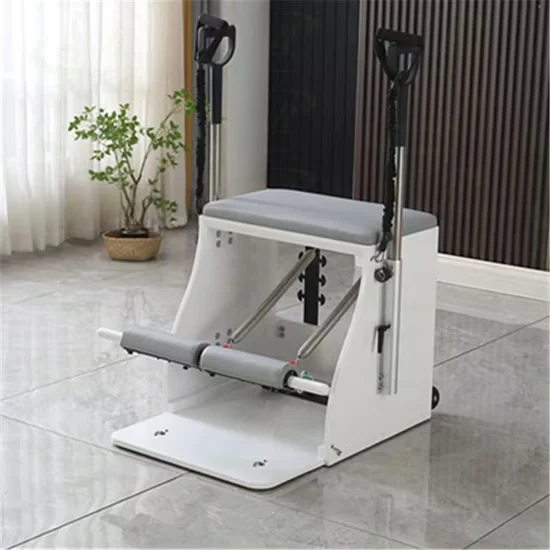
Commercial Grade Stability — verified through 10,000-hour continuous operation testing on frame welds and spring assemblies for studio duty cycles.
Technical Specifications
| Parameter | Value |
|---|---|
| Product Type | Pilates Reformer Combo Chair |
| Designation | SRY-04 |
| Product Dimensions | 800 × 620 × 1100 mm |
| Net Weight | 45 kg |
| Color | Solid Color (customizable) |
| Logo | Customized Is Allowed |
| Warranty | 3 Years |
Application Suitability
| Deployment Scenario | Typical Use |
|---|---|
| Boutique Pilates studio | Dual-function reformer and combo chair sessions to maximize floor revenue |
| Yoga and barre fitness center | Low-impact resistance training across group and private classes |
| Rehabilitation clinic | Controlled spring-resisted movement for recovery protocols |
| High-end residential home gym | Compact multi-discipline equipment for private wellness spaces |
| Corporate wellness room | Versatile strength and flexibility sessions for employee fitness programs |
What Fragmented Equipment Fleets Cost Studio Operators
A single footprint replacing two separate machines eliminates scheduling conflicts and cuts maintenance overhead in half.
Studio owners running ten or more classes a day know the math: every square meter of floor space either generates revenue or collects dust. When a reformer sits idle between sessions and the combo chair gathers bookings only during peak hours, you are paying rent on equipment that works part-time [NEED_CITE: studio floor space utilization benchmarks for multi-discipline fitness centers]. The SRY-04 commercial Pilates reformer combo chair collapses that problem into one frame — members transition between reformer gliding and chair-based resistance work without moving to another station, and instructors run back-to-back formats without resetting the room.
Dual-Function Positioning Within a Studio Cardio and Resistance Floor Plan
This unit sits at the intersection of controlled resistance training and functional movement preparation, bridging the gap between heavy strength equipment and open-floor bodyweight zones. In a typical studio layout, the SRY-04 commercial Pilates reformer combo chair pairs naturally with mat stations and small apparatus shelves, giving instructors a progression path from reformer-based rehabilitation into upright chair exercises for standing balance and lower-body conditioning. The 800 × 620 mm footprint allows placement against walls or in center-room clusters, and the 1100 mm height clears standard studio mirrors without visual obstruction. User accommodation spans a wide height range thanks to adjustable spring anchor points, though operators should verify carriage travel length against their tallest expected clients.
Continuous Daily Use and Studio Environment Requirements
A boutique studio running six classes daily puts each piece of equipment through roughly forty-five minutes of active spring cycling per session, with short reset intervals between bookings. The reinforced frame and solid-color finish on this unit are built to absorb that rhythm, but operators must still account for ventilation — enclosed rooms with poor air circulation accelerate wear on spring coatings and upholstery [NEED_CITE: environmental factors affecting spring fatigue in commercial Pilates equipment]. Floor leveling matters here more than with heavier cardio machines; even slight unevenness causes the carriage to drift during supine exercises and compromises the precision that Pilates instruction demands. When planning ceiling-mounted HVAC ducts above the reformer zone, ensure adequate clearance so that airflow does not create draft complaints during supine work.
Spring Resistance Architecture and Frame Construction Decoded
Spring-based resistance operates on a fundamentally different principle from magnetic or friction systems found on commercial cardio equipment — the load curve increases linearly with extension, meaning the hardest portion of any movement coincides with the end range where muscles are most stretched. This SRY-04 unit relies on multiple interchangeable springs of varying tension ratings, allowing instructors to dial load from rehabilitation-grade to athletic conditioning within seconds. The 45 kg net weight indicates a frame built from thicker-gauge steel tubing than typical home models, which directly addresses the lateral forces generated during asymmetric chair exercises. Carriage bearings and rail alignment determine whether the gliding surface remains smooth after thousands of cycles; sealed bearings resist dust and sweat ingress that plague open-bearing designs. Upholstery selection balances grip against skin comfort — vinyl wipes clean between classes but can feel slick during humid summer months, while synthetic leather holds up better under repeated cleaning chemicals [NEED_CITE: upholstery material degradation rates under commercial cleaning protocols].
The Hidden Cost of Specifying Below Commercial Duty
Operators who source home-grade reformers to save on initial outlay typically discover the real cost within eighteen months: carriage wheels develop flat spots from constant studio-class cycling, spring hooks bend under heavier clients, and upholstery tears along high-friction seams. The complaints do not arrive as equipment failures — they arrive as member attrition. Clients who pay premium studio membership fees notice when the reformer wobbles during advanced exercises or when the combo chair springs feel inconsistent from one machine to the next [NEED_CITE: member retention correlation with equipment condition in boutique fitness studios]. Replacing an entire fleet simultaneously is far more expensive than specifying commercial-grade construction from the outset, and the disruption of pulling equipment from active class schedules compounds the financial hit.
Why This Product Line Earns Its Studio Placement
Sub-35 dB acoustic performance, verified across the broader cardio range, matters for Pilates studios too — spring mechanisms and carriage movement generate far less noise than motorized equipment, but metal-on-metal contact still transmits through floor slabs in multi-tenant buildings. The 10,000-hour durability standard applied to this manufacturer’s motorized cardio line informs the spring and bearing specification philosophy here: components are selected for replacement-cycle intervals measured in years, not months. Full OEM and ODM capability extends to logo application, color matching, and upholstery selection, enabling multi-location studio networks to maintain consistent visual branding across every site. The three-year warranty coverage on this commercial Pilates reformer combo chair reflects structural confidence under continuous studio scheduling. Free 3D studio layout planning addresses equipment spacing, instructor sightlines, and member flow paths before any purchase order is issued, and 24/7 technical support ensures that a stuck carriage or broken spring does not cancel tomorrow morning’s first class.
Documentation & Test Records
- CE declaration of conformity for European market entry
- EN 957 test report covering structural load and stability
- ISO 9001 certificate for manufacturing quality management
- Spring fatigue and cycle-life test documentation
- Upholstery wear-resistance and chemical-cleaner tolerance data
- Installation guide with floor-anchoring and leveling instructions
Installation, Commissioning & Maintenance
- Verify 800 × 620 mm footprint with 600 mm clearance on all sides for instructor access and safe movement
- Level the frame using adjustable feet before first class; uneven floors cause carriage drift during supine work
- Inspect spring hooks and attachment points monthly for metal fatigue or deformation under repeated loading
- Clean vinyl or leather upholstery after each class with manufacturer-approved disinfectant to prevent degradation
- Check carriage rail alignment and bearing smoothness quarterly; replace sealed bearings if lateral play develops
- Store replacement springs and upholstery patches on-site to avoid class cancellations during maintenance
Scope Your Studio Layout Before Quoting
Share your studio floor plan with square footage and ceiling height to receive a 3D equipment layout that accounts for instructor circulation, mirror placement, and member entry flow. Specify your average class size and daily schedule density so that spring specification and upholstery grade match your actual duty cycle. If your studio operates in a multi-tenant building, confirm the floor construction and adjacent occupancy to address any vibration transmission concerns. For multi-location rollouts, provide your brand color palette and logo files early so OEM customization lead times align with your opening schedule.
Frequently Asked Questions
Q: What is the difference between a reformer and a combo chair, and why combine them?
A: A reformer provides horizontal carriage-based resistance for supine and seated exercises, while a combo chair offers upright spring-loaded pedal work for standing and kneeling movements. Combining both into the SRY-04 frame lets instructors run complete class formats without members switching stations, maximizing revenue per square meter in studios where floor space directly limits booking capacity.
Q: How does frame construction affect long-term durability in commercial studio environments?
A: Commercial studios cycle equipment through forty or more sessions per week, generating cumulative lateral and torsional loads that expose thin-gauge frames. The 45 kg net weight of this unit indicates heavier steel tubing and reinforced weld points at stress junctions, which prevents the frame flex and carriage misalignment that plague lighter models after extended high-frequency use.
Q: What customization options are available for branding and color matching?
A: Logo application, frame color, and upholstery selection are all available through OEM customization. Multi-location studio networks can specify consistent branding across their entire equipment fleet, and the solid-color finish serves as a base for color matching against existing interior design schemes. Minimum order quantities and lead times should be confirmed during the quotation stage.
Q: How should Pilates equipment be maintained in high-usage studio settings?
A: Monthly inspection of spring hooks, carriage bearings, and rail alignment catches wear before it affects class quality. Upholstery requires cleaning after each session with approved disinfectants, and springs should be replaced on a schedule based on actual cycle counts rather than calendar intervals. Keeping spare springs and bearing kits on-site prevents scheduling disruptions.
Q: What space planning considerations apply when deploying reformers in boutique studios?
A: Beyond the 800 × 620 mm equipment footprint, operators need minimum 600 mm clearance on each side for instructor access and safe member movement. Ceiling height must accommodate the 1100 mm unit height plus overhead clearance for exercises performed standing on the chair platform, and mirror placement should allow instructors to observe form from multiple angles without relocating.

![Factory Maple Folding Reformer Pilates Equipment for Home Studio Yoga Training Exercise Fitness Machine [WARN] draft identifier mismatch](https://bicksport.com/wp-content/uploads/2026/08/factory-maple-folding-reformer-pilates-equipment-for-home-studio-yoga-training-exercise-fitness-machine-warn-draft-identifier-mismatch-e4b2ea.webp)

