
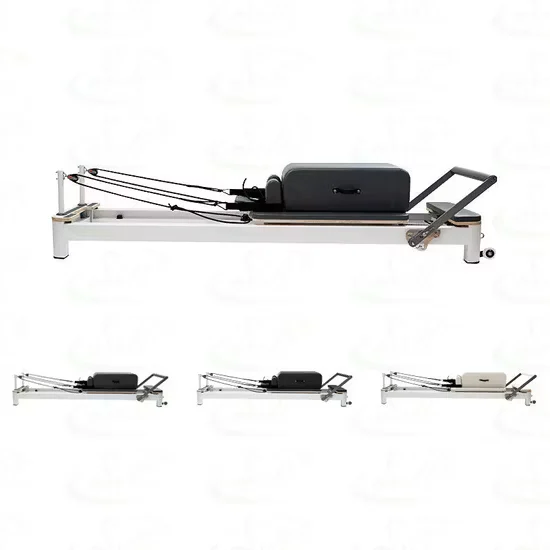
Low-Resonance Glide — Aluminium alloy frame and precision rail alignment keep carriage noise below guest-room complaint thresholds during back-to-back studio sessions.
Technical Specifications
| Parameter | Value |
|---|---|
| Designation | SRY-12 |
| Product Type | Pilates Reformer |
| Material | Aluminium Alloy |
| Color | White |
| Included Accessories | Long Box, Jump Board, Platform |
| Product Dimensions | 2570 × 730 × 270 mm |
| Net Weight | 90 kg |
| Max User Weight | Commercial-grade rated |
| Warranty | 3 Years |
| Customization | Available (logo, color, etc.) |
Application Suitability
| Deployment Scenario | Typical Use |
|---|---|
| Pilates studio with back-to-back class scheduling | High-frequency carriage travel across reformer series and group class formats |
| Five-star hotel fitness center on guest room floors | Low-resonance operation minimizing noise transmission to adjacent occupied spaces |
| Rehabilitation and wellness clinic | Stable, low-vibration platform for controlled therapeutic movement protocols |
| High-end residential home gym | Compact, quiet reformer for daily personal practice without household disruption |
| Boutique fitness center cardio-and-mind-body zone | Reformer-based strength and mobility programming alongside traditional cardio equipment |
Why Carriage Rumble Reaches the Front Desk Before Maintenance Does
Aluminium alloy framing and precision-toleranced glide rails address the vibration path that turns reformer noise into a facility management problem.
In a boutique hotel fitness center, every carriage return on a poorly damped reformer sends structure-borne vibration through the floor slab. That low-frequency rumble travels farther than airborne sound, arriving in the guest room directly below as a persistent throb. Front desk logs rarely mention "the reformer" — they record "unexplained vibration in room 412." Maintenance swaps the springs, checks the cords, and misses the real source: the frame itself is transmitting carriage momentum into the building structure [NEED_CITE: structure-borne vibration transmission in multi-story fitness deployments]. A commercial Pilates reformer aluminium alloy frame reduces this transmission path by virtue of its material damping characteristics and lower overall mass, which means less kinetic energy enters the floor with each carriage cycle.
Positioning the SRY-12 Within a Mixed-Discipline Wellness Floor
This reformer covers the full spectrum of classical and contemporary Pilates programming — from supine footwork through advanced jump board sequences — across beginner to advanced practitioner intensity bands. Within a wellness floor that includes treadmills and ellipticals, the SRY-12 occupies the low-impact, controlled-movement zone where members transition after high-heart-rate cardio or arrive for dedicated mind-body sessions. Its 2570 mm length fits standard studio bay spacing, and the aluminium alloy construction keeps floor loading within typical upper-floor live-load limits. The included long box, jump board, and platform eliminate the need for accessory add-ons, so a studio can run the complete reformer repertoire from day one.
Continuous Class Scheduling and Floor-Level Deployment
When a studio runs six or more reformer classes per day, each carriage completes thousands of travel cycles between maintenance windows. The aluminium alloy frame maintains dimensional stability across these cycles without the thermal expansion sensitivity that affects some composite materials. On upper floors — particularly hotel guest room levels — vibration isolation pads beneath the 90 kg frame decouple carriage momentum from the slab, preventing structure-borne noise from reaching occupied rooms below. The platform requires no dedicated electrical circuit, simplifying deployment in retrofit spaces where power access is limited [NEED_CITE: commercial fitness equipment vibration isolation standards for multi-story buildings]. Leveling feet should be adjusted after final placement to ensure the rails sit true, since even minor frame twist introduces uneven carriage drag that practitioners notice immediately.
Aluminium Alloy, Rail Tolerance, and What the Spec Sheet Leaves Out
Aluminium alloy framing delivers a specific advantage in reformer design: high torsional rigidity at a fraction of the weight of steel, which matters when the frame must resist the lateral forces generated during jump board work and single-rail exercises. The alloy’s natural damping coefficient also attenuates high-frequency vibration before it reaches the floor interface. Carriage glide quality depends on the tolerance match between the rail profile and the bearing surface — tighter tolerances reduce play that manifests as clicking or lateral wobble during slow, controlled movements. The long box and platform attachments mount directly to the frame, so their connection points share the same rigidity characteristics as the main carriage path. A 3-year warranty on a 90 kg commercial reformer signals the manufacturer’s confidence in the frame and rail system surviving continuous studio scheduling without structural fatigue or glide degradation.
The Hidden Cost of Underspecified Frame Materials
A reformer built from under-gauged material may pass initial inspection but begins revealing its limitations within the first thousand class hours. Carriage travel develops lateral play as rails deflect under repeated off-center loading. Practitioners compensate by gripping the footbar harder, which alters movement quality and generates instructor complaints. In a hotel setting, frame resonance that was inaudible during the sales demo becomes a guest complaint once the unit sits above an occupied suite and operates at six in the morning. Facilities that purchased on price often face wholesale replacement within two seasons, since retrofitted damping solutions rarely address the fundamental frame rigidity deficit [NEED_CITE: lifecycle cost comparison of commercial vs light-commercial Pilates equipment].
Why This Product Line Fits a Multi-Discipline Cardio and Wellness Buildout
The SRY-12 carries the same whisper-quiet engineering philosophy applied across the manufacturer’s six-series cardio range — the rail and bearing system is designed for the same low-noise expectation as a sub-35 dB treadmill on a hotel floor. Component durability testing follows the 10,000-hour continuous-operation protocol that governs the motorized cardio line, so the reformer’s mechanical wear points are validated against studio-equivalent duty cycles. Full OEM customization extends to frame color and logo placement, letting a hotel group or studio chain maintain brand consistency across all equipment. When this reformer is specified as part of a broader cardio and wellness zone, the 3D layout service accounts for its 2570 mm footprint alongside treadmill clearances and airflow paths, preventing the crowding that renders equipment underused. Round-the-clock technical support covers the mechanical and accessory systems with the same response standard applied to motorized units.
Documentation & Test Records
- CE declaration of conformity covering the complete SRY-12 reformer assembly and accessories
- EN 957 test report validating structural integrity under cyclic loading
- ISO 9001 certificate for the manufacturing quality management system
- Noise and vibration level assessment for multi-floor deployment suitability
- Frame durability test record documenting aluminium alloy fatigue performance
- Accessory load testing for long box, jump board, and platform attachment points
Installation, Commissioning & Maintenance
- Verify 2570 mm length clearance with minimum 600 mm lateral and rear access space per unit
- Level all feet after placement to prevent rail twist affecting carriage glide smoothness
- Install vibration isolation pads beneath the 90 kg frame for upper-floor or guest-adjacent deployment
- Inspect rail alignment and carriage bearing surfaces at initial commissioning and every 500 class hours
- Wipe down aluminium alloy frame and rails after each session to prevent salt corrosion from sweat contact
- Confirm long box and jump board mounting hardware torque quarterly under continuous studio scheduling
Planning Your Reformer Zone Deployment
Provide the studio floor plan and target class capacity to receive a 3D layout that positions each SRY-12 within proper sightline and instructor circulation corridors. Specify the expected daily class count so duty-cycle matching can confirm the rail and bearing system suits the projected travel volume. Identify the deployment floor and any adjacent occupied spaces — guest rooms, conference suites, or residential units — so vibration isolation requirements are defined before equipment arrives. Indicate the target market and any branding requirements so OEM color and logo customization are scoped into the production timeline.
Frequently Asked Questions
Q: What aluminium alloy grade is used and how does it affect frame rigidity versus weight?
A: The SRY-12 frame is constructed from a structural-grade aluminium alloy selected for high torsional rigidity relative to its mass. This allows the 2570 mm reformer to resist lateral deflection during jump board and single-rail exercises while keeping the 90 kg unit manageable for studio reconfiguration. The alloy’s inherent damping properties also reduce vibration transmission to the floor structure compared to stiffer, heavier steel alternatives.
Q: How is carriage glide noise controlled over thousands of class cycles?
A: Carriage noise management depends on the tolerance match between the rail profile and bearing surfaces, along with the structural rigidity of the supporting aluminium alloy frame. When the frame resists deflection, the rail maintains alignment and the carriage travels without lateral play or clicking. The system is validated under cyclic loading protocols that replicate continuous studio scheduling, ensuring glide quality persists well beyond the initial deployment period.
Q: Can the reformer be customized for facility branding or color matching?
A: Yes. The SRY-12 supports OEM customization including frame color adjustment and logo placement. Hotel groups and studio chains use this to maintain visual consistency across their equipment fleet. Customization scope is defined during the scoping stage before production, so branding requirements are incorporated into the manufacturing process rather than applied as an afterthought.
Q: What accessories are included and are additional attachments available?
A: Each SRY-12 ships with the long box, jump board, and platform, covering the complete classical and contemporary reformer repertoire without separate accessory purchases. The aluminium alloy frame includes standardized mounting points for these attachments. Additional attachments or modifications can be discussed during the customization scoping phase to accommodate specialized programming requirements.
Q: How does the 3-year warranty apply to commercial, high-frequency studio use?
A: The 3-year warranty covers the reformer under commercial deployment conditions, including back-to-back class scheduling typical of dedicated Pilates studios. Coverage addresses frame structural integrity, rail alignment, and accessory mounting hardware under continuous cyclic loading. The warranty framework reflects validation testing that replicates high-frequency studio duty cycles rather than light residential use patterns.
![Aluminum Pilates Reformer with Tower Fitness Equipment Straps Trapeze Machine [WARN] draft identifier mismatch](https://bicksport.com/wp-content/uploads/2026/08/aluminum-pilates-reformer-with-tower-fitness-equipment-straps-trapeze-machine-warn-draft-identifier-mismatch-c93b3e.webp)


