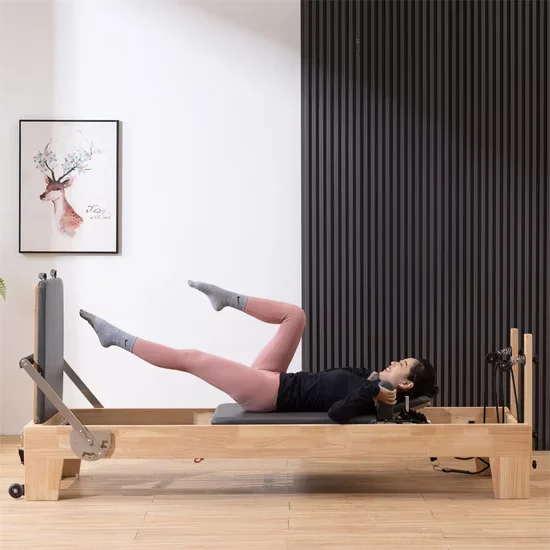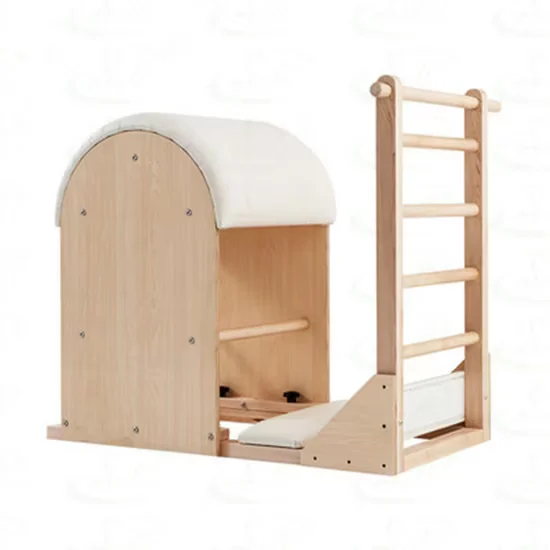
Structural Vibration Damping — Solid wood frame construction with reinforced joinery eliminates transmitted noise to adjacent rooms during high-load Pilates movements.
Technical Specifications
| Parameter | Value |
|---|---|
| Designation | SRY-03 |
| Product Type | Pilates Ladder Barrel |
| Material | Wood |
| Color | Solid Color |
| Specification | 1100770980mm |
| Net Weight | 50kgs |
| User Age Group | Adult |
| Gender | Unisex |
| Logo | Customized Is Allowed |
| Warranty | 3 Years |
| Production Capacity | 800 Pieces/Month |
| HS Code | 9506911900 |
Application Suitability
| Deployment Scenario | Typical Use |
|---|---|
| Boutique Pilates studio | Spinal articulation and core stabilization exercises between reformer sessions |
| High-end residential wellness center | Daily flexibility and back extension routines for private users |
| Rehabilitation and physiotherapy facility | Controlled spinal decompression and postural retraining under supervision |
| Hotel fitness center on guest room floors | Quiet stretching and mobility work without disturbing adjacent rooms |
| Chain gym functional training zone | Supplemental mobility station complementing mat and apparatus programming |
Why Vibration Complaints Reach the Studio Owner Before the Equipment Supplier Does
A solid wood frame with proper joinery absorbs movement energy instead of transmitting it through the floor.
Pilates studios operating in mixed-use commercial buildings or hotel floors face a recurring problem: equipment that looks stable during slow controlled movements starts transmitting low-frequency vibration through the structure once users perform dynamic barrel work [NEED_CITE: structural vibration transmission in multi-use fitness facilities]. Metal-framed barrels with hollow tube construction act as resonance chambers, amplifying every shift in weight into the floor slab. Facility managers hear about it from neighboring tenants before maintenance even logs a ticket.
The commercial Pilates ladder barrel wood frame addresses this at the material level. Solid timber has inherent damping properties that dissipate vibrational energy rather than conducting it. When a 70kg user rolls over the barrel crest during a swan dive, the wood absorbs the transient load instead of channeling it into the floor structure.
Positioning Within a Commercial Pilates Apparatus Layout
The SRY-03 ladder barrel occupies a specific role in studio programming: spinal articulation, back extension, and advanced core work that reformers and cadillacs cannot replicate. It serves as the dedicated station for movements requiring curved-surface support, from basic pelvic tilts to full barrel rolls and side-lying mermaid stretches. In a facility layout, it complements reformers and trap tables by handling the flexion-extension spectrum.
This commercial Pilates ladder barrel wood unit suits deployment in studios running 6-10 group classes daily, positioned along perimeter walls where its 1100mm length fits between reformer bays. The 50kg weight and 180kg-class structural stability accommodate users across the adult body composition range without repositioning between sessions. The apparatus supports passive stretching, active articulation, and loaded core positions without requiring spring tension adjustments or accessory swaps.
Continuous Use and Deployment Environment Considerations
Unlike motorized cardio equipment, the ladder barrel has no duty-cycle rating in the traditional sense, but structural fatigue under repetitive commercial loading is the equivalent concern. A studio running eight classes daily will see the barrel承受 hundreds of mounting, dismounting, and weight-shifting cycles per week [NEED_CITE: commercial Pilates equipment load cycle expectations]. The reinforced joint design addresses this by preventing the gradual loosening that causes creaking in lesser-constructed units.
Floor deployment matters for vibration transmission. Units placed on upper floors of multi-tenant buildings should sit on high-density rubber mats to further isolate residual vibration from the structure below. Ground-floor studios with concrete slabs have less concern but still benefit from leveling checks after the first month of use, as timber frames settle under sustained load. The 1100*770mm footprint requires approximately 2.5 square meters of clear floor area including approach clearance on both sides.
Humidity control affects long-term wood stability. Facilities maintaining 40-60% relative humidity will see minimal dimensional movement in the frame. Studios in tropical climates without climate control should specify moisture-resistant finish options during the OEM customization phase.
Wood Joinery and Frame Engineering Decoded
The choice between solid wood and welded steel for Pilates apparatus frames involves trade-offs that affect both performance and maintenance. Steel frames offer uniform rigidity but transmit vibration efficiently, which becomes problematic in shared-occupancy buildings. Solid wood frames provide natural damping but require different engineering approaches to joint integrity.
Reinforced joinery on the SRY-03 uses mortise-and-tenon connections at primary load paths rather than simple dowel or screw assembly. This means the barrel crest, ladder uprights, and base rails transfer force through interlocking wood geometry instead of relying solely on fastener shear strength. Over years of commercial use, this prevents the progressive loosening that causes rattling and requires periodic re-tightening in screw-assembled units.
The 50kg net weight reflects material density sufficient to resist tipping during asymmetric loading — when a user performs side-lying work with weight concentrated on one end of the barrel. Lighter units require floor anchoring or wide outrigger bases to achieve equivalent stability. The solid color finish penetrates the wood grain rather than sitting on the surface, resisting the sweat and cleaning chemical exposure inherent to studio environments.
The Hidden Cost of Frame Specification Compromises
Studios that select ladder barrels based on visual similarity rather than structural specification discover the difference within the first year of commercial operation. Hollow-tube steel frames develop audible creaking at welded joints as repeated loading fatigues the weld zones. Screw-assembled wood frames require quarterly fastener checks to prevent loosening, and missed maintenance windows result in customer complaints about equipment noise during quiet concentration phases of class [NEED_CITE: Pilates studio equipment maintenance frequency standards].
Lighter-weight barrels that save on shipping cost create a different problem: users feel instability during dynamic movements and lose confidence in the apparatus. Instructors spend class time coaching caution instead of progression. Facilities replacing under-specified equipment within two years spend more on the replacement cycle than they would on properly weighted units from the start.
Why This Product Line Addresses Studio Procurement Concerns
The SRY-03 was developed with commercial Pilates facility requirements driving the specification decisions. Solid wood construction with reinforced joinery eliminates the vibration transmission that causes tenant complaints in multi-use buildings. The 3-year warranty reflects confidence in long-term structural integrity under repetitive loading.
OEM customization covers logo placement and finish color, allowing multi-location studio chains to maintain visual brand consistency across all apparatus. Dimensional customization accommodates space-constrained boutique studios where standard 1100mm length requires adjustment for specific wall placements. The 800 pieces per month production capacity supports full-studio outfitting orders without extended lead times.
Free 3D studio layout planning addresses the spatial coordination challenge: ladder barrel placement relative to reformers, cadillacs, and mat zones affects both class flow and instructor sightlines. The layout service covers equipment spacing, member circulation paths, and ventilation requirements specific to Pilates environments where heat generation differs from cardio zones. Documentation includes structural load testing records and material finish specifications for facility compliance review.
Documentation & Test Records
- CE declaration of conformity for Pilates apparatus
- EN 957 test report covering structural load and stability
- ISO 9001 certificate for manufacturing quality management
- Structural load testing documentation with maximum user weight verification
- Wood material grade and finish specification sheet
- OEM customization scope and MOQ confirmation documentation
Installation, Commissioning & Maintenance
- Verify 1100*770mm footprint clearance with minimum 600mm approach space on ladder and barrel sides
- Level unit on deployment surface using adjustable feet; confirm no rocking under asymmetric load
- Inspect all joinery connections after first 30 days of commercial use; re-tighten if any movement detected
- Clean wood surfaces with pH-neutral cleaner only; avoid ammonia-based products that degrade finish
- Reapply wood finish annually in high-humidity environments to maintain moisture barrier integrity
- Check ladder rung security quarterly; replace any rung showing visible wear or loosening
Sizing Your Studio Order and Customization Requirements
Provide your studio floor plan with dimensions and existing apparatus layout to receive a 3D placement plan showing optimal barrel positioning relative to other equipment. Specify whether ceiling height or wall proximity requires dimensional adjustment from the standard 1100770980mm envelope.
Indicate your facility’s humidity control capability to determine whether standard or moisture-resistant finish is appropriate. Multi-location chains should provide brand guidelines for logo placement and finish color matching. State your target market for any applicable compliance documentation requirements beyond standard CE and EN 957 coverage.
Frequently Asked Questions
Q: Solid wood vs metal frame — which lasts longer in a commercial Pilates studio?
A: Solid wood frames with reinforced joinery typically outperform metal in vibration-sensitive environments because they do not develop fatigue cracks at weld points. Metal frames transmit more vibration to the floor structure, which becomes a problem in multi-tenant buildings. Both materials can achieve long service life when engineered correctly, but wood requires humidity control maintenance that steel does not. The choice depends on deployment environment and acoustic requirements.
Q: How do I customize ladder barrel dimensions for a space-constrained studio?
A: The standard 1100770980mm specification can be adjusted through OEM customization for facilities with specific wall placements or ceiling height limitations. Provide your studio floor plan with exact available space dimensions, and the engineering team will confirm which parameters can be modified without compromising structural stability or exercise range of motion. Lead times for custom dimensions are typically longer than standard specification orders.
Q: What OEM branding options are available for multi-location studio chains?
A: Logo customization is available on the ladder barrel frame, with placement options and size determined during the scoping phase. Finish color can be matched to your brand palette for visual consistency across all locations. Multi-location orders can specify uniform branding and finish across the entire equipment list. Minimum order quantities for custom branding differ from standard specification orders and should be confirmed during inquiry.
Q: What maintenance does a wood Pilates ladder barrel require in high-frequency use?
A: Wood equipment in commercial studios requires regular cleaning with pH-neutral products to prevent sweat residue from degrading the finish. Joint connections should be inspected after the first month and quarterly thereafter for any loosening under repetitive loading. Annual finish reapplication may be necessary in environments with humidity fluctuations. Unlike metal frames, wood does not develop weld fatigue but does require moisture management to prevent dimensional movement.
Q: Ladder barrel vs spine corrector — which should I prioritize for studio programming?
A: The ladder barrel offers a broader range of exercises including advanced articulation, side-lying work, and deep stretching that the smaller spine corrector cannot accommodate. Spine correctors excel at targeted thoracic mobilization and are more portable for mat classes. Most commercial studios deploy both: ladder barrels as permanent perimeter stations and spine correctors as supplemental accessories that move between class formats. Programming requirements determine the ratio of each apparatus type.
![Senrui Fitness Folding Reformer Bed Oak Wood Foldable Pilates Reformer [WARN] draft identifier mismatch](https://bicksport.com/wp-content/uploads/2026/08/senrui-fitness-folding-reformer-bed-oak-wood-foldable-pilates-reformer-warn-draft-identifier-mismatch-1ad75d.webp)