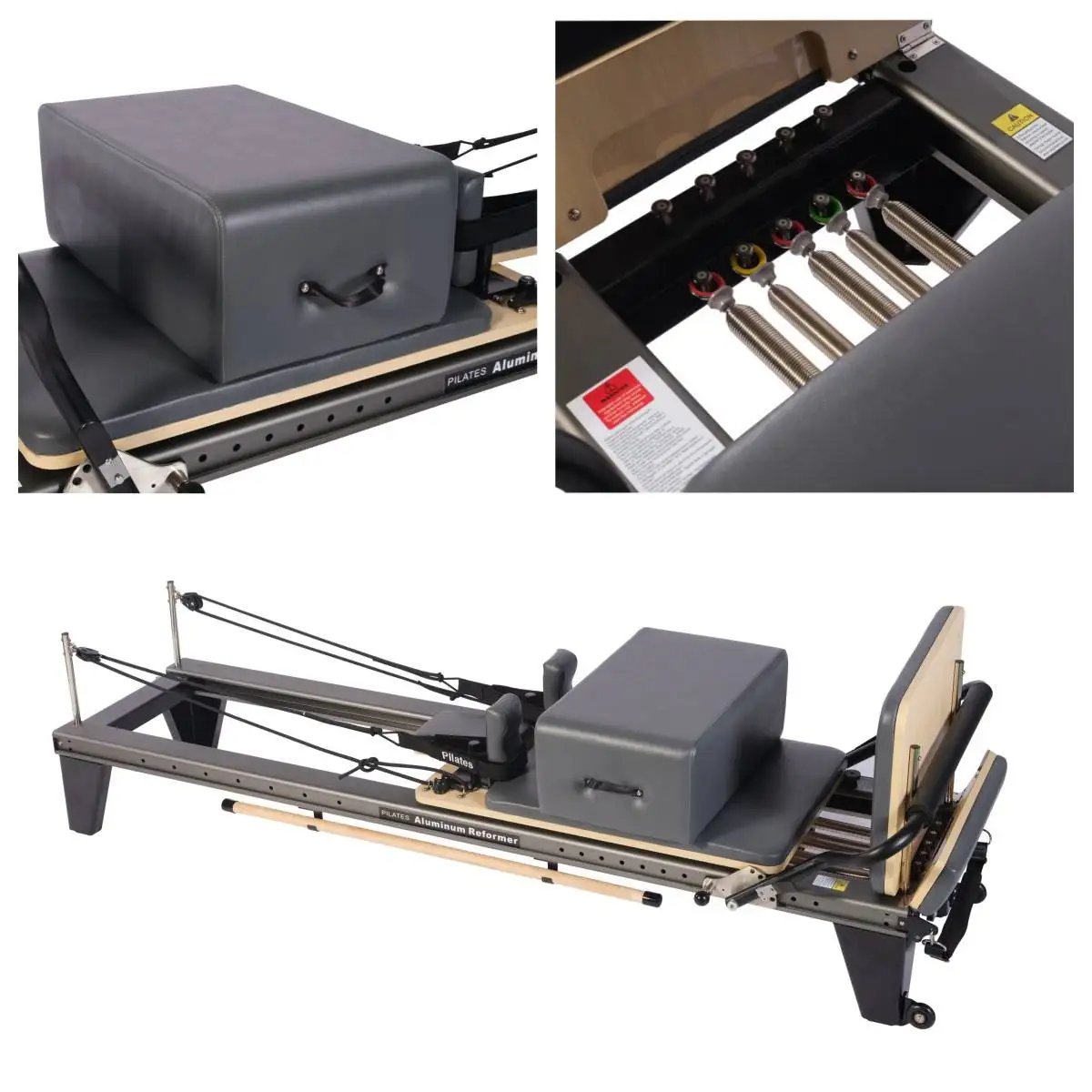
![Reformer Maple Wood Pilates Full Track Flat Bed Core Training Equipment [WARN] draft identifier mismatch](https://bicksport.com/wp-content/uploads/2026/08/reformer-maple-wood-pilates-full-track-flat-bed-core-training-equipment-warn-draft-identifier-mismatch-3c39d2.webp)
Reformer Maple Wood Pilates Full Track Flat Bed Core Training Equipment
Whisper-Quiet Carriage Glide — Precision-machined full-track rails on solid maple wood frames eliminate the rattle and vibration that bleed into adjacent studio rooms during high-frequency core training sessions.
Technical Specifications
| Parameter | Value |
|---|---|
| Product Type | Pilates Reformer |
| Frame Material | Solid Maple Wood |
| Track System | Full Track Flat Bed |
| Dimensions | 2460 × 730 × 680 mm |
| Net Weight | 100 kg |
| Accessories Included | Long Box / Jump Board / Platform |
| Color Options | Solid Color |
| User Type | Adult, Unisex |
| Logo Customization | Available |
| Origin | China |
| Production Capacity | 80 Pieces/Month |
| Warranty | 3 Years |
Application Suitability
| Deployment Scenario | Typical Use |
|---|---|
| Boutique Pilates studio | Group reformer classes with back-to-back scheduling and high carriage cycle counts |
| Commercial fitness center mind-body room | Dedicated reformer zone complementing cardio and strength floors |
| Rehabilitation and physiotherapy clinic | Low-impact core stabilization sessions with smooth resistance transitions |
| High-end residential home gym | Daily personal practice in shared living spaces where noise carries |
| Professional sports training center | Athlete recovery sessions emphasizing controlled eccentric loading |
Why Studio Operators Replace Reformers Before the Frame Shows Wear
Track degradation and carriage noise drive equipment swaps far more often than structural failure.
In multi-room studio environments, a reformer with imprecise rail tolerances begins producing audible carriage chatter within the first season of group class use. That vibration transmits through maple wood frames and hardwood floors directly into adjacent yoga or mat classes. Operators start receiving complaints about disrupted concentration [NEED_CITE: noise transmission thresholds in shared fitness studio environments]. The commercial Pilates reformer maple wood full track flat bed configuration addresses this at the source — a continuous rail profile with tight machining tolerances keeps the carriage gliding without lateral play, even after repeated loading cycles from unbalanced user weight distribution.
Positioning Within the Studio Equipment Mix
This reformer occupies the controlled-strength end of a studio floor plan, bridging mat-based core work and higher-intensity conditioning. The full-track flat bed accommodates the complete range of Pilates repertoire — supine footwork, seated arm series, and long box prone work — without requiring the instructor to adjust track limits mid-class. In a mixed-equipment deployment, it pairs naturally with Cadillac towers and Wunda chairs for progressive resistance programming. The 100 kg frame mass anchors the unit during Jump Board plyometric sequences, minimizing walk-off on polished concrete or sprung wood floors. User height ranges from approximately 155 cm to 190 cm are comfortably served by the 2460 mm bed length with full carriage travel remaining for overhead pull strap exercises.
Continuous Operation and Studio Environment Requirements
In a studio running four to six group classes daily, each reformer carriage completes hundreds of full-track cycles between maintenance intervals. The maple wood frame dampens operational vibration differently than welded steel, reducing structure-borne noise that reaches rooms below [NEED_CITE: vibration isolation properties of solid hardwood versus tubular steel frames]. Deployment on upper floors of mixed-use buildings requires attention to sub-floor rigidity — any flex in the joist system amplifies carriage impact during Jump Board work. Standard 220–240V single-phase power is not required since this unit operates purely on spring-based resistance, but adequate ambient ventilation around the 2460 × 730 mm footprint prevents sweat accumulation on the maple surface from warping the bed over time. A minimum 600 mm clearance on all sides allows instructor circulation and safe boarding.
Rail Profile and Spring Resistance Dynamics
The full-track flat bed design maintains uniform carriage contact across the entire glide path, eliminating the dead zones that appear when partial-track systems allow the carriage to dip at the extremes of travel. Solid maple wood as a frame material provides inherent vibration absorption — high-frequency oscillation from spring recoil dissipates into the wood grain rather than radiating as audible hum through a metal chassis. The spring-based resistance system requires no electrical supply, eliminating motor heat buildup and power cable management in tight studio layouts. Resistance modulation through spring attachment points gives instructors analog control over loading curves, from light rehabilitation protocols to heavy eccentric conditioning. The Long Box, Jump Board, and Platform accessories mount directly to the carriage rail system, maintaining alignment without secondary fastening hardware that can loosen under cyclic loading.
The Hidden Cost of Underspecified Track Hardware
Reformers built with partial-track or under-gauged rail systems develop carriage play that manifests as lateral wobble during asymmetric exercises like single-leg footwork. Instructors compensate by reducing exercise complexity, which limits class programming variety and drives member disengagement [NEED_CITE: equipment capability impact on studio retention rates]. When carriage wheels wear unevenly against misaligned rails, replacement intervals compress from annual to quarterly. In high-turnover studio deployments, this maintenance burden compounds across a fleet of eight to twelve machines. Studios that initially saved on equipment procurement end up facing cumulative downtime and parts costs that exceed the price differential within the first two years of operation. The maple wood frame’s dimensional stability under humidity cycling further reduces seasonal track realignment needs compared to laminated or composite alternatives.
Why This Product Line Fits Commercial Studio Deployment
The full-track system on this reformer undergoes loaded cycle testing that simulates the carriage travel patterns of actual group class choreography, not just linear back-and-forth motion. Solid maple wood sourcing ensures frame density consistency across production batches, which matters when an operator is outfitting twelve identical stations and needs uniform tactile feedback. The accessory ecosystem — Long Box for supine exercises, Jump Board for plyometric intervals, Platform for standing balance work — arrives calibrated to the carriage rail, eliminating field fitting. OEM customization covers logo placement and color matching so franchise operators maintain brand consistency across locations without post-delivery finishing work. The three-year warranty reflects confidence in track hardware and spring anchor points surviving sustained commercial duty cycles. Technical support covers deployment planning including room layout with airflow considerations for humidity-sensitive maple surfaces.
Documentation & Test Records
- CE conformity declaration covering mechanical safety requirements for fitness equipment
- EN 957 test report validating structural integrity under cyclic loading
- ISO 9001 certificate covering manufacturing quality management systems
- Frame material certification confirming solid maple wood construction
- Carriage glide consistency test records from loaded cycle validation
- Installation and commissioning guide with studio spacing requirements
Installation, Commissioning & Maintenance
- Maintain minimum 600 mm clearance around the 2460 × 730 × 680 mm footprint for instructor access
- Verify sub-floor flatness within tolerance before anchoring to prevent frame twist under load
- Inspect carriage wheel bearings and rail contact surfaces monthly under group class frequency
- Lubricate spring attachment points quarterly to prevent corrosion from studio humidity
- Clean maple wood surfaces with pH-neutral solutions only to avoid finish degradation
- Check Long Box and Jump Board mounting hardware for looseness after every 500 class cycles
Planning Your Reformer Studio Deployment
Provide your studio floor plan with total square footage and target station count to receive a 3D layout that accounts for instructor sightlines, member flow between equipment, and HVAC airflow across maple wood surfaces. Specify whether deployment is ground-level or upper-floor to confirm vibration isolation requirements for Jump Board use. Indicate your target market’s humidity range so we can advise on seasonal frame care protocols. State whether OEM logo customization and color matching are required for brand alignment across multiple locations.
Frequently Asked Questions
Q: How does a solid maple wood frame compare to steel for commercial studio use?
A: Solid maple wood provides inherent vibration dampening that steel frames lack, which matters when reformers are deployed in multi-room studios where sound carries between classes. The wood grain absorbs high-frequency oscillation from spring recoil rather than transmitting it as audible resonance. Maple also maintains dimensional stability under the humidity fluctuations typical of climate-controlled studio environments, reducing seasonal track realignment needs. The 100 kg frame weight provides stable anchoring during dynamic exercises like Jump Board sequences without additional floor mounting in most installations.
Q: What is the difference between full-track and partial-track reformer designs?
A: A full-track flat bed maintains consistent carriage contact and glide quality across the entire range of motion, which is critical when exercises require the carriage to reach the extremes of travel — such as long strap pulls or full-extension leg work. Partial-track designs can develop dead zones where carriage wheels lose optimal rail contact, creating uneven resistance feel and audible clicking. For commercial studios running varied class programming that cycles through the complete Pilates repertoire, full-track eliminates the need for instructors to avoid certain exercises due to equipment limitations.
Q: Which accessories are included and how do they integrate with the carriage system?
A: Each unit ships with a Long Box for supine and prone exercises, a Jump Board for plyometric conditioning intervals, and a Platform for standing balance and proprioception work. All accessories mount directly to the existing carriage rail geometry without requiring separate fastening brackets or aftermarket adapters. The mounting interfaces are machined to the same tolerance as the carriage track itself, ensuring that accessory attachment does not introduce lateral play or alter glide characteristics. This integrated approach eliminates the compatibility uncertainty that arises when sourcing accessories from separate suppliers.
Q: What floor space and clearance does each reformer require in a group class layout?
A: The unit footprint is 2460 × 730 mm with an additional 600 mm clearance recommended on all sides for instructor circulation and safe member boarding during class transitions. In a typical group studio configuration with rows of six to eight reformers, total room width should accommodate equipment width plus aisle space — approximately 1930 mm per station row-to-row. Ceiling height must allow full overhead arm extension during strap exercises without fixture interference, typically requiring 2400 mm minimum. Floor surface should be level and rigid to prevent frame twist that accelerates carriage track wear.

![Senrui SRY-02 Wood Pilates Reformer for Home Use Studio [WARN] draft identifier mismatch](https://bicksport.com/wp-content/uploads/2026/08/senrui-sry-02-wood-pilates-reformer-for-home-use-studio-warn-draft-identifier-mismatch-5ecfa6.webp)
![Sry-03 Natural Wooden Pilates Ladder Barrel for Studio Physical Therapy [WARN] draft identifier mismatch](https://bicksport.com/wp-content/uploads/2026/08/sry-03-natural-wooden-pilates-ladder-barrel-for-studio-physical-therapy-warn-draft-identifier-mismatch-127801.webp)