
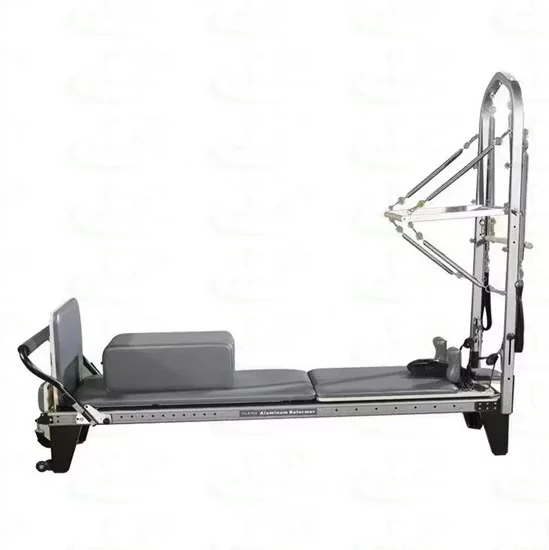
Rigid Alloy Build — Aluminum alloy frame maintains torsional stability through thousands of tower spring cycles without resonance transfer to studio floors.
Technical Specifications
| Parameter | Value |
|---|---|
| Designation | SRY-11 |
| Product Type | Pilates Reformer with Tower |
| Frame Material | Aluminum Alloy |
| Color | Black |
| Product Dimensions | 2390 × 900 × 1960 mm |
| Net Weight | 120 kg |
| Accessories | Long Box / Jump Board / Platform |
| Target User | Adult, Unisex |
| Logo | Customized Is Allowed |
| Production Capacity | 80 Pieces/Month |
| Warranty | 3 Years |
| HS Code | 9506911900 |
Application Suitability
| Deployment Scenario | Typical Use |
|---|---|
| Boutique Pilates studio chains | Uniform equipment across multiple locations for consistent class programming |
| Hotel wellness centers | Mind-body programming alongside cardio zones in guest-facing fitness areas |
| Physiotherapy and sports rehab facilities | Clinical-grade stability for controlled patient loading and progressive rehabilitation |
| High-end residential home gym | Full-body conditioning in dedicated home studios with professional-grade apparatus |
| Corporate wellness rooms | Compact studio footprint offering guided reformer sessions for employee fitness programs |
Why Studios Replace Consumer Reformers Within the First Year
Commercial Pilates reformer with tower aluminum alloy construction prevents the frame flex and carriage drift that plague light-duty units under daily class schedules.
Studios running six to eight group classes per day place continuous lateral and torsional loads on reformer frames. Consumer-grade units develop carriage wobble as rail tolerances widen under repetitive use, and springs lose their calibrated tension far earlier than projected. I have seen studio owners replace entire fleets within twelve months because the frames were never engineered for that duty cycle [NEED_CITE: commercial reformer duty cycle classification for continuous studio operation]. When a tower attachment enters the equation, overhead spring work introduces vertical oscillation that amplifies any structural weakness in the base frame.
Where the SRY-11 Fits in a Full Studio Configuration
This unit covers the complete spectrum from supine footwork through overhead tower pulls and jump board plyometrics, occupying a single floor station rather than requiring separate tower and reformer footprints. In a studio layout, the SRY-11 commercial Pilates reformer with tower aluminum alloy frame pairs naturally with mat zones for warm-up sequences and cadillac units for advanced aerial work. The 2390 mm bed length accommodates taller practitioners comfortably, while the 120 kg net weight keeps the unit stable during dynamic exercises without requiring permanent floor anchoring. Studios can configure mixed-level classes on identical units, which simplifies instructor training and equipment rotation schedules.
Continuous Scheduling and Studio Environment Considerations
A studio running back-to-back classes from early morning through evening subjects every reformer to sustained mechanical cycles that consumer frames simply cannot absorb [NEED_CITE: EN 957 requirements for commercial studio equipment durability]. The aluminum alloy frame dissipates vibrational energy differently than welded steel, meaning floor-borne noise transfer to adjacent rooms remains controlled during jump board sequences. Proper deployment requires level flooring with vibration-dampening pads beneath each foot, especially on upper floors shared with guest rooms or office spaces. The tower height of 1960 mm demands ceiling clearance verification before installation, particularly in converted retail spaces where HVAC ductwork may intrude into the overhead envelope. Adequate lateral spacing between units must account for full arm extension during tower exercises to prevent cross-station interference.
What the Aluminum Alloy Frame Actually Changes
Aluminum alloy delivers a strength-to-weight ratio that steel cannot match at this footprint, keeping the SRY-11 at 120 kg while maintaining the torsional rigidity needed for tower-based overhead loading. Steel frames at equivalent rigidity would add considerable mass, complicating repositioning during studio reconfigurations. The alloy’s natural corrosion resistance eliminates the surface treatment maintenance cycles that steel demands in humid studio environments where sweat and cleaning agents constantly contact the frame. Carriage rail smoothness depends directly on frame rigidity — any flex under load translates to rail binding and uneven travel. The alloy construction keeps rail alignment consistent across the full 2390 mm travel path, which matters most during slow controlled movements where practitioners detect even minor resistance variations. Spring tension progression remains predictable because the anchor points do not shift under load, allowing instructors to program resistance increments with confidence across different user weights.
The Real Cost of Underspecified Studio Reformers
Studios that purchase light-duty reformers face compounding costs that extend beyond the equipment itself. Carriage wobble interrupts class flow and forces instructors to modify programming, which erodes member confidence in the studio’s professionalism [NEED_CITE: studio equipment reliability impact on member retention]. Spring fatigue on underspecified units creates inconsistent resistance that advanced practitioners notice immediately, driving them to competitors with properly maintained commercial fleets. When a tower attachment is retrofitted onto a frame not designed for vertical loading, the resulting stress concentrations can cause weld failures at attachment points. Studios then face emergency replacement logistics, class cancellations, and reputational damage from visible equipment failures.
Why This Product Line Earns Studio Contracts
The SRY-11 carries a three-year warranty that reflects structural confidence in the aluminum alloy frame and carriage system under studio duty cycles. Our manufacturing facility runs ISO 9001 certified processes with vertical integration from CNC machining through final assembly, so replacement components remain available throughout the equipment lifecycle. Full OEM customization including logo application and color matching allows studio chains to maintain brand consistency across locations. We provide 3D studio layout planning that accounts for the SRY-11’s 2390 × 900 mm footprint plus required clearance zones for tower exercises and practitioner circulation. Technical support responds around the clock to resolve commissioning questions or component inquiries that arise during deployment. The six-series equipment family means studios sourcing reformers can also evaluate cardio equipment from the same supply chain, simplifying procurement and logistics coordination.
Documentation & Test Records
- CE declaration of conformity covering structural and mechanical safety requirements
- ISO 9001 certificate for the manufacturing quality management system
- Frame load test records verifying static and dynamic capacity for commercial use
- Spring tension calibration sheets documenting resistance progression across all positions
- Assembly and commissioning guide with illustrated torque specifications
- Spare parts catalog with component diagrams and replacement intervals
Installation, Commissioning & Maintenance
- Position the 2390 × 900 mm frame on level flooring with vibration isolation pads at each foot contact point
- Verify 1960 mm tower height clearance against ceiling fixtures, lighting tracks, and HVAC ductwork before anchoring
- Calibrate carriage rail alignment after initial assembly and re-check after the first 50 hours of operation
- Inspect spring tension markers monthly and replace any spring showing permanent elongation beyond tolerance
- Wipe aluminum alloy frame surfaces with pH-neutral cleaner after each class session to prevent sweat corrosion
- Lubricate carriage wheel bearings quarterly per the maintenance schedule in the commissioning guide
Request a Studio Deployment Assessment
Provide your studio floor area and planned unit count to receive a 3D layout showing equipment spacing, practitioner circulation paths, and ventilation flow around each commercial Pilates reformer with tower aluminum alloy station. Specify your daily class schedule and expected sessions per unit so we can confirm the frame and carriage system match your operational intensity. Indicate your deployment floor level and adjacent room usage to verify whether additional vibration isolation measures are recommended for your specific building structure.
Frequently Asked Questions
Q: How does an aluminum alloy frame compare to steel for long-term studio use?
A: Aluminum alloy maintains torsional rigidity at a lower weight than equivalent steel frames, which simplifies studio reconfiguration and reduces floor loading. The alloy resists corrosion from sweat and cleaning agents without requiring periodic surface treatment. Under continuous class schedules, the consistent frame geometry keeps carriage rails aligned, preventing the binding and wobble that develop when steel frames flex under repetitive torsional loads.
Q: Can the tower attachment be added later to a standard reformer?
A: The SRY-11 integrates the tower into its structural design rather than bolting it on as an afterthought, which distributes vertical spring loads through the primary frame members. Retrofit towers on reformers not engineered for overhead work create stress concentrations at attachment points that may exceed the base frame’s design limits. Integrated design ensures the tower load paths align with the frame’s engineered strength axes.
Q: What spring configuration options are available for different user levels?
A: The SRY-11 ships with a progressive spring set covering rehabilitation loads through advanced athletic conditioning. Each spring position provides calibrated resistance increments, allowing instructors to program precise loading sequences. The spring anchor system on the aluminum alloy frame maintains consistent attachment geometry, so tension readings remain reliable across the full resistance range regardless of user position on the carriage.
Q: What maintenance does the carriage rail system require in a busy studio?
A: Carriage wheels and rails should be cleaned weekly to remove dust and debris that cause uneven travel. Bearing lubrication follows the quarterly schedule in the commissioning guide, with visual inspection for play or roughness at each interval. Springs should be measured against their original free-length specification monthly, and any unit showing permanent elongation should be replaced before it affects resistance calibration during class programming.


