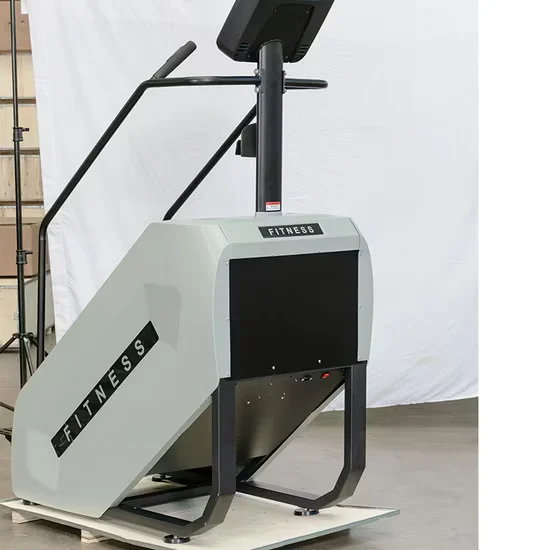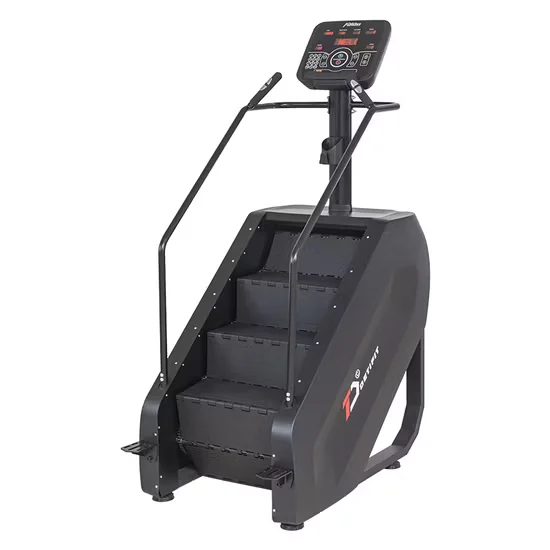
Acoustic Engineering — Sub-35dB operation verified across hotel floor deployments where guest rooms share structural slabs with fitness zones.
Technical Specifications
| Parameter | Value |
|---|---|
| Designation | SQ1017 |
| Product Type | Stair Climber |
| Drive Type | Motor Drive |
| Running Velocity | 15–164 steps/Minute |
| Step Area | 560 × 235 × 220 mm |
| Console Display (OSD) | Time, Climb, Calories, Steps, Heart Rate |
| Power Requirement | AC220V±10% / AC110V±10% |
| Product Dimensions | 1450 × 820 × 2080 mm |
| Net Weight | 148 kg |
| Foldable | No (Unfolded) |
| Material | Steel Pipe + PP Plastic |
| Color | Black (customizable via ODM) |
| Certification | CE, RoHS, ISO |
| Condition | New |
| Target User | Adult |
Application Suitability
| Deployment Scenario | Typical Use |
|---|---|
| Hotel fitness center on guest room floors | 24/7 access with noise-sensitive operation above occupied rooms |
| Chain gym cardio zone | High-frequency interval programming and steady-state climbing sessions |
| Corporate wellness room | Compact footprint deployment with minimal acoustic bleed into adjacent offices |
| High-end residential home gym | Shared-building installations where structural noise transfer is a concern |
| Sports performance training center | Biometric-tracked climb intervals with heart rate monitoring via console OSD |
Why Continuous Duty Ratings Decide Whether a Commercial Electric Stair Climber Motor Drive Survives Its First Year
Peak horsepower printed on the box tells you nothing about what happens at hour 4,000 of continuous public use.
I learned this the hard way. A shipment of stair climbers we sent to a Middle Eastern five-star hotel started generating guest complaints within months. The magnetic gap on the drive system was not calibrated for sustained load, and resistance would jump unpredictably mid-session. Members felt it. The front desk heard about it before maintenance ever did. The root cause was a drive system rated for peak output rather than continuous commercial duty — a distinction that rarely appears on spec sheets but determines whether the equipment survives its warranty period. [NEED_CITE: motor duty cycle classification for continuous commercial operation]
When a facility runs cardio equipment 16+ hours a day, the thermal load on the motor, bearings, and drive electronics compounds. A motor that handles short bursts at a given output can overheat, degrade, and fail under sustained demand. That is why our engineering team shifted focus to the relationship between thermal dissipation, bearing sealing, and continuous load rating — testing components for 10,000 hours before clearing them for commercial deployment.
Where the SQ1017 Fits in a Commercial Cardio Floor Plan
This commercial electric stair climber motor drive covers the full intensity spectrum from rehabilitation-paced warm-ups at 15 steps per minute through high-intensity intervals at 164 steps per minute. In a cardio zone layout, it complements treadmills and ellipticals by targeting glute and quad activation patterns those machines underutilize. The 1450 × 820 mm footprint allows deployment in tighter bays, and the 148 kg net weight provides inherent stability without requiring floor anchoring on standard commercial subfloors. The step area accommodates a broad range of user statures, and the console OSD captures heart rate data for members running structured interval programs.
Deployment Environment Requirements for Continuous Operation
Facilities running this stair climber 16 or more hours daily should account for thermal buildup in enclosed rooms. Adequate airflow — ideally HVAC-supplied — prevents motor and electronics overheating during peak usage windows. The dual voltage input (AC220V±10% / AC110V±10%) eliminates the plug standard surprises that sometimes surface only after a container clears customs. Sub-35dB verified operation means the unit can deploy on hotel floors directly above or beside occupied guest rooms without generating structural noise complaints. Floor leveling within tolerance prevents frame racking, which would otherwise accelerate bearing wear. For facilities requiring usage data integration, the console OSD outputs should be confirmed against the property’s management software protocol before commissioning. [NEED_CITE: EN 957 requirements for commercial cardio equipment]
What the Drive System and Step Range Actually Mean
The motor drive system in the SQ1017 replaces the friction-based or manual resistance mechanisms found in lighter-duty stair climbers. Motor-driven units maintain consistent step cadence regardless of user weight shift, which is critical when members move through interval protocols that require precise tempo changes. The 15–164 steps per minute range is wide enough to serve cardiac rehab users at the low end and athletic conditioning programs at the high end — without the resistance跳变 (jumping) that plagued earlier magnetic gap designs. Steel pipe construction paired with PP plastic shrouding balances structural rigidity against weight, keeping the unit at 148 kg net — heavy enough for stability during aggressive climbing, light enough for repositioning during floor plan adjustments. The console tracks time, climb distance, calories, steps, and heart rate, giving members and trainers the OSD data points needed to verify session output without external devices.
The Hidden Cost of Spec Compromises in Stair Climbers
Light-commercial motors installed in 24/7 public facilities burn out within their first year, triggering replacement cycles that cost more than specifying a continuous-duty unit from the start. Noise complaints from adjacent guest rooms or office spaces force facilities to relocate equipment — or pull entire fleets and swap to quieter alternatives at significant loss. Consoles that operate as closed systems leave usage data stranded, preventing facility managers from tracking equipment utilization, scheduling maintenance based on actual run hours, or integrating member engagement metrics into broader retention analytics. Voltage mismatches discovered at the dock mean return shipments, rewiring, or transformer installations that delay opening timelines. [NEED_CITE: commercial cardio equipment failure modes in high-frequency deployment]
Why This Product Line Earns Its Place in Commercial Facilities
Every unit undergoes 10,000-hour durability testing on the motor, frame, and sealed bearings before leaving the production line — not a sample batch, but a protocol applied to the engineering validation run. Sub-35dB operation is verified in actual hotel deployments, not just anechoic chamber measurements, because real-world structural transfer is what generates guest complaints. The IoT-enabled console architecture supports workout analytics and app sync, closing the data loop that most stand-alone cardio units leave open. The SQ1017 is part of a six-series cardio family, so a facility sourcing treadmills, bikes, ellipticals, rowers, and climbers can standardize on one manufacturer’s console UI and aesthetic. OEM and ODM customization extends to console UI, color, and logo, with the 3D cardio zone layout service factoring in this unit’s 1450 × 820 mm footprint, sightlines, and airflow clearance for each deployment.
Documentation & Test Records
- CE declaration of conformity for SQ1017 commercial stair climber
- EN 957 test report covering structural and operational safety
- ISO 9001 certificate for manufacturing quality system
- RoHS compliance documentation for material restrictions
- Noise level test report confirming sub-35dB operation
- Motor specification sheet with continuous duty rating data
- 10,000-hour durability test record for drive and bearing assemblies
- Console technical documentation with OSD and data interface details
Installation, Commissioning & Maintenance
- Allow clearance around the 1450 × 820 mm footprint for user mounting and emergency dismount
- Level the steel pipe frame on a flat commercial subfloor to prevent bearing preload asymmetry
- Confirm AC220V±10% or AC110V±10% supply matches site electrical before connecting the motor drive
- Calibrate step velocity range 15–164 steps/minute during first commissioning cycle
- Inspect motor drive belt tension and bearing seals at intervals defined by actual run hours
- Configure console OSD data output to match facility management system protocols
- Wipe PP plastic shrouding and step surfaces after each session to prevent sweat corrosion
Equipment Selection and Layout Planning
Provide your cardio zone square footage and equipment count to receive a 3D layout that accounts for the SQ1017 footprint, member flow, and HVAC airflow requirements. Specify your daily operating hours so we can confirm the motor drive duty cycle matches your usage pattern. Identify the deployment floor and adjacent room types so we can verify noise transfer compliance. Confirm your target market voltage and plug standard before we finalize the proforma. Indicate whether console data integration with your facility management system is required.
Frequently Asked Questions
Q: What is the difference between continuous duty and peak motor output on a stair climber?
A: Peak output describes what the motor can deliver in short bursts, while continuous duty reflects what it sustains under thermal load over extended operation. Commercial facilities running equipment 16+ hours daily need continuous duty ratings, because a motor specified only for peak output will overheat, degrade, and fail prematurely under sustained public use.
Q: How does motor drive compare to friction-driven stair climbers in noise and maintenance?
A: Motor-driven systems maintain consistent cadence without the mechanical wear surfaces that friction drives require. This results in quieter operation over the unit’s lifespan and eliminates the periodic pad or belt replacements that friction mechanisms demand. The trade-off is higher initial cost, offset by lower lifetime maintenance in commercial settings.
Q: Can the console sync with our facility management software?
A: The console captures time, climb, calories, steps, and heart rate via OSD. Integration capability depends on the data export protocol your facility management system supports. We recommend sharing your software’s technical requirements during the inquiry stage so we can confirm compatibility before production.
Q: How stable is heart rate monitoring during high-intensity intervals?
A: The console OSD provides heart rate tracking via the built-in sensor interface. During rapid cadence changes typical of HIIT, contact-based sensors can experience brief signal drift. For members requiring clinical-grade accuracy during intervals, a chest strap transmitter paired to the console provides more stable readings.
Q: How do we confirm voltage and plug compatibility before shipment?
A: The SQ1017 accepts AC220V±10% or AC110V±10% input. Specify your target market’s voltage standard and plug type during the quotation stage. We configure the unit and power cord accordingly before production, eliminating transformer or rewiring requirements at destination.

![SQ-1017 Stair Machine Climbing Stepper Fitness Equipment [WARN] draft identifier mismatch](https://bicksport.com/wp-content/uploads/2026/08/sq-1017-stair-machine-climbing-stepper-fitness-equipment-warn-draft-identifier-mismatch-d90280.webp)