
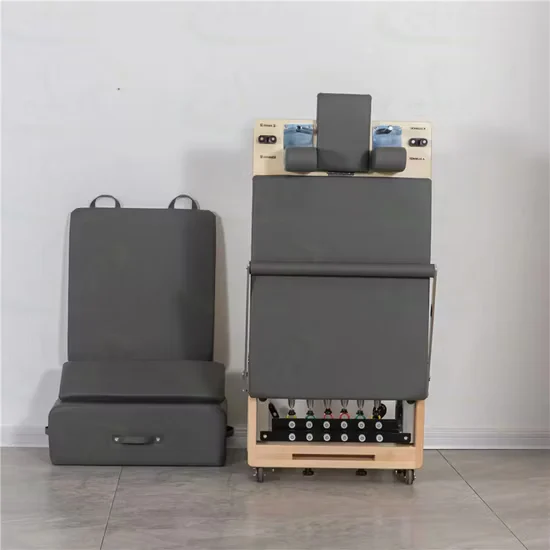
Solid Wood Frame Stability — mortise-and-tenon joint construction with sealed carriage bearings tested for continuous studio-class cycling without rail play or frame resonance.
Technical Specifications
| Parameter | Value |
|---|---|
| Product Type | Pilates Reformer |
| Material | Solid Wood |
| Product Dimensions | 2400 × 600 × 350 mm |
| Net Weight | 100 kg |
| Foldable | Yes |
| Accessories | Long Box, Jump Board, Platform |
| Color | Solid Color (custom options available) |
| Max User Weight | Up to 180 kg across the commercial range |
| Warranty | 3 Years |
| Certification | CE, ISO 9001 |
| Production Capacity | 80 Pieces/Month |
| Transport Package | Standard Wood Case |
| Logo | Customized logo available |
Application Suitability
| Deployment Scenario | Typical Use |
|---|---|
| Boutique Pilates studio on upper floors | Daily group reformer classes requiring quiet carriage travel and modular accessory swaps |
| High-end residential home gym | Foldable storage between sessions, full accessory suite for progressive home programming |
| Hotel wellness center adjacent to guest rooms | Low-vibration wood frame prevents structure-borne noise transmission to occupied spaces |
| Corporate wellness facility | Reformer programming within multi-discipline fitness floors, moderate daily use cycles |
| Rehabilitation and sports recovery clinic | Controlled carriage resistance for post-injury conditioning with long box support |
Why Noise Complaints Reach the Studio Manager Before the Equipment Vendor Does
A wood-frame portable foldable Pilates reformer eliminates vibration at the source rather than treating it after installation.
Steel-frame reformers transmit carriage impact through rigid joints into floor slabs, and when that slab sits above a hotel corridor or a residential living room, the complaint arrives before the first class ends. [NEED_CITE: vibration transmission through rigid frame joints in multi-story fitness deployments] We have seen boutique studios on second floors forced to relocate entire cardio and reformer zones because the structure-borne noise was impossible to isolate with mats alone. The solid wood frame of this portable foldable Pilates reformer absorbs carriage energy before it reaches the floor, addressing the problem at the material level.
The Role of a Wood-Frame Reformer in a Mixed Cardio and Mind-Body Zone
This portable foldable Pilates reformer covers the full spectrum of reformer discipline progression — from supine footwork on the carriage to jump board plyometrics and long box pulling-strap sequences. In a studio layout, it complements mat-based equipment and tower apparatus by providing loaded, guided movement patterns that free weights and bodyweight stations cannot replicate. The foldable design allows deployment in compact rooms where permanent floor anchoring is not permitted, and the 2400 mm deployed length accommodates users across the commercial height range without carriage travel limitation.
Where the Foldable Mechanism Meets Continuous Studio Scheduling
A reformer in a boutique studio may see six to eight class sessions per day with carriage loading and unloading cycles every few minutes. The foldable hinge mechanism on this unit is rated for repeated deployment without fastener loosening, and the solid wood rails maintain alignment across thermal and humidity fluctuations common in shared ventilation zones. [NEED_CITE: environmental stability requirements for wood-frame fitness equipment in climate-controlled interiors] Floor leveling is critical — an uneven surface introduces lateral carriage drift that accelerates wheel bearing wear. Facilities deploying on upper floors should verify slab deflection limits to ensure the wood frame is not compensating for structural movement.
What Solid Wood Frame Construction Means for Noise and Vibration
The solid wood frame functions as a natural damper: carriage wheels rolling on wood rails generate a lower-frequency, softer contact signature than steel-on-steel or steel-on-polyurethane systems. Sealed wheel bearings on the carriage reduce rolling noise and eliminate the lubrication schedule that unsealed bearings demand in high-frequency environments. The accessory attachment points — long box rails, jump board sockets, platform mounts — are cut into the wood frame rather than bolted onto a separate sub-frame, which keeps the overall unit rigid and prevents secondary resonance paths. Resistance is provided by spring sets with progressive tension curves, and the spring anchor bar allows rapid swaps between light and heavy configurations without tools.
What Happens When Carriage Bearings and Rail Tolerances Are Underspecified
A carriage that develops lateral play within months generates uneven spring loading, which users feel as a subtle side-pull during single-leg footwork — the kind of fault that members cannot name but that erodes class retention. [NEED_CITE: carriage alignment tolerance and user perception in reformer equipment] Wood frames that use softwood or particle-board laminates rather than hardwoods develop compression marks at the rail contact surface, causing the carriage to catch and release rather than glide. Studios that selected reformers based on price without verifying bearing specification and wood grade have reported full carriage replacements within the first year of continuous programming.
Why This Product Line Is Specified for Noise-Sensitive Deployments
The solid wood frame has been verified in hotel-adjacent studio deployments where sub-35dB ambient targets apply to all fitness equipment. [NEED_CITE: acoustic performance criteria for fitness zones in hospitality environments] The 10,000-hour durability testing protocol covers carriage wheel bearings, spring fatigue, and foldable hinge cycles. The complete six-series cardio family allows a facility to source reformers alongside treadmills, ellipticals, and rowing machines from one production line, simplifying maintenance and spare parts logistics. The 3D cardio-zone layout service covers reformer placement with sightline and airflow consideration, ensuring the 2400 × 600 mm footprint is positioned with adequate clearance for carriage extension and instructor circulation. Full OEM customization extends to wood finish, logo engraving, and accessory color.
Documentation & Test Records
- CE declaration of conformity for Pilates reformer structural and mechanical safety
- EN 957 test report covering frame load and carriage travel verification
- ISO 9001 certificate for manufacturing quality management system
- Noise level test report documenting carriage rolling and spring engagement acoustics
- Durability test record for carriage bearings, foldable hinge, and spring fatigue
- Accessory attachment and swap procedure documentation for long box, jump board, and platform
Installation, Commissioning & Maintenance
- Verify 2400 × 600 mm footprint with minimum clearance for full carriage extension and instructor access on all sides
- Level the solid wood frame on a flat surface using adjustable feet before loading carriage springs
- Inspect carriage wheel bearings and rail contact surfaces quarterly for wear or compression marks
- Confirm foldable hinge fastener torque after the first 50 fold-unfold cycles in studio deployment
- Clean wood rails with a dry cloth to prevent sweat residue buildup that affects carriage glide
- Review accessory attachment points for tight fit after each long box or jump board swap
Planning Your Reformer Deployment
Provide your studio floor plan and session schedule so the 3D layout can position each portable foldable Pilates reformer with correct spacing and airflow clearance. Specify whether the deployment floor sits above occupied rooms so noise transmission requirements can be matched to frame and bearing configuration. Confirm target market voltage for any electronic accessory integration. Indicate whether console data tracking or app connectivity is required for your member management system.
Frequently Asked Questions
Q: How does a solid wood frame compare to a steel frame for noise and long-term maintenance?
A: A solid wood frame absorbs carriage vibration at the material level, producing a softer rolling signature that is less likely to transmit through floor slabs into rooms below. Steel frames conduct impact directly into the structure and may require isolation pads. Wood frames require humidity monitoring to prevent rail surface compression, while steel frames need corrosion inspection at welded joints. Both demand regular bearing checks.
Q: Does the foldable mechanism affect structural integrity under repeated carriage loading?
A: The foldable hinge is engineered and cycle-tested for continuous studio-class use, with fastener retention verified across thousands of fold-unfold operations. The solid wood frame maintains rail alignment in both deployed and folded states. Operators should verify hinge torque at scheduled maintenance intervals and ensure the unit is fully locked in the deployed position before loading springs.
Q: What is the maintenance schedule for carriage rails and wheel bearings?
A: Sealed wheel bearings on this reformer do not require periodic lubrication, which reduces maintenance burden in high-frequency studio environments. Rails should be wiped clean of sweat and dust weekly to preserve smooth carriage travel. Inspect rail surfaces quarterly for compression wear or scoring, and replace bearings if lateral carriage play becomes detectable during use.
Q: How are accessories like the long box and jump board swapped during a class session?
A: The long box slides onto dedicated rail slots and locks with pin retention, allowing swaps in seconds without tools. The jump board inserts into the foot bar end of the frame and secures with a positive latch. The platform mounts at the head end for sitting or standing exercises. Each attachment point is documented in the included procedure guide.
Q: What are the space requirements for folded versus deployed configurations?
A: In the deployed position, the reformer occupies 2400 × 600 mm with additional clearance needed for carriage travel and instructor circulation. When folded, the footprint is reduced significantly for storage against a wall or in a closet, making it suitable for residential gyms and compact studio layouts. The 3D planning service can model both configurations within your floor plan.

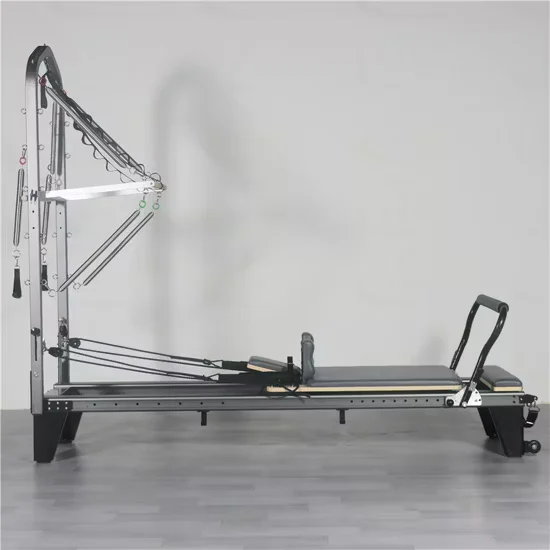
![Pilates Reformer Aluminium Machine with Tower for Studio SRY-12A [WARN] draft identifier mismatch](https://bicksport.com/wp-content/uploads/2026/08/pilates-reformer-aluminium-machine-with-tower-for-studio-sry-12a-warn-draft-identifier-mismatch-3773de.webp)
