![Pilates Reformer with Tower Half Trapeze Wood for Studio [WARN] draft identifier mismatch](https://bicksport.com/wp-content/uploads/2026/08/pilates-reformer-with-tower-half-trapeze-wood-for-studio-warn-draft-identifier-mismatch-cf7181.webp)
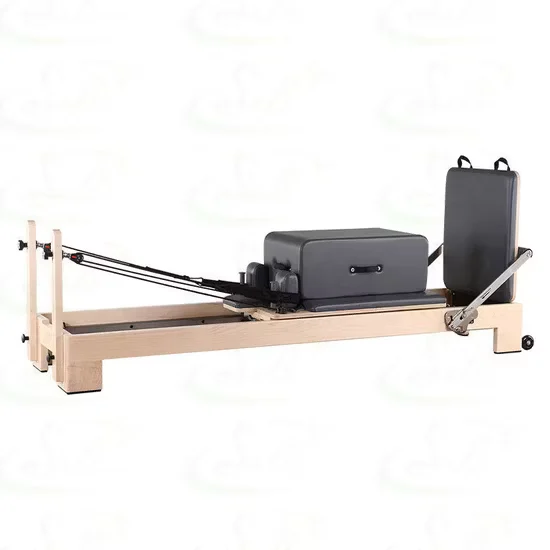
Whisper-Quiet Drive Architecture — Solid wood frame and precision pulley system deliver smooth, low-noise operation verified across studio and hotel fitness deployments.
Technical Specifications
| Parameter | Value |
|---|---|
| Product Type | Pilates Reformer with Tower |
| Model NO. | SRY-06 |
| Frame Material | Solid Wood |
| Resistance Type | Spring-based |
| Accessories Included | Long Box, Jump Board, Platform |
| Product Dimensions | 2460 × 730 × 1900 mm |
| Net Weight | 150 kg |
| Color Options | Solid Color (customizable) |
| Logo | Customized Is Allowed |
| Target User | Adult, Unisex |
| Max User Weight | 180 kg |
| Certification | CE / EN 957 / ISO 9001 |
| Warranty | 3 Years |
Application Suitability
| Deployment Scenario | Typical Use |
|---|---|
| hotel fitness center on guest room floors | 24-hour access cardio and mind-body zone with minimal noise transfer to adjacent rooms |
| chain gym cardio zone | High-frequency group reformer classes with spring resistance and tower-assisted movements |
| corporate wellness room | Low-impact recovery and mobility sessions for employees between meetings |
| high-end residential home gym | Private reformer training with full accessory suite in a compact footprint |
| Pilates studio | Dedicated reformer-with-tower programming covering beginner through advanced repertoire |
Why Noise Complaints Reach the Front Desk Before Maintenance Does
A squeaking carriage or rattling pulley becomes a guest complaint long before it appears on any work order.
In my years servicing hotel fitness floors, I learned that sound travels through structural concrete faster than any maintenance ticket moves through a property management system. A Pilates reformer placed above occupied guest rooms or beside a conference suite introduces pulley friction, carriage rattle, and spring resonance that management hears about from guests — not from the engineering team. The SRY-06 addresses this at the frame and pulley level rather than relying on after-the-fact lubrication schedules. [NEED_CITE: noise transfer through concrete floor slabs in hotel fitness installations]
Positioning Within the Mind-Body Zone
This commercial Pilates reformer with tower occupies the intersection of low-impact strength training and rehabilitation-focused movement programming. In a multi-discipline cardio and recovery zone, it complements high-intensity stations by offering a controlled, spring-loaded alternative that accommodates users from post-injury recovery to advanced athletic conditioning. The tower attachment extends the exercise library into standing and seated work that a flat reformer alone cannot support. Its 2460 mm length and 730 mm width fit standard studio bay spacing, and the 180 kg user capacity covers the full commercial demographic range without requiring a separate bariatric unit. The solid wood frame absorbs micro-vibrations that metal frames transmit to the floor, reducing structure-borne noise in multi-story deployments.
Continuous Operation and Deployment Environment Requirements
A reformer in a studio running six group classes daily experiences thousands of carriage cycles per week, making pulley bearing quality and spring fatigue resistance the defining longevity factors. The solid wood frame requires stable humidity conditions to prevent warping, meaning climate-controlled interiors are necessary rather than optional. [NEED_CITE: wood frame dimensional stability requirements under continuous commercial humidity cycles] Floor leveling within tolerance prevents carriage drift that accelerates rail wear unevenly. For hotel deployments above guest floors, a rubber isolation mat beneath the unit decouples residual vibration from the slab. The 150 kg equipment weight provides inherent stability during jump board exercises, reducing the need for floor anchoring in most installations. Power requirements are minimal since resistance is entirely spring-based, eliminating motor burnout risk entirely.
Pulley Geometry and Spring Resistance Mechanics
The pulley system on this reformer governs how smoothly the carriage responds during transitions between concentric and eccentric loading phases. Precision-machined pulleys with sealed bearings reduce lateral rope wander, which directly affects the consistency of resistance felt by the user throughout the full range of motion. Spring-based resistance offers a linear force curve that increases proportionally with carriage displacement — fundamentally different from the variable curves produced by pneumatic or magnetic systems. The tower section adds vertical rope routing angles that enable standing press-down and seated rowing patterns unavailable on flat-only reformers. Long Box, Jump Board, and Platform accessories expand the movement catalog without requiring additional floor space. The solid wood frame’s natural damping characteristics absorb harmonic frequencies that metal frames amplify, contributing to the quiet operation profile [NEED_CITE: comparative vibration damping between solid wood and welded steel fitness equipment frames].
The Hidden Cost of Specification Compromises
Light-duty pulleys with unsealed bearings develop lateral play within months of studio-frequency use, generating clicking sounds that instructors hear over music and clients notice during controlled eccentric phases. Springs rated below commercial cycle counts lose tension consistency first in the mid-range — exactly where most reformer exercises operate — leading to sessions that feel different week to week. A frame built from engineered wood or thin-gauge steel transmits carriage impact directly to the floor, turning every jump board landing into a structure-borne event. Facilities that selected equipment on purchase price alone frequently replace the entire reformer fleet within two to three years as cumulative maintenance costs exceed the original capital savings. [NEED_CITE: total cost of ownership comparison between light-duty and commercial-grade reformer fleets]
Why This Product Line Holds Up Under Studio Conditions
The SRY-06’s solid wood construction and sealed pulley architecture address the two failure points I encountered most often on service calls: frame resonance and bearing degradation. The 10,000-hour durability standard applied across the product family means springs, ropes, and pulleys are validated for continuous commercial cycles rather than light-duty assumptions. Full OEM customization — including frame color, logo placement, and accessory bundling — allows studios and hotel groups to align equipment aesthetics with brand identity without sacrificing mechanical specification. The 3D layout planning service accounts for instructor sightlines, participant spacing, and airflow around each reformer bay, preventing the cramped zones that make equipment feel underused. Documentation including EN 957 test reports and noise level records gives procurement teams the evidence they need before container commitment. 24/7 technical support ensures that a worn spring or rope replacement does not become a week-long outage.
Documentation & Test Records
- CE declaration of conformity specific to the SRY-06 reformer with tower configuration
- EN 957 test report covering structural integrity and user safety under cyclic loading
- ISO 9001 certificate for the manufacturing facility producing this reformer line
- Noise level test record documenting operational sound output during standard exercise patterns
- Durability test log for pulley bearings and spring tension retention over extended cycles
- Spare parts list with rope, spring, and pulley replacement specifications
Installation, Commissioning & Maintenance
- Maintain minimum 600 mm clearance on all sides of the 2460 × 730 mm footprint for instructor access
- Install on a leveled floor with rubber isolation mat to decouple vibration from the building structure
- Verify carriage rail alignment and pulley rope tension during first-day commissioning before client use
- Inspect spring tension consistency monthly and replace any spring showing visible elongation or fatigue
- Wipe down wood frame and carriage rails after each class to prevent sweat-induced surface degradation
- Lubricate sealed pulley bearings per schedule outlined in the included maintenance guide
Equipment Selection and Deployment Inquiry
Provide your studio or fitness center floor area along with the planned reformer count to receive a 3D layout plan addressing bay spacing, instructor circulation, and HVAC airflow. Specify the average daily class schedule so that pulley and spring specifications can be matched to your actual cycle frequency. Indicate the deployment floor level and adjacent room types so that isolation and noise mitigation requirements are confirmed before shipment. State your destination market so that accessory packaging and documentation language align with local regulatory expectations.
Frequently Asked Questions
Q: How does a solid wood frame compare to a metal frame for commercial reformer use?
A: Solid wood naturally dampens vibration frequencies that metal frames amplify and transmit to the floor structure. This results in quieter carriage movement and reduced structure-borne noise, which is particularly important in multi-story hotel or residential deployments. Wood frames require stable humidity conditions but offer superior acoustic performance over welded steel alternatives in shared-occupancy buildings.
Q: What maintenance does the pulley system require under studio-frequency use?
A: Sealed pulley bearings on this reformer reduce routine maintenance compared to open-bearing designs. Monthly inspection of rope alignment and bearing smoothness is recommended. Pulley replacement intervals depend on daily class volume; high-frequency studios running six or more sessions daily should plan for bearing inspection at regular intervals outlined in the commissioning guide.
Q: What customization options are available for branding and configuration?
A: The SRY-06 supports custom frame color, logo application, and accessory bundling to match studio or hotel brand standards. Customization scoping occurs after initial inquiry and layout confirmation, ensuring that aesthetic choices do not alter structural or mechanical specifications. Lead times adjust based on the scope of custom work requested.
Q: How much floor space should I allocate per reformer bay including instructor clearance?
A: Each SRY-06 occupies 2460 × 730 mm with a recommended minimum of 600 mm clearance on all sides for safe instructor access and participant entry. The 3D layout service factors in tower height, accessory storage, and airflow requirements to optimize bay density without compromising the training experience or emergency egress paths.
Q: Which accessories have the greatest impact on exercise variety?
A: The included Long Box enables seated and supine pulling exercises that extend the reformer’s upper-body programming. The Jump Board adds plyometric cardiovascular intervals to traditional spring-loaded strength work. The Platform converts the carriage into an elevated surface for standing balance and tower-assisted movements, significantly expanding the repertoire beyond flat-bed exercises.
![Foldable Wooden Pilates Reformer for Studio and Wellness Facilities [WARN] draft identifier mismatch](https://bicksport.com/wp-content/uploads/2026/08/foldable-wooden-pilates-reformer-for-studio-and-wellness-facilities-warn-draft-identifier-mismatch-8e325e.webp)