
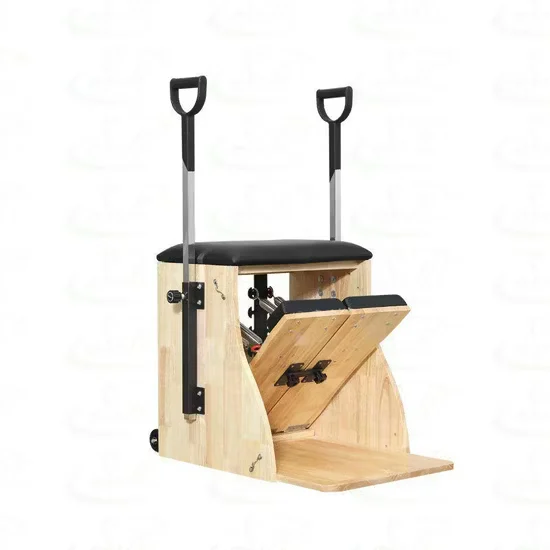
Solid-Frame Stability — Engineered to withstand high-frequency studio repetitions without wobble, spring fatigue, or padding compression across thousands of training cycles.
Technical Specifications
| Parameter | Value |
|---|---|
| Designation | SRY-04 |
| Brand | Senrui |
| Product Type | Pilates Reformer / Wunda Chair |
| Product Dimensions | 800 × 620 × 1100 mm |
| Net Weight | 45 kg |
| Color Options | Solid Color (customizable) |
| Logo | Customized Is Allowed |
| Age Group | Adult |
| Gender | Unisex |
| Certification | ISO 9001, CE |
| Warranty | 3 Years |
| Production Capacity | 80 Pieces/Month |
Application Suitability
| Deployment Scenario | Typical Use |
|---|---|
| Pilates and yoga studio | Group reformer classes and private chair sessions with frequent equipment rotation |
| Rehabilitation and physical therapy clinic | Low-impact controlled movement training for patient recovery programs |
| Boutique fitness studio | Mixed-format movement classes alternating between reformer and chair exercises |
| Corporate wellness center | Employee movement sessions in compact multi-use wellness rooms |
| High-end home gym | Personal Pilates practice with studio-grade frame stability |
Why Studio Frames Warp Before the Warranty Expires
Frame rigidity under repetition determines whether commercial Pilates reformer equipment Wunda chair setups survive their first year.
Studio operators regularly discover that reformer frames begin to shift and wobble within months of daily class rotation. Springs lose consistent tension, padding compresses into hard spots, and carriage alignment drifts — problems that compound until members start questioning whether the equipment feels safe [NEED_CITE: structural fatigue patterns in high-frequency Pilates studio equipment]. I once watched a batch of chairs returned from a boutique studio because the pedal linkage developed lateral play after heavy group use, and every unit needed linkage bushings replaced. The cost of pulling equipment out of scheduled classes for mid-cycle repairs hits harder than the repair bill itself.
Where This Unit Fits in a Movement Studio Layout
This Pilates Reformer / Wunda Chair combination covers controlled resistance training across core stabilization, limb strengthening, and spinal articulation patterns. In a studio configuration, it sits alongside mat zones and larger reformer carriages as a focused station for targeted resistance work. The 800 × 620 × 1100 mm footprint allows placement in multi-discipline training zones where floor space must accommodate class flow and instructor sightlines. It accommodates adult users of varying body sizes, with the 45 kg net weight anchoring the unit firmly during high-tension spring exercises. Commercial Pilates reformer equipment Wunda chair units in this range serve as workhorse stations rather than feature-heavy flagship pieces — reliable for back-to-back scheduling without requiring cool-down intervals between users.
What Continuous Studio Scheduling Demands from Frame and Spring Components
A fully booked Pilates studio may run six or more group sessions daily, placing each commercial Pilates reformer equipment Wunda chair unit under near-continuous loading for eight to ten hours [NEED_CITE: commercial Pilates studio daily equipment utilization benchmarks]. The solid-color frame finish must resist sweat corrosion and repeated cleaning chemicals without delaminating. Ventilation matters less than with motorized cardio machines, but rubber flooring beneath the unit prevents micro-migration during lateral spring exercises. Standard indoor power is irrelevant here — this equipment operates entirely on mechanical spring resistance — yet floor leveling remains critical, because even slight unevenness causes carriage drift or pedal binding over extended use cycles.
Spring Tension, Frame Welding, and Padding Density Explained
The spring resistance system on this unit provides the progressive loading that defines reformer and chair exercise mechanics. Spring tension consistency across repetitions determines whether a user experiences smooth resistance or jarring catch points during controlled movements. Frame welding quality at stress junctions — particularly where the pedal linkage meets the main upright and where spring anchor points connect to the carriage rail — dictates long-term structural integrity under commercial load. Padding compression resistance matters because studio members cycle through equipment quickly, and foam that collapses within months creates pressure points that generate member complaints. The 3-year warranty signals confidence that these mechanical and structural elements hold up under studio-frequency operation without premature degradation.
The Hidden Cost of Specifying Below Commercial Grade
Operators who furnish studios with light-duty reformers and chairs often face a replacement cycle that outpaces their equipment depreciation schedule. Springs that fatigue unevenly force instructors to adjust programming around hardware limitations rather than client needs. Padding that compresses prematurely generates member attrition as clients seek studios with better-maintained equipment [NEED_CITE: equipment comfort degradation and member retention correlation in boutique fitness]. Frame wobble that develops mid-lifecycle creates liability concerns during balance-intensive exercises, and pulling units offline for structural repairs leaves gaps in class capacity that revenue cannot recover.
What Sets This Product Line Apart for Studio Procurement
The solid-frame construction has been validated through production runs that supply Pilates studios and rehabilitation clinics across multiple markets. Every unit undergoes durability verification aligned with 10,000-hour continuous use standards adapted from our cardio equipment testing protocols. The customizable logo and color options allow studios to maintain visual brand consistency across an entire equipment fleet without managing multiple vendors. Our team provides 3D studio layout planning that accounts for this unit’s 800 × 620 × 1100 mm footprint, instructor sightlines, and member flow between stations. OEM customization covers branding, finish, and specification adjustments at flexible minimum order quantities. Technical support remains available around the clock for deployment questions.
Documentation & Test Records
- CE declaration of conformity for Pilates Reformer / Wunda Chair
- EN 957 test report covering structural load and safety requirements
- ISO 9001 certificate for manufacturing quality management
- Durability test record documenting spring and frame cycle performance
- Installation and commissioning guide with leveling procedures
- Spare parts list covering springs, padding, and linkage components
Installation, Commissioning & Maintenance
- Maintain minimum clearance around the 800 × 620 mm footprint for safe movement during exercises
- Level the floor surface beneath the 45 kg frame to prevent carriage drift or pedal binding
- Inspect spring tension consistency and anchor point integrity monthly under studio-frequency use
- Clean padded contact surfaces with pH-neutral solutions to prevent material degradation
- Verify all linkage bushings and frame bolts quarterly during scheduled maintenance windows
- Replace compression-degraded padding before member comfort complaints accumulate
Requesting a Studio Equipment Proposal
Provide your studio floor area and intended class format to receive a 3D layout plan that positions commercial Pilates reformer equipment Wunda chair units for optimal instructor sightlines and member flow. Specify your daily session count so we can confirm spring and frame durability matches your scheduling intensity. Indicate whether custom branding and color matching are required across your equipment fleet. Clarify your target delivery timeline to align with production capacity scheduling.
Frequently Asked Questions
Q: What frame materials are used for commercial-grade Pilates reformers?
A: Commercial-grade Pilates reformer and Wunda chair frames use reinforced steel construction with welded joints at all primary stress points. The solid-frame design on this unit eliminates the flex and wobble that lighter materials develop under repeated spring-loaded exercises. Frame welding is inspected for consistency at spring anchor points and pedal linkage connections to ensure structural integrity across thousands of daily repetitions in studio environments.
Q: How do spring tension and padding quality affect long-term performance?
A: Springs that fatigue unevenly create inconsistent resistance, forcing instructors to modify exercises around hardware limitations. Padding that compresses prematurely generates pressure points that drive member complaints and attrition. This unit carries a 3-year warranty reflecting tested confidence that spring tension remains consistent and padding retains its density through extended commercial use cycles without requiring mid-lifecycle replacement.
Q: Can equipment be customized with studio branding and color schemes?
A: Yes, this commercial Pilates reformer equipment Wunda chair supports full logo customization and solid color options to match studio brand identity. OEM customization extends across finish specifications at flexible minimum order quantities, allowing studios to outfit entire movement zones with visually consistent equipment from a single production source without coordinating multiple vendors.
Q: What warranty coverage is provided for commercial use environments?
A: This unit carries a 3-year warranty covering structural frame integrity, spring resistance components, and padding durability under commercial operating conditions. The warranty reflects testing protocols adapted from our 10,000-hour continuous operation standards, ensuring that studio operators receive coverage aligned with actual high-frequency daily use rather than light residential duty cycles.
Q: How does equipment footprint impact studio layout and class capacity?
A: The 800 × 620 × 1100 mm dimensions allow this unit to fit into multi-discipline training zones without consuming excessive floor space. Compact footprint directly influences how many stations a studio can deploy, affecting class capacity and revenue per session. Our 3D layout planning service optimizes spacing between units for instructor sightlines and safe member movement during transitions.
![Commercial Walnut Wood Pilates Reformer for Yoga Studio Gym [WARN] draft identifier mismatch](https://bicksport.com/wp-content/uploads/2026/08/commercial-walnut-wood-pilates-reformer-for-yoga-studio-gym-warn-draft-identifier-mismatch-221cf2.webp)


![Portable Folding Pilates Reformer for Yoga Studio Physiotherapy [WARN] draft identifier mismatch](https://bicksport.com/wp-content/uploads/2026/08/portable-folding-pilates-reformer-for-yoga-studio-physiotherapy-warn-draft-identifier-mismatch-fd1e14.webp)