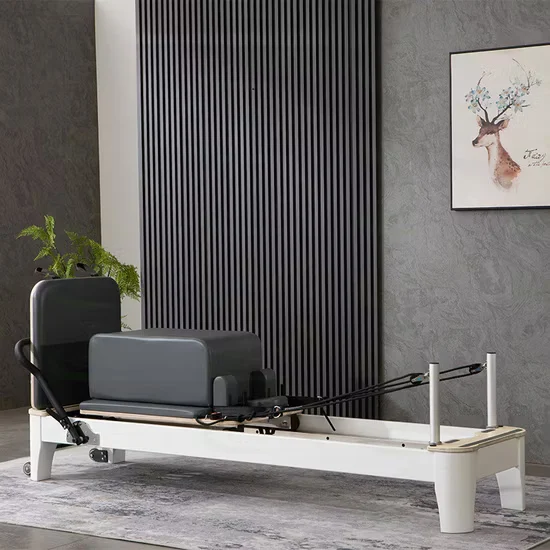
Whisper-Quiet Operation — Spring-resistance mechanics and precision rail assemblies keep the Pilates Cadillac with Reformer Studio Reformer below acoustic thresholds that trigger complaints in mixed-use buildings.
Technical Specifications
| Parameter | Value |
|---|---|
| Product Type | Pilates Cadillac / Reformer Combo |
| Model NO. | SRY-01A |
| Specification | 2400 × 770 × 2160 mm |
| Net Weight | 150 kg |
| Frame Construction | Reinforced Steel |
| Resistance Type | Spring-Resistance with Progressive Tension |
| Accessory Compatibility | Long Box / Jump Board / Platform |
| Color | Solid Color |
| Logo | Customized Is Allowed |
| Warranty Time | 3 Years |
| Production Capacity | 80 Pieces/Month |
Application Suitability
| Deployment Scenario | Typical Use |
|---|---|
| Boutique Pilates studio on commercial floors | High-frequency group and private sessions requiring multi-discipline programming |
| Hotel fitness center on guest room floors | Premium mind-body classes in noise-sensitive environments |
| Rehabilitation and physical therapy clinic | Controlled-resistance patient recovery protocols with stable loading |
| Private training studio in residential buildings | One-on-one sessions demanding low vibration transmission to adjacent units |
| Corporate wellness room | Compact multi-apparatus footprint serving employee movement programs |
Why Carriage Roll and Spring Vibration Reach the Front Desk Before Maintenance Does
Noise travels through structure before anyone opens a work order.
In mixed-use buildings, reformer carriage roll and tower spring vibration transmit low-frequency energy through floor slabs. Studios operating commercial Pilates Cadillac reformer combo studio equipment not built for continuous duty cycles develop frame flex and pulley track wear within months. The resulting rattle and resonance generate guest complaints on the floor below long before the studio owner notices degraded performance. We have seen entire equipment batches replaced because the frame specification suited home use, not back-to-back scheduling [NEED_CITE: structural vibration transmission from fitness equipment in multi-story buildings].
Positioning This Combo Within the Studio Equipment Matrix
The Pilates Cadillac with Reformer serves as the primary apparatus for comprehensive programming, covering supine, prone, seated, and standing movement patterns across beginner to advanced intensity ranges. It complements standalone Wunda Chairs and spine correctors by handling the majority of spring-loaded repertoire in a single footprint. Deployment works best along perimeter walls where the 2160 mm tower height clears standard ceilings and the carriage aligns with natural traffic flow. The commercial Pilates Cadillac reformer combo studio configuration accommodates users across a broad anthropometric range, with the Long Box and Platform extending exercise variety without requiring additional floor space. Data capture remains analog — spring selection and carriage position define resistance magnitude, keeping the interface mechanical and maintenance-light.
Continuous Scheduling and Structural Deployment Requirements
Studios running six or more sessions daily place repetitive loading on carriage wheels and tower pulleys. The reinforced steel frame maintains alignment under this duty cycle, preventing the lateral drift that causes uneven rail wear. Noise transmission depends on floor construction and isolation — units on suspended timber floors benefit from anti-vibration pads beneath all four contact points, while concrete slabs absorb energy more effectively. Adequate clearance of at least 600 mm on three sides allows instructor access during private sessions. Voltage considerations do not apply to purely mechanical spring systems, simplifying international deployment [NEED_CITE: commercial fitness equipment duty cycle classifications for scheduling density]. Overhead lighting and HVAC vents should be positioned to avoid shadowing the tower and creating downdraft discomfort during supine work.
Spring Tension Progression and Frame Rigidity Under Load
Spring-resistance systems deliver force proportional to extension length, producing a smooth loading curve that differs fundamentally from friction-based or motorized mechanisms. This progression operates without generating the mechanical noise associated with magnetic detents or belt drives. The reinforced steel frame resists torsional flex when users load the carriage asymmetrically during single-leg work or standing exercises on the platform. Precision rail and wheel assemblies maintain consistent glide performance by distributing carriage weight across multiple contact surfaces, reducing point wear that leads to tracking irregularities. Pulley tracks on the tower require periodic inspection for cable fraying and sheave alignment, but the absence of electronic components eliminates firmware updates and sensor calibration [NEED_CITE: EN 957 requirements for static and dynamic loading on resistance training equipment].
What Specification Compromises Cost in Studio Environments
Frames built to home-use material grades develop micro-flex under repetitive commercial loading, causing tower spring anchors to drift from their designed geometry. This misalignment accelerates pulley wear and produces the clicking that clients interpret as equipment failure. Carriage wheels molded from low-hardness compounds flatten under sustained static loads, creating flat spots that generate audible thumping during dynamic exercises. Studios that purchase equipment without verifying spring fatigue cycle data face unpredictable tension loss, forcing instructors to compensate by adjusting programming rather than relying on calibrated resistance. The cumulative effect surfaces as member attrition driven by inconsistent experience rather than any single catastrophic failure [NEED_CITE: spring fatigue testing protocols for commercial resistance equipment].
Why This Product Line Addresses the Deployment Gaps
The sub-35dB verification standard developed for our cardio range applies directly to the spring and rail assemblies on the Pilates Cadillac with Reformer — mechanical noise sources are identified and controlled at the component level during production. Every unit undergoes continuous cycle testing equivalent to 10,000 hours of operation on bearings, rails, and spring anchors before release. The 2400 × 770 mm footprint allows our 3D layout service to plan studio configurations that account for instructor circulation paths, mirror sightlines, and ventilation flow around each station. Full OEM customization extends to logo placement and color specification, enabling brand consistency across multi-location rollouts. Twenty-four-hour technical support covers rail alignment questions and spring replacement scheduling without requiring on-site service visits for routine maintenance.
Documentation & Test Records
- CE declaration of conformity covering the complete Pilates Cadillac with Reformer assembly
- EN 957 test report documenting static and dynamic structural loading verification
- ISO 9001 certificate for the manufacturing quality management system
- Spring fatigue cycle testing documentation with tension retention data
- Rail and carriage wheel material hardness and wear resistance specification
- Installation and commissioning guide with accessory configuration reference
Installation, Commissioning & Maintenance
- Position the 2400 × 770 mm footprint with minimum 600 mm clearance on three sides for instructor access
- Verify floor levelness and install anti-vibration pads beneath all steel frame contact points
- Inspect tower spring anchors and pulley sheave alignment before the first loaded session
- Establish a quarterly carriage rail cleaning and wheel bearing inspection schedule
- Rotate spring positions monthly to distribute wear across the full tension range
- Document spring replacement intervals based on recorded session volume per unit
Scoping Your Studio Deployment
Provide floor plan dimensions and ceiling height to receive a 3D layout showing equipment spacing, instructor circulation paths, and ventilation requirements for the Pilates Cadillac with Reformer configuration. Specify daily session volume so spring fatigue projections align with your maintenance schedule. Confirm the building floor construction type to determine whether anti-vibration isolation is required beneath each unit. Indicate whether accessory packages should include the Long Box, Jump Board, or Platform based on your programming model.
Frequently Asked Questions
Q: What frame construction standards differentiate commercial Pilates equipment from home-use models?
A: Commercial frames use higher-grade steel sections with reinforced weld patterns at load-bearing junctions. This prevents the torsional flex that develops when carriage loading is applied asymmetrically during single-leg or standing exercises. The resulting rigidity maintains tower spring anchor geometry and pulley track alignment across thousands of repetitive cycles, preventing the progressive misalignment that causes noise and irregular resistance delivery in lighter constructions.
Q: How does spring-resistance progression compare to motorized reformer systems in terms of noise and maintenance?
A: Spring-resistance systems generate force through mechanical extension without motors, belts, or electronic controllers. This eliminates the humming, belt slap, and sensor drift associated with motorized alternatives. Maintenance reduces to periodic spring inspection for fatigue and cable replacement based on visual wear assessment. The absence of electronic components means no firmware updates, no power supply failures, and no calibration procedures required between service intervals.
Q: What ceiling height and floor space are required for full Cadillac tower operation?
A: The tower extends to 2160 mm, requiring ceiling clearance of at least 2400 mm to accommodate overhead exercises and instructor hand positioning above the crossbar. The base footprint measures 2400 × 770 mm, and studios should allocate an additional 600 mm on three sides for instructor positioning and client approach paths. Total effective floor area per unit approaches six square meters when circulation space is included in the layout calculation.
Q: How do integrated reformer rails maintain alignment under continuous studio use?
A: Precision-machined rail surfaces and multi-wheel carriage assemblies distribute dynamic loads across several contact points rather than concentrating force at single bearings. The reinforced steel frame prevents the lateral deflection that would otherwise push rails out of parallel alignment. Routine maintenance involves cleaning debris from the rail channel and verifying wheel rotation freedom, tasks that require no specialized tooling and can be completed between scheduled sessions.
Q: What accessory configurations maximize programming versatility within a single equipment footprint?
A: The Long Box extends the carriage surface for supine and prone exercises requiring full-body support. The Jump Board converts the reformer carriage into a plyometric platform for cardiovascular intervals within the Pilates session structure. The Platform provides an elevated standing surface for balance and lower-limb work at the tower end. Together these three accessories enable programming that would otherwise require separate apparatus occupying additional floor area.
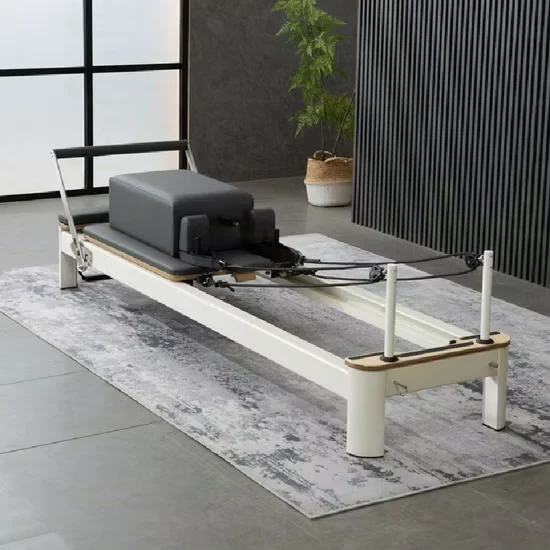
![Pilates Reformer Aluminum Training Yoga Exercise Bed Reformer Pilates for Studio [WARN] draft identifier mismatch](https://bicksport.com/wp-content/uploads/2026/08/pilates-reformer-aluminum-training-yoga-exercise-bed-reformer-pilates-for-studio-warn-draft-identifier-mismatch-fa5e59.webp)
![Pilates Reformer Oak Wood Full Track Flat Bed Core Training Equipment [WARN] draft identifier mismatch](https://bicksport.com/wp-content/uploads/2026/08/pilates-reformer-oak-wood-full-track-flat-bed-core-training-equipment-warn-draft-identifier-mismatch-816db0.webp)