

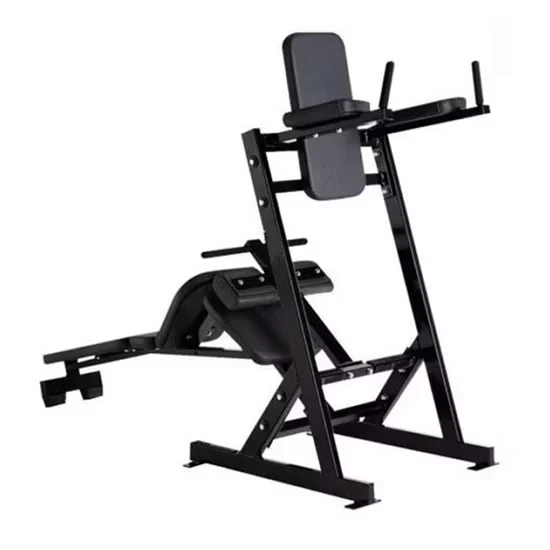
Biomechanical Precision — Reinforced 160kg steel frame engineered for high-frequency lower-body training in commercial strength zones.
Technical Specifications
| Parameter | Value |
|---|---|
| Designation | OS-H5040 |
| Product Type | Integrated Gym Trainer |
| Exercise Target | Waist and Lower Body |
| Construction Material | Heavy-Duty Steel |
| Product Dimensions | 1550 × 1850 × 1650 mm |
| Net Weight | 160 kg |
| Main Frame Color | Available according to customer requirements |
| Cushion Color | Available according to customer requirements |
| Max User Weight | 180 kg |
| Age Group | Adult |
| Gender | Unisex |
| OEM/ODM | Acceptable |
| Certification | ISO 9001, CE |
Application Suitability
| Deployment Scenario | Typical Use |
|---|---|
| Professional gym and club | High-frequency lower-body strength training for members |
| Community fitness center | Durable, accessible V-Squat station for diverse users |
| Corporate wellness facility | Structured leg and waist training for employee fitness programs |
| Sports performance training center | Controlled biomechanical loading for athletic conditioning |
Why Frame Weight Determines Longevity in Commercial Strength Bays
A 160kg chassis resists the lateral torque that fractures lighter frames within eighteen months of continuous use.
When a commercial V-squat machine OS-H5040 integrated gym trainer sits in a high-traffic strength zone, members load it with plates, drop it under fatigue, and repeat for thousands of cycles. Lighter frames flex at the weld seams, generating micro-fractures that maintenance crews only discover after catastrophic failure. I have seen facilities replace entire squat stations twice a year because the procurement spec only checked footprint and ignored steel gauge. [NEED_CITE: structural fatigue patterns in commercial strength equipment under cyclic loading]
Positioning the V-Squat Within a Strength Training Floor Plan
The OS-H5040 occupies a dedicated footprint within the lower-body zone, complementing free-weight squat racks and leg press machines by offering a guided, controlled movement path. It serves members who require joint-friendly loading without the stabilization demands of barbell work. The 1550 × 1850 mm footprint demands clear lateral and overhead clearance for safe plate loading and full range of motion. The commercial V-squat machine OS-H5040 integrated gym trainer accommodates users up to 180 kg, covering the majority of the commercial gym demographic.
Operational Duty Cycle and Facility Environment Requirements
This unit operates without electrical dependency, relying entirely on mechanical resistance and gravity, which eliminates motor heat buildup and power circuit requirements. However, the 160 kg mass demands a level concrete subfloor with anti-vibration padding to prevent micro-migration during heavy sets. Facilities deploying on upper floors must verify load-bearing capacity. Adequate ceiling height is non-negotiable given the 1650 mm frame height plus user clearance during full extension. [NEED_CITE: floor load requirements for heavy commercial strength equipment]
Decoding the Mechanical and Structural Specifications
The steel frame construction prioritizes rigidity over weight savings, ensuring the guide rods maintain parallel alignment under asymmetric plate loading. When a member loads unevenly, a flexible frame allows the carriage to bind, creating friction and uneven wear on the linear bearings. The 160 kg net weight provides an inherent stability base that prevents the unit from lifting during explosive concentric phases. The unisex design with adjustable back pad and shoulder yoke accommodates different torso lengths, keeping the spine aligned through the full V-Squat range. The 1550 × 1850 × 1650 mm envelope reflects the angled sled path, which differs from a vertical Smith machine and requires specific spatial planning within the commercial V-squat machine OS-H5040 integrated gym trainer deployment zone.
The Hidden Cost of Compromised Structural Specs
Procurement decisions driven by unit price rather than frame mass produce a predictable cycle: weld cracks appear at the guide rod mounting points within the first year, the carriage develops lateral play, and members report grinding noises during descent. Maintenance attempts to shim the bearings, but the root cause—frame flex under load—cannot be corrected without replacing the chassis. [NEED_CITE: maintenance frequency comparison between light and heavy-duty commercial strength frames] Facilities then face a choice between ongoing repair costs and full replacement, often spending more over three years than they would have on a heavier unit from the start.
Why This Product Line Addresses Facility Pain Points
Every OS-H5040 leaving the Shandong facility undergoes structural verification against ISO 9001 standards, with weld inspections and load-path stress testing documented before shipment. The 10,000-hour durability protocol applies to the linear bearings and guide rod surface treatment, ensuring smooth carriage travel through years of high-frequency use. Full OEM and ODM customization means frame and cushion colors can align with facility branding without compromising structural specifications. The six-series cardio family from this production line allows a facility to source both strength and cardio from a single OEM partner. Free 3D layout planning covers the spatial requirements of this unit alongside complementary equipment, accounting for member flow, plate storage proximity, and overhead clearance.
Documentation & Test Records
- CE declaration of conformity covering mechanical safety requirements
- EN 957 test report for stationary strength training equipment
- ISO 9001 certificate for manufacturing quality management
- Structural load and weld integrity test record
- Linear bearing and guide rod durability test documentation
- Installation and commissioning guide with spare parts list
Installation, Commissioning & Maintenance
- Verify 1550 × 1850 mm footprint with 800 mm clearance on all sides for plate loading access
- Install on level concrete with anti-vibration pads to prevent frame migration under load
- Check guide rod parallelism and carriage bearing preload upon delivery before first use
- Lubricate linear bearings and inspect guide rod surface treatment every 90 days
- Tighten all structural bolts to specified torque after the first 500 use cycles
- Clean steel frame and cushion surfaces daily to prevent sweat corrosion
Planning Your Strength Zone Equipment Selection
Provide your strength area dimensions and intended equipment list to receive a 3D layout that accounts for the OS-H5040 footprint, member circulation, and plate storage zones. Specify the daily member throughput so we can confirm the bearing and guide rod durability matches your usage intensity. Clarify whether the unit deploys on ground level or an elevated floor to verify load-bearing and vibration requirements.
Frequently Asked Questions
Q: What structural features ensure durability of the OS-H5040 in commercial settings?
A: The 160 kg reinforced steel frame resists lateral torque during heavy loading, preventing the weld fatigue that causes lighter frames to crack within eighteen months. Guide rods maintain parallel alignment through thousands of cycles, ensuring the carriage travels smoothly without binding. Full weld inspection and load-path testing are documented before each unit ships from the facility.
Q: How does the biomechanical design enhance user safety during training?
A: The V-Squat angle reduces shear force on the lumbar spine compared to free-weight back squats, while the guided carriage path prevents the bar from drifting forward under fatigue. Adjustable shoulder yokes and back pads accommodate different torso lengths, maintaining neutral spine alignment through the full range. This makes the movement accessible to members returning from injury.
Q: What customization options are available for facility branding?
A: The main frame color and cushion color can both be specified to match your facility design palette. OEM and ODM options extend to logo placement and minor dimensional adjustments. The 160 kg structural chassis and mechanical specifications remain unchanged regardless of cosmetic customization, ensuring performance consistency across all branded variants.
Q: How should the OS-H5040 be positioned within a strength zone layout?
A: Place the unit in the lower-body training area with at least 800 mm clearance on all sides for safe plate loading and member circulation. Proximity to plate storage racks reduces carry distance and floor congestion. The 1650 mm frame height plus user extension requires adequate ceiling clearance, and the 1550 × 1850 mm footprint must be verified against your 3D layout plan.

![Commercial Half Rack Hammer Strength Training Gym Equipment [WARN] draft identifier mismatch](https://bicksport.com/wp-content/uploads/2026/08/commercial-half-rack-hammer-strength-training-gym-equipment-warn-draft-identifier-mismatch-37e6d8.webp)