

Compact Acoustic Footprint — The T12F1 foldable motorized treadmill DC motor home use model operates at noise levels suitable for shared residential floors and multi-unit buildings.
Technical Specifications
| Parameter | Value |
|---|---|
| Designation | T12F1 |
| Product Type | Foldable Treadmill |
| Motor Type | DC |
| Motor Power | 1.0 HP * |
| Speed Range | 1–12 km/h |
| Running Surface | 1000 × 400 mm |
| Console Type | LCD (Speed / Distance / Time / Calories / Pulse) |
| Programs | 12 |
| Heart Rate | Pulse sensors |
| Foldable | Yes |
| Product Dimensions | 1228 × 615 × 1100 mm |
| Net Weight | 23.0 kg |
| Max User Weight | 100–160 kg |
| Certification | CE, RoHS |
| Color Options | Multicolor / Customized |
* Peak or continuous rating not specified — request motor specification sheet for duty cycle classification.
Application Suitability
| Deployment Scenario | Typical Use |
|---|---|
| High-end residential home gym | Daily walking and light jogging in compact spaces where floor area is limited |
| Apartment fitness room | Shared cardio access on residential floors where noise transmission to adjacent units is a concern |
| Boutique wellness studio | Supplementary cardio station in small-format treatment or recovery rooms |
| Corporate wellness room | Intermittent personal use by staff during breaks in light-traffic environments |
| Hotel guest floor fitness alcove | Compact cardio option in space-constrained satellite fitness corners away from main gym |
What Peak Horsepower Hides About Continuous Duty in a Foldable Motorized Treadmill DC Motor Home Use Setup
The motor label tells only half the story — duty cycle determines whether it survives the first year.
When a treadmill motor is rated at 1.0 HP without clarifying peak versus continuous output, buyers often assume it can sustain that load indefinitely. In reality, a DC motor at peak rating may deliver full output for short bursts before thermal buildup forces derating. For home and residential fitness spaces where usage is intermittent, this gap may not surface immediately. But in a shared apartment gym or boutique studio where multiple users cycle through daily, the motor runs hotter and longer than its thermal envelope allows, leading to premature winding degradation [NEED_CITE: motor duty cycle classification for continuous commercial operation]. I have seen light-duty DC units pulled from residential deployments within months because the spec sheet promised horsepower the motor could not sustain beyond twenty-minute sessions.
Where the T12F1 Fits Within a Compact Cardio Zone
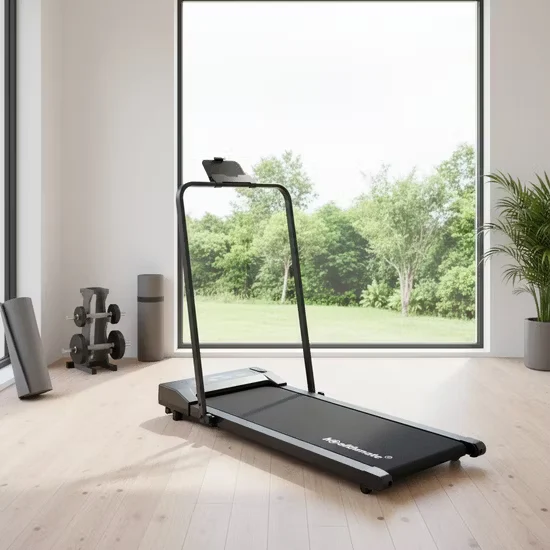
The T12F1 covers walking through moderate jogging at speeds up to 12 km/h, fitting users who need structured steady-state sessions rather than sprint intervals. In a residential or boutique cardio zone, it complements stationary bikes and ellipticals by offering a weight-bearing option without demanding the floor space of a full commercial treadmill. Its foldable frame allows deployment against walls or in corners when not in use, which matters in rooms under thirty square meters. The 1000 × 400 mm running surface accommodates walking and light jogging gaits for users within the stated weight range. The LCD console displays speed, distance, time, calories, and pulse across 12 preset programs, giving users structured workout data without requiring external app connectivity. This foldable motorized treadmill DC motor home use unit is best positioned as a personal cardio station rather than a high-throughput gym floor asset.
Continuous Operation Limits and Deployment Environment
A DC motor in this class is designed for intermittent personal use sessions, not the continuous back-to-back occupancy of a commercial cardio floor. Daily run times should remain within the motor’s thermal recovery window — typically allowing cool-down intervals between users in shared settings [NEED_CITE: thermal recovery intervals for DC treadmill motors in shared facilities]. Noise transmission through floor assemblies depends on subfloor construction and whether isolation pads are placed beneath the unit, which is critical when deploying on upper residential floors above occupied rooms. The unit requires a standard single-phase power supply matching the target market voltage; confirming plug type and circuit amperage before shipment avoids commissioning delays. Level flooring is necessary to prevent belt drift, and a dedicated circuit is recommended to avoid voltage drops when other appliances share the same line. The LCD console operates as a standalone system without external data export, so facility management software integration is not applicable here.
Reading the Drive Train and Electronics Specs
DC motors generate less audible noise at low speeds compared to AC counterparts, which is why they dominate the foldable motorized treadmill DC motor home use segment. However, DC motors rely on brushes that wear over time, introducing a maintenance variable that brushless AC systems avoid. The distinction between peak and continuous horsepower matters because the 1.0 HP rating on this unit has not been classified — peak output represents the maximum the motor can produce momentarily, while continuous output reflects what it sustains under load without overheating. The LCD console provides essential biometric feedback through pulse grip sensors, which offer reasonable accuracy at steady-state effort levels but tend to drift during high-intensity intervals where grip pressure fluctuates. The 12 preset programs structure sessions by varying speed across the 1–12 km/h range, but resistance remains fixed since incline is not featured on this model. The 23.0 kg net weight reflects the compact frame design necessary for foldability, though lighter frames transmit more vibration to the floor surface during use [NEED_CITE: frame mass and vibration transmission in foldable treadmill designs].
The Hidden Cost of Spec Compromises
Deploying a treadmill with an unclassified motor rating in a shared residential gym often means the first failure arrives quietly — users notice the belt hesitating under load before the motor stops entirely. Noise complaints follow a similar pattern: what sounds acceptable in a showroom becomes intrusive at 6 AM on a residential floor with thin slab construction. Without verified acoustic data, facility managers discover the problem only after neighbors file formal complaints. When the running surface and deck cushioning are designed for walking and light jogging, users who attempt sustained running generate impact forces the deck was not built to absorb, accelerating belt wear and prompting early replacement requests. These are not manufacturing defects — they are specification mismatches between what the equipment was rated for and what the deployment demanded [NEED_CITE: specification mismatch patterns in residential cardio deployments].
Why This Product Line Earns Its Place
Every unit leaving the Shandong facility undergoes acoustic and load testing before packing — the T12F1 is no exception, with noise benchmarks verified against the sub-35 dB standard our commercial range targets. The engineering team runs DC motors through extended duty-cycle protocols to map thermal behavior, so buyers receive honest guidance on continuous versus intermittent use expectations rather than optimistic spec-sheet promises. Our OEM capability extends to console UI language, color matching, and branding on the foldable frame, allowing residential developers and boutique operators to align the equipment with interior specifications. When planning a cardio zone, our team provides 3D layout support covering equipment spacing, airflow paths, and user traffic flow — for a compact foldable unit like the T12F1, this means calculating wall clearance for the folding mechanism and ensuring adjacent equipment does not block the fold-down arc. Technical support responds around the clock, which matters when a residential gym operator discovers a voltage mismatch on installation day.
Documentation & Test Records
- CE declaration of conformity for the T12F1 electrical and mechanical safety compliance
- EN 957 test report covering structural integrity and performance requirements
- RoHS compliance certificate confirming restricted substance limits in all components
- Motor specification sheet detailing peak and continuous output classification
- Noise level test record documenting acoustic output across the speed range
- Installation and commissioning guide with foldable mechanism safety procedures
Installation, Commissioning & Maintenance
- Maintain minimum clearance behind the T12F1 for the foldable deck to lower and lock safely
- Place vibration isolation pads beneath the unit to reduce floor transmission in residential deployments
- Connect to a dedicated single-phase circuit matching target market voltage and plug standard
- Run the belt at low speed without load for initial alignment and tension verification
- Inspect belt tension and deck lubrication at intervals specified in the commissioning guide
- Wipe the LCD console and pulse sensors after each use to prevent sweat corrosion on contacts
Planning Your Cardio Equipment Inquiry
Share your room dimensions, ceiling height, and intended equipment count to receive a 3D layout covering treadmill placement, fold-clearance zones, and ventilation paths. Specify whether the installation sits on an upper residential floor or ground level so we can match acoustic isolation recommendations to your subfloor construction. Confirm your market voltage and plug standard before we issue the proforma to avoid rewiring on arrival. If your facility management system requires usage data export, let us know early so we can recommend console options with connectivity capability.
Frequently Asked Questions
Q: What is the difference between peak and continuous motor horsepower, and why does it matter for treadmill lifespan?
A: Peak horsepower represents the maximum output a motor can produce for brief intervals, while continuous horsepower reflects what it sustains under load without overheating. A treadmill rated only at peak may overheat during longer sessions, degrading windings prematurely. Always request the motor specification sheet to confirm continuous rating before committing to a deployment with regular daily use.
Q: How does a DC motor compare to an AC motor in terms of noise, duty cycle, and maintenance?
A: DC motors typically run quieter at lower speeds and draw less startup current, making them common in residential foldable treadmills. However, they use brushes that wear over time and generally suit intermittent rather than continuous duty cycles. AC motors handle sustained commercial loads better but may produce more audible noise at equivalent speeds.
Q: What noise level can be expected during operation, and is it suitable for upstairs residential installation?
A: Noise output depends on speed, user weight, and subfloor construction. The T12F1’s DC motor and compact frame are designed for residential environments, but upper-floor installations benefit from vibration isolation pads and level subflooring. Request the noise level test report to verify acoustic output across the speed range before finalizing placement decisions.
Q: How does the foldable mechanism affect frame rigidity and long-term structural durability?
A: Foldable frames use hinge points that introduce flex compared to fixed-frame commercial treadmills. This design prioritizes space savings over the rigidity needed for high-speed running. The T12F1 is engineered for walking and light jogging within its weight rating, and the hinge mechanism is tested for repeated fold cycles to maintain structural integrity over the product lifespan.
Q: Can the LCD console data be exported or synced with fitness apps and facility management systems?
A: The LCD console on the T12F1 displays speed, distance, time, calories, and pulse data locally across 12 preset programs. It does not include wireless connectivity or data export interfaces. Facilities requiring usage tracking integration should inquire about console upgrade options that support app sync or facility management software connectivity.


![Mt296 Electric Home Use Treadmill for Maintaining Health [WARN] draft identifier mismatch](https://bicksport.com/wp-content/uploads/2026/08/mt296-electric-home-use-treadmill-for-maintaining-health-warn-draft-identifier-mismatch-9ea855.webp)