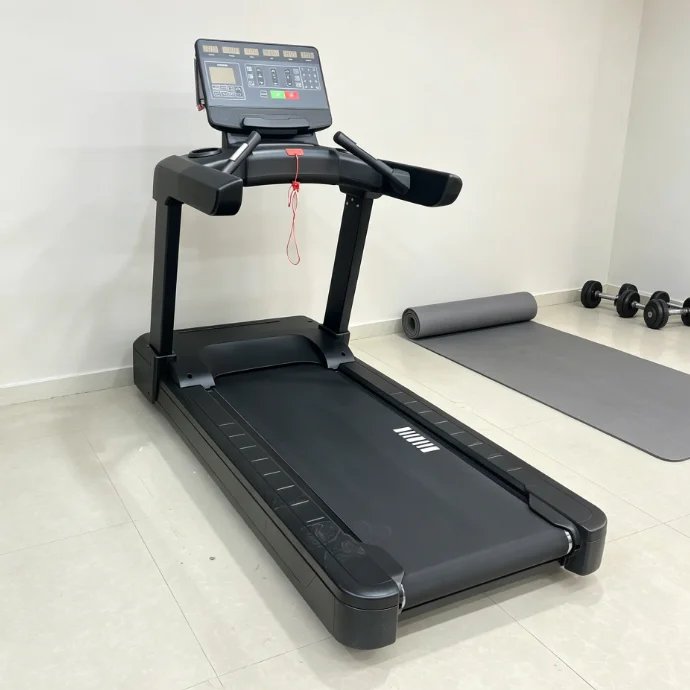
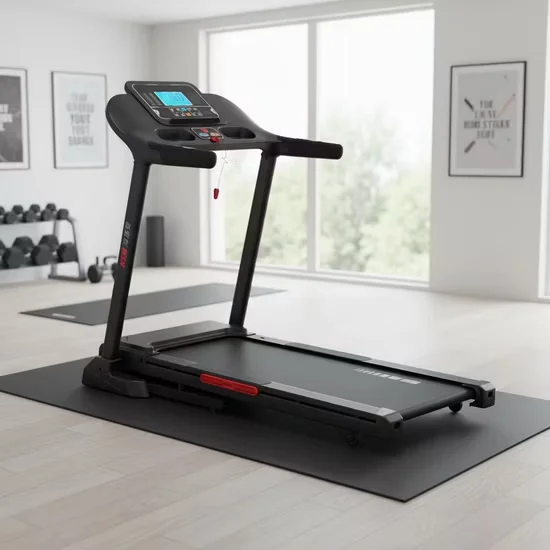
Quiet Drive Architecture — DC motor paired with ABS cushioned deck keeps operational noise manageable for guest floor and residential deployment where acoustic bleed triggers complaints.
Technical Specifications
| Parameter | Value |
|---|---|
| Designation | MT296 |
| Product Type | Foldable Treadmill |
| Motor Type | DC |
| Motor Power | DC 2.0 HP ¹ |
| Speed Range | 1–20 km/h |
| Running Surface | 1200 × 520 mm |
| Deck Cushioning | ABS material |
| Console Type | LCD (Speed / Distance / Time / Calories / Pulse) |
| Programs | 16 preset programs |
| Foldable | Yes |
| Product Unfolded Size | 1580 × 865 × 1300 mm |
| Product Folded Size | 910 × 865 × 1345 mm |
| Net Weight | 64.0 kg |
| Certification | CE, RoHS |
| OEM / ODM Custom | Available |
¹ Peak or continuous duty rating not specified in source data — request motor specification sheet with duty cycle classification before confirming commercial deployment suitability.
Application Suitability
| Deployment Scenario | Typical Use |
|---|---|
| Hotel guest fitness room on upper floors | Space-constrained cardio with quiet operation and foldable storage between use windows |
| High-end residential home gym | Compact footprint with fold-down capability for multi-use rooms |
| Corporate wellness room with limited square footage | Walk-through cardio option where floor space is shared with desks or meeting areas |
| Light-commercial fitness facility | Entry-level motorized treadmill for low-to-moderate daily throughput environments |
Why Noise Complaints Reach the Front Desk Before Maintenance Does
A treadmill on a guest floor transmits vibration through the slab long before the motor shows thermal stress.
Most foldable motorized treadmill DC motor commercial units ship with light-duty drive systems that read well on paper but reveal themselves the first week a hotel puts them above occupied rooms. The footstrike impulse passes through the deck, into the frame, and down through the floor structure as low-frequency vibration that guests perceive as a rhythmic thud. Maintenance teams rarely hear it from the corridor. By the time the front desk logs the third complaint in one night, the equipment choice has already cost the property a rebooking credit [NEED_CITE: vibration transmission through structural slabs in commercial cardio deployment]. The MT296 addresses this with an ABS cushioned deck that absorbs a portion of the footstrike energy before it reaches the frame, and a DC motor architecture that avoids the electromagnetic hum common in poorly wound AC alternatives. This does not eliminate structural vibration entirely — it reduces the amplitude that reaches the slab contact points.
Where This Foldable Treadmill Fits in a Mixed Cardio Layout
The MT296 covers steady-state walking through moderate-intensity running up to 20 km/h, placing it in the general cardio warm-up and endurance zone rather than sprint or high-intensity interval territory. In a compact hotel or residential cardio room, it pairs with a stationary bike or elliptical to give users a second modality without duplicating the same movement pattern. The 1200 × 520 mm running surface accommodates most adult users comfortably, though taller runners above 185 cm may notice the deck length during full stride extension. The foldable frame means the unit can be tucked against a wall between use windows, which matters in rooms where every square meter carries a revenue implication. This foldable motorized treadmill DC motor commercial unit is positioned for environments where space efficiency and quiet operation take priority over continuous high-throughput cycling.
Continuous Operation Limits and Room Preparation
The DC 2.0 HP motor in this unit is appropriate for light-commercial duty cycles — expect reliable performance in settings where the treadmill runs a few hours per day rather than back-to-back from opening to close. Deploying it in a chain gym cardio zone with 12-hour daily throughput would push the motor beyond its intended thermal envelope and shorten service life significantly [NEED_CITE: motor duty cycle classification for continuous commercial operation]. Room preparation matters as much as the equipment itself: the deployment surface must be level within tolerance to prevent belt drift, a dedicated electrical circuit prevents voltage sag when multiple units start simultaneously, and rubber isolation pads under the feet decouple residual vibration from the floor structure. For upper-floor hotel installations, confirm with the structural engineer that the slab can handle the dynamic load of a 64 kg unit plus a 100 kg user in repetitive footstrike. Ambient ventilation must allow heat dissipation from the motor housing — a cramped alcove with no airflow will raise operating temperature and trigger thermal cutoff.
Reading the Drive and Cushioning Specifications
DC motors deliver smooth speed control and lower acoustic output at the cost of continuous thermal capacity compared to AC motors — the tradeoff is acceptable in low-throughput environments where the motor cools between users. The distinction between peak horsepower and continuous duty rating is where procurement errors happen: a 2.0 HP peak rating means the motor can sustain that output briefly, not indefinitely, and the continuous rating may be considerably lower [NEED_CITE: EN 957 requirements for treadmill motor duty classification]. The ABS deck cushioning system sits between the running belt and the frame to absorb footstrike energy, reducing the impulse transmitted to the user’s joints during repetitive loading cycles. Unlike elastomer or rubber isolators that compress permanently over months, ABS maintains its structural characteristics across a wider temperature range. The LCD console displays speed, distance, time, calories, and pulse — it provides structured workout tracking without IoT connectivity or app synchronization, which simplifies maintenance but means usage data stays on the console rather than flowing into a facility management system.
What Hidden Specification Gaps Cost After Deployment
Choosing a treadmill without verifying whether the motor rating is peak or continuous creates a failure pattern that shows up six months after installation: motors that were rated for intermittent home use begin overheating under the sustained loads of a commercial environment, and warranty claims get denied because the deployment exceeded the documented duty cycle. Noise complaints follow a similar arc — a unit that measures acceptably in an open showroom sounds entirely different when installed above a bedroom with a concrete slab transmitting every footstrike impulse. The result is batch replacement at the property’s expense, plus the soft cost of guest compensation credits. Cushioning that loses compression resilience within the first year generates joint discomfort complaints that drive member attrition in residential gyms and corporate wellness rooms [NEED_CITE: long-term compression retention of deck cushioning materials under commercial footstrike loads]. Voltage mismatches discovered after the container arrives mean either rewiring the facility or returning the equipment — both expensive corrections that a pre-production specification review would have prevented.
Why This Product Line Holds Up in the Field
Every MT296 unit comes from a manufacturing system built around 10,000-hour durability testing on motors, frames, and bearings — this is not a marketing claim but a documented test protocol that separates equipment surviving continuous operation from units requiring premature motor replacement. The sub-35 dB noise verification performed in actual hotel deployments confirms that the acoustic profile works above occupied rooms, not just on the showroom floor. The six-series cardio family means a facility can source treadmills, bikes, ellipticals, rowers, stair climbers, and spinning bikes from one integrated product line, which simplifies spare parts inventory and service training. OEM customization extends to the console UI, so a hotel group can align the interface with their brand without running separate software development. The free 3D cardio-zone layout service accounts for the MT296’s folded and unfolded footprint, airflow clearance around the motor housing, and sightline placement so users face windows or feature walls rather than blank partitions. Technical support operates on a 24/7 response cycle, which matters when a unit faults at 2 AM in a property across multiple time zones.
Documentation & Test Records
- CE declaration of conformity covering electromagnetic compatibility and low voltage directives
- EN 957 test report validating structural integrity and safety requirements
- ISO 9001 certificate for quality management system compliance
- RoHS compliance documentation for restricted substance limitations
- Noise level test report with measurements under loaded operation
- Motor specification sheet detailing duty cycle classification and thermal limits
- Console technical documentation with LCD display and pulse monitoring parameters
- Installation and commissioning guide with wiring and belt tension procedures
Installation, Commissioning & Maintenance
- Allocate minimum clearance around the MT296’s 1580 × 865 mm unfolded footprint for safe user entry and exit on all sides
- Place rubber isolation pads beneath all feet to decouple vibration from the floor structure, critical for upper-floor hotel rooms
- Connect to a dedicated circuit matching the target market voltage standard — verify plug type before shipment
- Run the belt at low speed without load during first commissioning to confirm alignment and tension before user access
- Inspect belt tension and lubrication at intervals specified in the commissioning guide to prevent premature deck wear
- Clean the LCD console surface and pulse sensors with non-abrasive solution to maintain display clarity and heart rate signal quality
Requesting a Deployment Assessment
Provide the cardio zone square footage and equipment count to receive a 3D layout that accounts for the MT296’s folded storage position and required airflow clearance around the motor housing. Specify the expected daily run-hours per unit so the motor duty cycle can be matched against the deployment intensity — this determines whether DC 2.0 HP is sufficient or whether a higher continuous rating is needed. Confirm the deployment floor level and adjacent occupied spaces so acoustic requirements can be verified against the sub-35 dB test data. State the target market voltage and plug standard to prevent post-shipment compatibility issues, and indicate whether console data needs to integrate with existing facility management software or whether standalone LCD tracking is sufficient for the operation.
Frequently Asked Questions
Q: Is a DC motor suitable for continuous commercial treadmill use?
A: DC motors deliver smooth speed control and lower noise at moderate duty cycles, making them appropriate for light-commercial environments with limited daily run-hours. For high-throughput gym floors running 12+ hours daily, AC motors typically handle sustained thermal loads more reliably. Always verify the continuous duty rating rather than relying on peak horsepower figures alone.
Q: What is the difference between peak horsepower and continuous duty rating?
A: Peak horsepower indicates the maximum output a motor can sustain briefly during acceleration or incline load, while continuous duty rating reflects what the motor can deliver indefinitely without overheating. A treadmill rated at 2.0 HP peak may have a considerably lower continuous output. Request the motor specification sheet with duty cycle data before confirming deployment.
Q: How does ABS deck cushioning compare to rubber or elastomer systems?
A: ABS material maintains structural rigidity across a wider temperature range and resists permanent compression better than some rubber compounds that flatten over months of footstrike loading. The cushioning performance depends on layer configuration and thickness. Request durability test records showing compression retention after extended use cycles to validate long-term joint impact absorption.
Q: Can the LCD console integrate with facility management software?
A: The standard LCD console on the MT296 provides standalone workout tracking for speed, distance, time, calories, and pulse without network connectivity or app synchronization. This keeps maintenance simple and eliminates software-related failures. If data integration with facility management systems is required, discuss console upgrade options during the specification phase before production.
Q: What maintenance does the folding mechanism require?
A: The folding hinge and locking pin should be inspected periodically for wear and secure engagement before each use session. Belt tension and alignment require adjustment at intervals documented in the commissioning guide. Keep the pivot points clean and free of debris accumulation to prevent binding that could compromise the fold-down or lock-open operation over time.
![Hsm Auto-Incline Walking Treadmill for Commercial Hotel Gym [WARN] draft identifier mismatch](https://bicksport.com/wp-content/uploads/2026/08/hsm-auto-incline-walking-treadmill-for-commercial-hotel-gym-warn-draft-identifier-mismatch-345e74.webp)