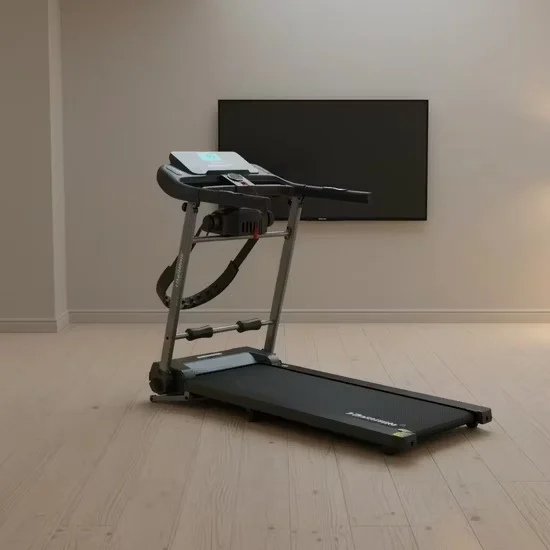
Engineered Quiet Operation — DC motor architecture paired with a cushioned deck delivers controlled noise output suitable for shared-wall rehabilitation and light-commercial environments.
Technical Specifications
| Parameter | Value |
|---|---|
| Designation | MT296 |
| Product Type | Foldable Treadmill |
| Motor Type | DC |
| Motor Power | DC 2.0 HP* |
| Speed Range | 1–20 km/h |
| Running Surface | 1200 × 520 mm |
| Console Type | LCD (Speed / Distance / Time / Calories / Pulse) |
| Preset Programs | 16 |
| Foldable | Yes |
| Product Unfolded Size | 1580 × 865 × 1300 mm |
| Product Folded Size | 910 × 865 × 1345 mm |
| Net Weight | 64.0 kg |
| Material | ABS |
| Certification | CE, RoHS |
*Peak or continuous duty rating not specified in source — confirm with manufacturer catalog before procurement.
Application Suitability
| Deployment Scenario | Typical Use |
|---|---|
| Rehabilitation and physiotherapy clinics | Controlled-speed, low-impact walking and recovery protocols |
| Boutique hotel guest fitness corners | Space-constrained cardio access for guests with foldable stowage |
| Corporate wellness rooms | Light- to moderate-frequency walking and jogging during breaks |
| High-end residential home gyms | Daily personal cardio in multi-use rooms requiring noise consideration |
| Community fitness centers | Shared cardio stations with moderate daily duty cycles |
Why Noise Complaints Reach the Front Desk Before Maintenance Does
A treadmill that sounds acceptable in a showroom behaves differently when installed above occupied guest rooms or beside shared residential walls.
I spent years on the motor assembly line in Jinan before moving into product engineering, and the most painful calls always came from hotel projects. They had installed home-grade treadmills on guest room floors, and nighttime running generated complaints that front desk staff could not resolve. The problem was not the machine breaking — it was the acoustic transmission through floor slabs. The MT296 uses a DC motor drive that produces a lower baseline acoustic signature than equivalent AC motors, which matters when the nearest listener is sleeping one floor below [NEED_CITE: acoustic transmission standards for cardio equipment in multi-story hospitality deployments]. Facilities that ignore this at procurement end up replacing entire cardio zones within the first year of operation.
Positioning Within a Mixed Cardio Zone
This foldable motorized treadmill covers walking through moderate jogging across its 1–20 km/h speed range, serving users who need controlled, repeatable pace settings rather than high-intensity sprint work. In a mixed cardio layout, it complements ellipticals and exercise bikes by offering weight-bearing movement for rehabilitation protocols and general conditioning. The 1200 × 520 mm running surface accommodates most adult stride lengths during walking and light jogging, while the foldable frame allows deployment in multi-use rooms where floor space must serve multiple functions throughout the day. The LCD console provides standalone biometric readouts — speed, distance, time, calories, and pulse — without requiring external device pairing, which simplifies setup in facilities that do not operate integrated member tracking systems.
Duty Cycle and Deployment Environment Requirements
The DC 2.0 HP motor is suited for environments where usage follows intermittent patterns rather than continuous all-day operation. Rehabilitation clinics and corporate wellness rooms typically see users cycling through 20- to 45-minute sessions with idle periods between, which aligns with DC motor thermal characteristics [NEED_CITE: DC motor thermal management under intermittent commercial duty cycles]. Noise propagation depends heavily on floor construction and isolation — deployment on upper floors with occupied rooms below requires attention to subfloor rigidity and vibration isolation pads. The unit requires a standard single-phase power supply with a dedicated circuit to prevent voltage sag when multiple units operate simultaneously. Ground leveling is critical: an uneven floor transfers load asymmetrically through the frame and accelerates belt wear on one side.
DC Drive Architecture and Cushioned Deck Engineering
DC motors operate at lower rotational speeds than AC counterparts at equivalent belt velocities, which reduces the high-frequency whine that propagates through structural connections. The distinction between peak and continuous horsepower matters here: a motor rated at 2.0 HP peak may deliver substantially less under sustained load, so facilities planning heavy daily use should request the continuous duty rating from the manufacturer catalog before committing to volume orders. The cushioned 1200 × 520 mm running deck uses a multi-layer belt and deck system that absorbs a portion of foot-strike energy before it reaches the user’s joints — this is especially relevant for rehabilitation populations recovering from lower-limb injuries where impact tolerance is limited. The LCD console tracks pulse through handlebar contacts, which provides adequate trend visibility for general conditioning but is subject to motion artifact during vigorous movement compared to chest-strap telemetry. Sixteen preset programs allow structured session progression without manual speed adjustment, reducing the cognitive load on users in unsupervised settings.
The Hidden Cost of Specification Compromises
Facilities that select treadmills based on peak horsepower alone frequently encounter motor burnout within months when the equipment faces daily commercial use cycles. Units with inadequate deck cushioning generate joint discomfort complaints that drive member attrition, particularly among rehabilitation users who are sensitive to impact forces [NEED_CITE: joint loading comparison between cushioned and rigid treadmill decks in rehabilitation populations]. Noise issues discovered after installation force costly relocations or wholesale equipment replacement — a problem that could have been addressed during procurement by requesting acoustic test data matched to the intended floor location. Deploying equipment without verifying voltage and plug standards for the target market results in entire shipments requiring transformer additions or rewiring before commissioning can begin.
Why This Product Line Addresses Those Gaps
The MT296’s DC drive architecture was selected specifically for environments where acoustic transmission is a procurement constraint, not just a preference. Components undergo durability testing aligned with the 10,000-hour continuous operation standard applied across the Biketon Sport commercial cardio range. The six-series cardio family means facilities can source treadmills, ellipticals, bikes, rowers, stair climbers, and spinning bikes from a single engineering platform, simplifying maintenance training and spare parts inventory. OEM customization extends to console interface design, allowing facility branding without third-party modification. The free 3D cardio zone layout service covers square footage calculations, equipment spacing, sightlines, and airflow planning — for the MT296 specifically, this accounts for its 1580 × 865 mm operational footprint plus required clearance zones for safe mounting and dismounting. Post-deployment technical support operates on a 24/7 response basis.
Documentation & Test Records
- CE declaration of conformity covering electrical safety and EMC requirements for this DC motor configuration
- EN 957 test report validating structural and mechanical safety of the foldable frame mechanism
- ISO 9001 certificate covering manufacturing process controls at the Shandong production facility
- RoHS compliance documentation confirming restricted substance limits in electronic and structural components
- Noise level test report with measurements relevant to shared-wall and upper-floor deployment scenarios
- Motor specification sheet detailing electrical characteristics and thermal performance under load
Installation, Commissioning & Maintenance
- Verify 1580 × 865 × 1300 mm operational clearance plus minimum one-meter safety perimeter on all sides before anchoring
- Level the floor surface and install vibration isolation pads to prevent asymmetric frame loading and structure-borne noise transmission
- Connect to a dedicated single-phase circuit matching target market voltage to prevent shared-load voltage sag across multiple units
- Run initial belt alignment and tension calibration at low speed before releasing the unit for user access
- Inspect belt tracking and deck lubrication at intervals matching the facility’s daily session volume to prevent uneven wear
- Clean LCD console surface and handlebar pulse sensors daily to maintain readable output and reliable heart rate contact
Planning Your Cardio Equipment Procurement
Provide your cardio zone dimensions and target unit count to receive a 3D layout incorporating equipment spacing, member flow paths, and HVAC airflow requirements. Specify the expected daily session volume per unit so the motor duty cycle can be matched to your operational pattern. Identify the deployment floor and adjacent occupied spaces to determine whether additional acoustic isolation measures are recommended. Confirm the target market voltage and plug standard before production begins. Indicate whether console data output needs to integrate with existing facility management software.
Frequently Asked Questions
Q: What is the practical difference between DC and AC motors for treadmill deployment?
A: DC motors generally produce lower baseline noise and operate efficiently under intermittent duty cycles, making them suited for rehabilitation clinics, hotel fitness rooms, and corporate wellness spaces where usage is session-based. AC motors sustain higher continuous thermal loads and are typically specified for gym cardio zones running ten or more hours daily. Match the motor type to your facility’s actual usage pattern rather than selecting by peak horsepower alone.
Q: Why does the distinction between peak and continuous horsepower matter?
A: Peak horsepower reflects the motor’s maximum output under brief surge conditions, while continuous horsepower indicates what it can sustain indefinitely without thermal degradation. A treadmill rated at 2.0 HP peak may deliver considerably less under sustained running loads. For procurement decisions involving daily commercial use, always request the continuous duty rating from the manufacturer to ensure the motor matches your expected session duration and frequency.
Q: How does a cushioned running deck benefit rehabilitation users?
A: A multi-layer belt and deck system absorbs a portion of foot-strike energy before it transmits through the lower limb, which matters for users recovering from joint injuries or managing impact sensitivity. The cushioning reduces the peak force reaching the knee and ankle during walking and light jogging. Deck cushioning materials degrade over time under repetitive loading, so facilities should verify expected material lifespan relative to their daily session volume.
Q: Can the LCD console data be exported or connected to facility management systems?
A: The MT296 LCD console displays speed, distance, time, calories, and pulse as standalone readouts designed for immediate user visibility. It does not include built-in wireless connectivity or third-party app synchronization. Facilities requiring automated usage logging or member data integration should evaluate whether the console’s standalone output meets their operational needs or whether a connected console variant from the product range is more appropriate.
Q: What noise level should be expected, and where can this unit be deployed without disturbance?
A: The DC motor architecture produces a lower acoustic signature than comparable AC-driven treadmills, which supports deployment in shared-wall environments and upper-floor hospitality settings. Actual perceived noise depends on floor construction, subfloor rigidity, and whether vibration isolation measures are in place. Request the manufacturer’s noise level test report and cross-reference it against your facility’s acoustic requirements before confirming placement on guest room floors or beside occupied residential spaces.
![Mt026m Efficient Fold Motorized Treadmill for Fat Burning [WARN] draft identifier mismatch](https://bicksport.com/wp-content/uploads/2026/08/mt026m-efficient-fold-motorized-treadmill-for-fat-burning-warn-draft-identifier-mismatch-093aed.webp)