

Whisper-Quiet Drive — DC motor tuning and ABS-cushioned deck validated for shared-space cardio deployment where noise complaints dictate equipment survival.
Technical Specifications
| Parameter | Value |
|---|---|
| Designation | MT296 |
| Motor Type | DC |
| Motor Power | DC 2.0 HP * |
| Speed Range | 1–20 km/h |
| Running Surface | 1200 × 520 mm |
| Console Type | LCD (Speed / Distance / Time / Calories / Pulse) |
| Preset Programs | 16 |
| Product Unfold Size | 1580 × 865 × 1300 mm |
| Product Folded Size | 910 × 865 × 1345 mm |
| Net Weight | 64.0 kg |
| Foldable | Yes |
| Certification | CE, RoHS |
| OEM/ODM Custom | Available |
* Peak or continuous duty rating not specified in source documentation — confirm before deployment planning.
Application Suitability
| Deployment Scenario | Typical Use |
|---|---|
| High-end residential home gym | Daily individual cardio in space-constrained rooms where foldable storage matters |
| Corporate wellness room | Moderate-frequency employee use during break windows with LCD program variety |
| Boutique hotel auxiliary fitness room | Limited-floor-space cardio option for guest self-service on shared floors |
| Light-commercial fitness facility | Moderate daily throughput where continuous-duty motor cycles remain within DC limits |
What Peak Horsepower Hides About Continuous Duty in a Foldable Motorized Treadmill DC Motor Commercial Environment
Motor rating language determines whether a treadmill survives its first quarter in a shared facility.
Most spec sheets advertise peak horsepower because the number looks larger on a brochure. What facility operators actually need is the continuous duty rating — the thermal output a motor sustains under unbroken load without winding insulation breakdown. I have pulled DC motors from hotel fitness rooms where the unit ran six hours daily and the windings fused within months [NEED_CITE: motor duty cycle classification for continuous commercial operation]. The MT296 lists DC 2.0 HP without specifying whether that figure represents peak or continuous output. Before committing this foldable motorized treadmill DC motor commercial unit to any deployment where daily run-time exceeds two hours, request written confirmation of the continuous duty rating from the motor specification sheet. A foldable frame introduces additional structural variables: hinge points transmit vibration differently than a welded commercial chassis, and underspecified motors compensate by drawing higher amperage under load, accelerating thermal fatigue.
Where This Foldable Motorized Treadmill DC Motor Commercial Unit Fits in a Cardio Zone
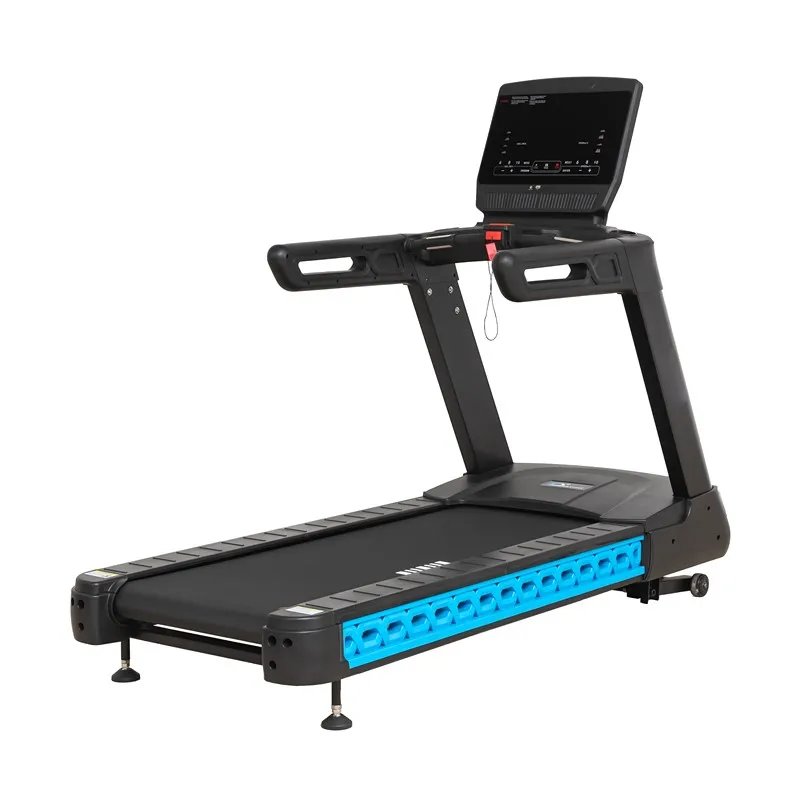
The MT296 covers steady-state walking through moderate-intensity running across 16 preset programs, occupying the endurance and tempo training band rather than sprint or HIIT intervals. In a mixed cardio zone it pairs with ellipticals and rowing machines to give members low-impact alternatives when the running deck is occupied. The 1200 × 520 mm surface accommodates users of average stride length comfortably; taller athletes with extended gaits may find the deck short at speeds above 14 km/h. Its foldable footprint makes it suitable for auxiliary rooms where a full commercial treadmill would dominate the floor plan. The LCD console delivers pulse, speed, distance, time, and calorie readouts — sufficient for self-guided sessions without facility management software integration.
Continuous Run-Time Limits and Deployment Environment Requirements
DC motors in this class tolerate moderate daily duty cycles but accumulate thermal stress faster than AC alternatives when pushed beyond their rated window. Plan deployment where average daily use stays within two to three hours of cumulative run-time per unit [NEED_CITE: DC versus AC motor thermal limits in commercial cardio equipment]. The foldable frame requires a level, rigid floor — uneven surfaces transmit lateral forces through the hinge mechanism and accelerate bearing wear. Acoustic transfer through floor slabs depends on subfloor construction; deploying above occupied guest rooms or office spaces warrants a vibration-dampening mat beneath the unit. Confirm local voltage and plug standards before shipment, as retrofitting power supplies on-site introduces warranty complications. The LCD console operates independently without network connectivity, eliminating data-interface requirements but also removing remote usage monitoring.
Reading the Drive and Cushioning Specifications
The DC motor delivers consistent torque at lower speeds, which translates to smooth acceleration from a walking pace without the hesitation sometimes felt in undersized AC units. However, DC brushed motors carry a finite brush life that AC induction motors do not, meaning maintenance intervals are inherently shorter. The ABS deck material provides a cushioning layer between the runner’s footfall and the steel frame — this absorbs a portion of impact force before it reaches the joints, though the degree of attenuation depends on runner weight and stride mechanics. The 520 mm belt width sits in the moderate range; narrower belts force runners into a constrained gait lane while wider belts increase motor load. The LCD panel reads pulse through handgrip contacts, which provides a general heart rate zone indication but is susceptible to grip pressure variation and sweat interference compared to chest-strap telemetry. Sixteen preset programs distribute workload across speed and time variables, giving users structured sessions without manual interval programming [NEED_CITE: EN 957 requirements for commercial treadmill safety and performance testing].
The Hidden Cost of Specifying Below the Deployment Reality
Facilities that select treadmills based on brochure horsepower rather than verified continuous duty output experience predictable failure sequences. Motors overheat and trip thermal cut-offs during peak usage hours, leaving members mid-workout. Repeated thermal cycling degrades winding insulation until the motor fails entirely — often outside warranty coverage because the manufacturer’s intended duty cycle was exceeded. Foldable frames deployed in high-throughput environments develop hinge play that manifests as lateral deck wobble at speed, generating noise complaints and user discomfort. LCD consoles without facility software integration leave operators blind to usage patterns, making it impossible to identify which units are overloaded and which sit idle [NEED_CITE: cardio equipment utilization tracking in commercial facilities]. Each of these failures traces back to a specification that was not verified against the actual deployment environment.
Why Operators Source This Product Line
The MT296 belongs to a six-series cardio family where every discipline is engineered under one manufacturing roof — meaning spare parts logistics and console familiarity remain consistent across treadmills, bikes, ellipticals, and rowers. Units undergo durability testing protocols that simulate extended high-frequency operation [NEED_CITE: 10,000-hour continuous operation testing methodology for commercial cardio motors]. OEM customization covers console UI, colorway, and branding at flexible minimum order quantities, so a hotel group or gym chain can maintain visual identity across locations. The foldable footprint of this model receives specific treatment in 3D cardio-zone layouts that account for folded clearance, unfolded swing radius, and member circulation paths. Technical support operates on a continuous basis, addressing commissioning questions and parts identification without business-hour delays.
Documentation & Test Records
- CE declaration of conformity covering electrical safety and EMC directives for this model
- EN 957 test report validating structural and performance requirements for stationary training equipment
- ISO 9001 certificate confirming quality management system across manufacturing processes
- RoHS compliance documentation for restricted substance limits in electrical components
- Noise level test record measured under defined load and speed conditions
- Motor specification sheet detailing duty cycle rating, thermal class, and brush life expectancy
Installation, Commissioning & Maintenance
- Allow minimum clearance around the 1580 × 865 mm unfolded footprint for safe user mounting and dismounting
- Place vibration-dampening mat beneath the 64 kg unit to reduce acoustic transfer through floor structures
- Confirm dedicated circuit matching DC motor voltage requirement before first power-on to avoid shared-load tripping
- Run belt alignment and tension check after initial 10-hour break-in period to prevent edge wear
- Schedule brush inspection on the DC motor per manufacturer interval to maintain consistent torque delivery
- Wipe LCD console and handgrip pulse sensors after each session to prevent sweat corrosion on contacts
Planning Your Deployment Inquiry
Provide the square footage and ceiling height of the intended cardio area to receive a 3D layout that accounts for the MT296’s folded and unfolded clearances alongside other equipment. Specify expected daily run-time per unit so the motor duty cycle can be matched to deployment density. Identify the floor level and adjacent occupied spaces to determine whether additional acoustic isolation is necessary. State the destination market voltage and plug standard to ensure factory-fitted power configuration. Indicate whether console data output is required for facility management integration, as this model’s LCD operates as a standalone display.
Frequently Asked Questions
Q: What is the difference between peak and continuous horsepower in DC treadmill motors?
A: Peak horsepower measures the maximum output a motor can deliver for a brief burst, typically seconds during acceleration. Continuous horsepower reflects the sustained thermal output the motor maintains without overheating under steady load. A DC 2.0 HP peak rating may correspond to a substantially lower continuous rating. Always request the continuous duty figure before planning deployment in any environment where daily cumulative run-time exceeds casual home use levels.
Q: How does a foldable frame affect stability and noise at running speed?
A: Foldable frames introduce hinge points that a fixed welded chassis does not have. Under repetitive footstrike at higher speeds, these junctions can develop micro-movement that transmits as low-frequency vibration through the floor. Proper deployment requires a level surface and vibration-dampening mat to mitigate acoustic transfer. Periodic inspection of hinge fasteners maintains structural tightness and prevents progressive noise increase over the unit’s service life.
Q: Can the LCD console on this treadmill sync with facility management software?
A: The LCD console on this model operates as a standalone display showing speed, distance, time, calories, and pulse. It does not include network connectivity or app synchronization capability. Facilities requiring usage data integration with management platforms should evaluate models with IoT-enabled consoles from the same product line that offer telemetry output and software interoperability.
Q: What maintenance does a DC motor treadmill require compared to AC-driven units?
A: DC brushed motors contain carbon brushes that wear through friction during operation and require periodic inspection and replacement. AC induction motors have no brushes, eliminating this maintenance item entirely. Beyond brush service, both motor types require belt tension checks, deck lubrication, and bearing inspection. Facilities planning high-frequency deployment should factor brush replacement intervals into their preventive maintenance schedule and confirm parts availability before procurement.
Q: How does the 1200 × 520 mm running surface compare to full commercial treadmill decks?
A: Full commercial treadmill decks typically measure 1400–1550 mm in length and 520–560 mm in width. The 1200 mm length accommodates walking and moderate-pace running for average-height users comfortably, but taller runners with longer stride patterns may find the deck constraining at speeds above 14 km/h. The 520 mm width provides adequate lateral margin for most users. Evaluate intended user demographics against these dimensions before finalizing unit quantities for a deployment.
![Mt026m Waterproof Electric Fold Home Silent Treadmill for Fat Burning [WARN] draft identifier mismatch](https://bicksport.com/wp-content/uploads/2026/08/mt026m-waterproof-electric-fold-home-silent-treadmill-for-fat-burning-warn-draft-identifier-mismatch-864393.webp)

![Hsm New Design Walking Treadmill with Transport Wheels[WARN] draft identifier mismatch](https://bicksport.com/wp-content/uploads/2026/08/hsm-new-design-walking-treadmill-with-transport-wheelswarn-draft-identifier-mismatch-cd69fe.webp)