

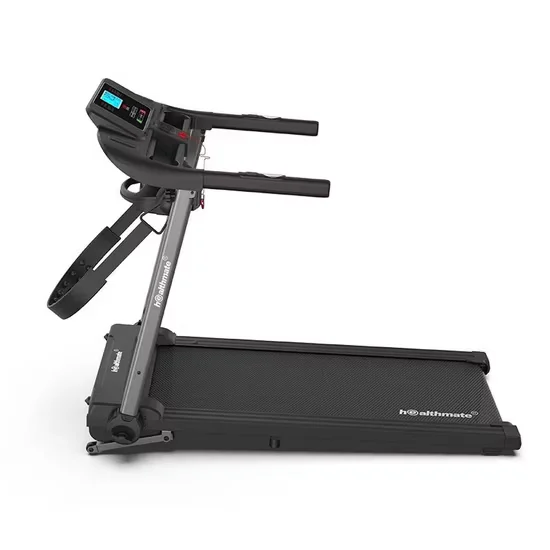
Compact Foldable Footprint — The MT296 folds to 910 x 865 x 1345 mm, clearing floor space in residential environments where dedicated gym square footage is unavailable.
Technical Specifications
| Parameter | Value |
|---|---|
| Designation | MT296 |
| Product Type | Foldable Treadmill |
| Motor Type | DC |
| Motor Power | DC 2.0 HP (peak or continuous not specified in source) |
| Speed Range | 1–20 km/h |
| Running Surface | 1200 x 520 mm |
| Console Type | LCD (Speed / Distance / Time / Calories / Pulse) |
| Programs | 16 |
| Product Unfold Size | 1580 x 865 x 1300 mm |
| Product Folded Size | 910 x 865 x 1345 mm |
| Net Weight | 64.0 kg |
| Foldable | Yes |
| Material | ABS |
| OEM Custom | Available |
| ODM Custom | Available |
| Certification | CE, RoHS |
Application Suitability
| Deployment Scenario | Typical Use |
|---|---|
| High-end residential home gym | Daily walking and light jogging sessions with foldable storage between uses |
| Apartment or shared living fitness corner | Quiet-operation cardio for individuals in noise-sensitive multi-unit buildings |
| Corporate wellness room with limited floor area | Low-to-moderate intensity cardio for employees during breaks |
| Boutique hotel guest room fitness option | In-room treadmill deployment where space reclamation after use is required |
What Peak Horsepower Hides About Continuous Duty
A 2.0 HP rating on a DC motor requires verification of whether it represents sustained output or momentary peak before matching it to expected daily run-time.
Home users and facility operators alike encounter treadmill motors that perform adequately during brief trial runs but degrade under repeated daily sessions. The DC motor inside this foldable home treadmill DC motor MT296 operates within a duty-cycle envelope that differs fundamentally from the AC induction motors found in full-commercial machines. When a motor is rated at peak output, it can sustain that level only in short bursts before thermal accumulation begins to affect winding insulation and bearing longevity [NEED_CITE: motor duty cycle classification for continuous commercial operation]. I have seen hotel fitness rooms deploy light-duty treadmills rated for 1–2 hours of daily use, only to face motor burnout within months when actual run-times exceeded four hours per day across multiple guests. Understanding this distinction at the specification-reading stage prevents costly batch replacements and guest complaints that arrive at the front desk long before maintenance notices the problem.
Positioning This Foldable Treadmill Within a Cardio Layout
The MT296 occupies the walking-to-light-jogging intensity band with its 1–20 km/h speed range and 1200 x 520 mm running surface, accommodating users who primarily train at moderate paces. In a mixed cardio zone, it complements higher-capacity commercial treadmills and ellipticals by serving overflow traffic or functioning as a dedicated warm-up station. Its foldable design makes it practical for corners or secondary rooms where a fixed-frame treadmill would dominate available square footage. The 520 mm belt width suits users of average build; individuals with longer stride patterns or those training exclusively at sprint intervals should evaluate whether the deck length supports their biomechanics. This foldable home treadmill DC motor MT296 delivers structured program variety through its 16 preset routines, sufficient for general fitness goals without the complexity of networked training platforms.
Daily Run-Time Limits and Deployment Environment
A DC motor at this power class is engineered for residential duty cycles, typically supporting one to two hours of continuous operation before requiring a cool-down interval. Deploying it in a setting where multiple users cycle through sequentially—such as a corporate wellness room with back-to-back lunch-break sessions—demands awareness of thermal limits that are rarely visible on a product label [NEED_CITE: continuous duty rating thresholds for DC treadmill motors in shared facilities]. Noise transmission through floor slabs matters when the unit sits above occupied rooms; while ABS housing dampens operational sound relative to open-frame designs, verifying actual decibel output against sub-35 dB benchmarks protects against complaints in multi-story residential buildings. The unit requires a standard single-phase power supply; confirming voltage and plug compatibility with the target market before shipment avoids the costly discovery of mismatched electrical standards after the container arrives. Proper floor leveling and a vibration-dampening mat beneath the frame further reduce structure-borne noise transfer to adjacent spaces.
Reading the Drive Train and Electronics Specifications
The DC motor architecture provides adequate torque for walking and jogging speeds while keeping overall unit weight at 64 kg, which directly enables the foldable frame design. DC motors deliver smoother speed transitions at lower velocities compared to AC counterparts, making them practical for users who alternate between walking warm-ups and moderate jogging intervals. The distinction between peak and continuous horsepower matters here: a peak rating indicates the motor’s maximum momentary output during acceleration or incline surges, not the sustained thermal capacity for uninterrupted hour-long sessions [NEED_CITE: treadmill motor horsepower measurement standards and thermal limits]. The LCD console displays speed, distance, time, calories, and pulse—providing essential biometric feedback through handgrip sensors, which are adequate for general awareness but inherently less stable than chest-strap telemetry during high-intensity efforts. The 16 preset programs offer structured variation without requiring manual speed adjustments, though the console operates as a standalone unit without IoT connectivity or app synchronization capability. The ABS material housing reduces overall weight for easier folding and repositioning while maintaining sufficient rigidity during use.
The Hidden Cost of Specification Compromises
Deploying a residential-grade treadmill in a setting that demands commercial duty cycles accelerates motor winding degradation, often manifesting as intermittent speed fluctuations months before complete failure. Noise complaints in hotel environments frequently trace back to treadmills whose acoustic output was never validated against the specific floor-construction and adjacent-room occupancy patterns of that property. When the running surface dimensions prove insufficient for taller users, the resulting gait compensation leads to joint discomfort that members attribute to personal fitness decline rather than equipment mismatch [NEED_CITE: treadmill deck length requirements relative to user height and stride biomechanics]. Voltage incompatibility discovered post-shipment forces either transformer procurement or complete unit return, both of which delay facility opening timelines. Data isolation—where the console cannot communicate usage metrics to facility management software—leaves operators blind to utilization patterns that inform equipment rotation and preventive maintenance scheduling.
Why This Product Line Addresses These Gaps
Every cardio unit in this product family undergoes sub-35 dB noise verification during deployment testing, providing acoustic data that facility planners can cross-reference against their specific floor and wall construction. The 10,000-hour durability testing protocol on motors, frames, and sealed bearings applies across the commercial range, establishing a verified lifespan baseline that goes beyond manufacturer claims on paper. Full OEM and ODM customization extends to console UI configuration, allowing brand-aligned interface design for hotel groups and gym chains that require consistent visual identity across their cardio fleet. The six-series cardio family—treadmills, bikes, ellipticals, rowers, stair climbers, and spinning bikes—enables a facility to source every discipline from one engineering platform with matched aesthetic and data standards. Free 3D cardio-zone layout planning accounts for the MT296’s specific folded and unfolded dimensions, ensuring adequate clearance for user passage and equipment ventilation. Round-the-clock technical support response covers firmware questions, parts availability, and deployment troubleshooting across time zones.
Documentation & Test Records
- CE declaration of conformity for the MT296 foldable treadmill
- EN 957 test report covering safety and performance requirements
- ISO 9001 quality management system certificate
- RoHS compliance documentation for electrical components
- Motor specification sheet detailing duty-cycle parameters
- Noise level test record from controlled deployment environments
Installation, Commissioning & Maintenance
- Maintain minimum 600 mm clearance behind the unfolded deck for safe user dismount and ventilation
- Place a vibration-dampening mat beneath the 64 kg frame to reduce structure-borne noise transfer
- Verify single-phase power supply matches target market voltage and plug standard before connection
- Run a full speed-range calibration cycle after initial assembly to confirm belt tracking and tension
- Inspect belt alignment and apply silicone lubricant at intervals specified in the commissioning guide
- Wipe LCD console and handgrip pulse sensors after each use to prevent sweat-induced corrosion
Equipment Selection Inquiry Points
Provide the cardio-zone floor area and intended unit count to receive a 3D layout plan that accounts for the MT296’s folded storage footprint and operational clearance requirements. Specify the expected daily run-time per unit so that motor duty-cycle matching prevents premature thermal degradation. Identify the deployment floor level and adjacent occupied spaces to determine whether acoustic performance meets the building’s noise transmission criteria. Confirm the target market’s voltage and plug standard to ensure electrical compatibility upon arrival. Indicate whether console data integration with facility management systems is required, as this model’s LCD operates as a standalone display.
Frequently Asked Questions
Q: What is the difference between continuous duty and peak horsepower for treadmill motors?
A: Peak horsepower represents the motor’s maximum output during brief acceleration bursts, while continuous duty reflects the thermal capacity for sustained operation over extended sessions. A motor rated at 2.0 HP peak may deliver considerably less during hour-long runs. Requesting the motor specification sheet clarifies which rating applies and whether it aligns with your expected daily usage patterns and session duration.
Q: Is a DC motor suitable for daily home use versus commercial gym environments?
A: DC motors perform well in residential settings where one or two users operate the treadmill for moderate daily sessions. They offer smooth speed transitions and lower overall weight, supporting foldable designs. In high-traffic commercial environments with continuous back-to-back usage, AC motors with higher continuous duty ratings generally provide longer service life under sustained thermal load conditions.
Q: How does a foldable treadmill frame affect stability and noise during operation?
A: Foldable frames introduce hinge points that can transmit vibration differently than welded fixed frames. The ABS housing on this model dampens operational sound relative to open-frame constructions, while the 64 kg net weight provides reasonable stability during walking and jogging. Proper floor leveling and a vibration mat beneath the unit further minimize structure-borne noise transfer to rooms below.
Q: Can the LCD console sync with fitness apps or facility management software?
A: The LCD console on this model provides standalone feedback for speed, distance, time, calories, and pulse without built-in wireless connectivity or app synchronization. Users seeking data integration with external platforms would need models equipped with IoT-enabled consoles that support Bluetooth or Wi-Fi protocols. Facility operators requiring usage tracking should specify console data-interface requirements during the equipment selection process.
Q: What maintenance does a home treadmill require?
A: Regular maintenance includes inspecting belt alignment and applying silicone lubricant at manufacturer-specified intervals, checking deck surface wear for smooth operation, and keeping the motor compartment free of dust accumulation. Handgrip pulse sensors and the LCD display benefit from wiping after each use to prevent sweat corrosion. Verifying belt tension periodically prevents slippage during acceleration phases and extends motor life.
![Quiet Operation Mt296 ABS Material Motorized Treadmill for Training Mt296 ABS Motorized Treadmill for Commercial Training [WARN] draft identifier mismatch](https://bicksport.com/wp-content/uploads/2026/08/quiet-operation-mt296-abs-material-motorized-treadmill-for-training-mt296-abs-motorized-treadmill-for-commercial-training-warn-draft-identifier-mismatch-add049.webp)
![W08 Electric Folding Walking Treadmill with DC Motor for Training Space-Saving Design [WARN] draft identifier mismatch](https://bicksport.com/wp-content/uploads/2026/08/w08-electric-folding-walking-treadmill-with-dc-motor-for-training-space-saving-design-warn-draft-identifier-mismatch-51d39c.webp)