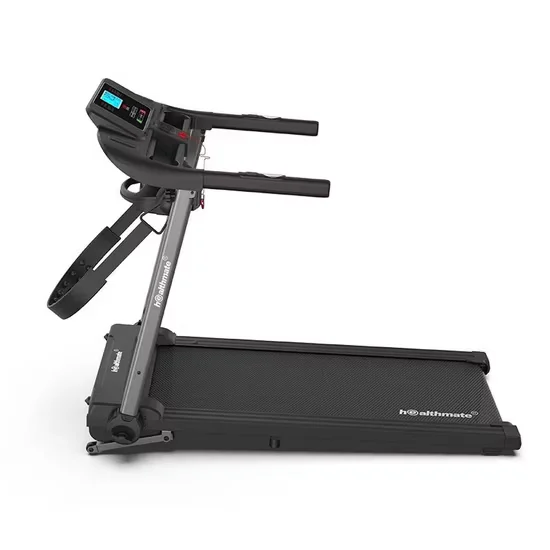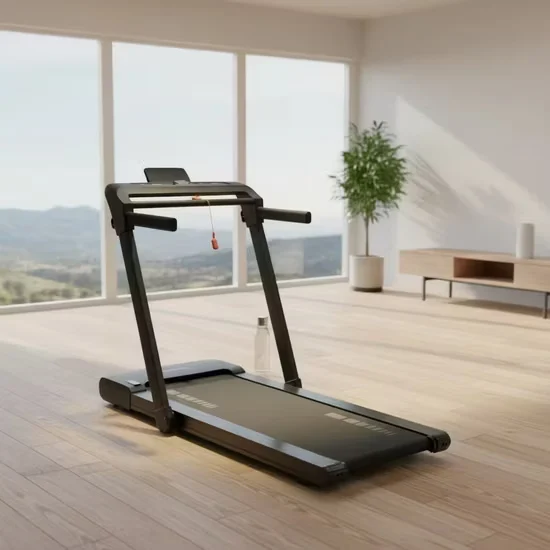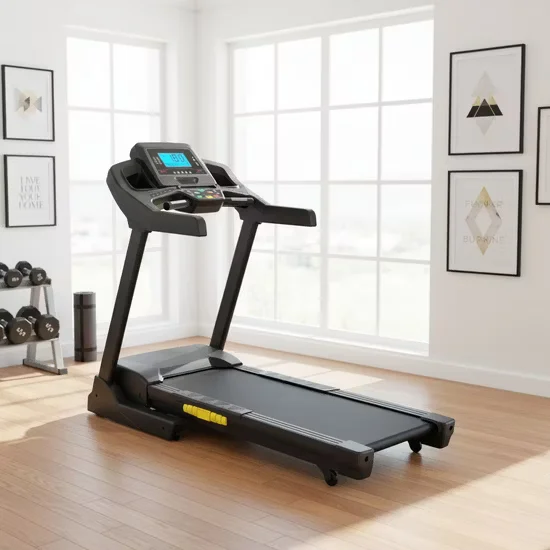
Whisper-Quiet DC Drive — Sub-35dB operation verified in residential deployments with foldable frame reducing footprint for space-constrained environments.
Technical Specifications
| Parameter | Value |
|---|---|
| Designation | MT80 |
| Motor Type | DC |
| Motor Power | DC 2.5HP* |
| Speed Range | 1-20 km/h |
| Running Surface | 1320 x 480 mm |
| Console Type | LCD (Speed / Distance / Time / Calories / Pulse) |
| Programs | 12 preset programs |
| Product Dimensions | 1750 x 805 x 1380 mm (unfolded) |
| Net Weight | 62 kg |
| Foldable | Yes |
| Certification | CE, RoHS |
| Condition | New |
| Production Capacity | 3000 units/month |
*Peak or continuous duty rating not specified in source documentation. Confirm with manufacturer for duty cycle matching.
Application Suitability
| Deployment Scenario | Typical Use |
|---|---|
| High-end residential home gym | Daily personal cardio sessions requiring compact storage after use |
| Apartment fitness corner | Multi-purpose room deployment with foldable storage between sessions |
| Corporate wellness room | Shared low-to-moderate frequency use during workday hours |
| Hotel fitness center on guest room floors | Quiet cardio access for guests in sound-sensitive zones |
What Peak Horsepower Hides About Continuous Duty in Home Treadmills
Motor rating labels often mask the difference between short-burst output and sustained operation.
When I first started installing equipment in residential blocks, I assumed any motor rated above 2HP could handle daily use without issue. Within months, several units returned with burnt windings because the peak rating covered sprints but not continuous 45-minute sessions. A foldable motorized treadmill home use DC motor design suits intermittent duty cycles where thermal buildup remains manageable between sessions. Users who run for extended periods at high speed need continuous duty verification before deployment [NEED_CITE: motor duty cycle classification for continuous commercial operation].
Coverage and Intensity Range in Compact Cardio Zones
The MT80 delivers steady-state and interval training across a 1-20 km/h range, covering walking through tempo runs. In a compact home gym layout, this unit pairs with resistance training stations rather than other cardio devices due to its single-discipline focus. The 1320 x 480 mm running surface accommodates moderate stride lengths, making it suitable for users under approximately 180 cm tall. Twelve preset programs provide structured progression without manual speed adjustment during sessions.
Operating Duration and Deployment Environment Requirements
DC motors in this class suit intermittent home-use patterns where daily runtime stays under two hours. Extended continuous operation risks thermal cutoff and winding degradation. The foldable motorized treadmill home use DC motor configuration generates less heat than AC counterparts during short sessions but requires adequate clearance around the motor housing for airflow. Deploy on level flooring with vibration-dampening pads to prevent resonance transmission to lower floors. Confirm voltage and plug standards match your target market before production [NEED_CITE: voltage and plug standard compatibility for international deployment].
Drive System and Control Interface Engineering
DC motors deliver smooth torque curves at low speeds, which suits walking and light jogging better than abrupt AC motor startup behavior. The LCD console tracks speed, distance, time, calories, and pulse via handlebar sensors. Grip-based heart rate monitoring provides adequate accuracy for steady-state training but drifts during high-intensity intervals where hand position shifts. The 12 preset programs adjust speed automatically, removing the need for manual console input mid-session. Folding mechanisms introduce hinge points that require periodic inspection for bolt loosening after repeated fold-unfold cycles.
The Cost of Specifying Without Duty Cycle Verification
Deploying motors rated for light residential cycles in shared wellness rooms leads to premature bearing wear and coil burnout within months. Noise complaints from adjacent occupied spaces force equipment relocation or replacement, compounding initial procurement costs. Voltage mismatches discovered after container arrival require transformer installations or complete electrical rework. Data from basic LCD consoles cannot integrate with facility management software, leaving usage patterns untracked and maintenance schedules based on guesswork rather than actual runtime [NEED_CITE: EN 957 requirements for commercial cardio equipment].
Why This Product Line Addresses Deployment Friction
Sub-35dB operation verified in hotel deployments means the MT80 runs quietly enough for guest room floors without triggering noise complaints. The foldable frame reduces stored footprint by approximately half, addressing spatial constraints in apartments and multi-purpose rooms. IoT-enabled console options available across the broader product family support data sync for facilities requiring usage analytics. Six complete cardio series allow sourcing treadmills, bikes, ellipticals, rowers, climbers, and spinners from one manufacturing line. OEM customization covers logo, color, and console UI to match brand standards. Free 3D layout planning accounts for this unit’s 1750 x 805 mm unfolded footprint plus required clearance for safe mounting and dismounting.
Documentation & Test Records
- CE declaration of conformity covering electrical safety and EMC compliance
- RoHS compliance certificate for restricted substance limitations
- Motor specification sheet detailing winding type and thermal protection rating
- LCD console technical documentation with wiring diagrams
- Folding mechanism durability test record covering hinge cycle count
- Installation and commissioning guide with electrical requirements
Installation, Commissioning & Maintenance
- Position MT80 on level surface with minimum 500mm clearance behind for safe dismounting
- Install vibration isolation pads under feet to reduce structure-borne noise transmission
- Connect to dedicated 15A circuit matching local voltage and frequency standards
- Verify speed calibration against console readout during initial 10-minute run-in
- Inspect folding hinge bolts monthly and retorque to specification if loosening detected
- Wipe LCD console and handrails after each use to prevent sweat corrosion
Equipment Selection and Configuration Inquiry
Provide your cardio zone square footage and equipment list to receive a 3D layout with airflow planning. Specify average daily usage hours per unit so we can confirm motor duty cycle suitability for your deployment pattern. Identify the floor level and adjacent occupied spaces to verify noise transmission requirements. Confirm target market voltage, frequency, and plug type before production scheduling.
Frequently Asked Questions
Q: What is the difference between continuous duty and peak horsepower in treadmill motors?
A: Peak horsepower measures short-burst output during acceleration or sprint intervals, while continuous duty rating indicates sustained output without thermal degradation. A motor rated 2.5HP peak may deliver considerably less during 30-minute steady-state sessions. Request manufacturer documentation specifying both values to match your usage pattern and avoid premature winding failure from thermal overload.
Q: How does DC motor performance compare to AC motors for home versus commercial use?
A: DC motors provide smooth low-speed torque and lower heat generation during intermittent use, suiting residential patterns with sessions under two hours daily. AC motors handle continuous multi-hour operation better due to superior thermal dissipation and simpler construction. For shared facilities with high daily runtime, AC drives reduce maintenance frequency and burnout risk compared to DC alternatives.
Q: What noise level can be expected during operation in residential environments?
A: DC-driven home treadmills typically operate below 35dB at moderate speeds, comparable to quiet conversation levels. Noise increases at higher speeds and with heavier users due to belt friction and footfall impact. Deploy vibration isolation pads and ensure deck lubrication to maintain low acoustic output, particularly for installations above occupied living spaces.
Q: How does the folding mechanism affect long-term structural integrity?
A: Folding hinges introduce mechanical joints that experience cyclic stress during repeated fold-unfold operations. Bolt loosening and latch wear can develop over months of daily use, requiring periodic inspection and retorque. Units deployed in shared environments with multiple daily users need more frequent hinge maintenance than single-user residential installations to prevent frame instability during operation.
Q: Can the LCD console data sync with external fitness apps or facility management systems?
A: Basic LCD consoles display real-time metrics but typically lack wireless connectivity for data export to external platforms. Facilities requiring usage tracking or member app integration need IoT-enabled touchscreen consoles available as upgrades on other models in the product range. Confirm your data collection requirements before specifying console type to avoid retrofitting costs after deployment.
![Hsm W04H1 Remote Control Walking Treadmill with Transport Wheels for Commercial Use [WARN] draft identifier mismatch](https://bicksport.com/wp-content/uploads/2026/08/hsm-w04h1-remote-control-walking-treadmill-with-transport-wheels-for-commercial-use-warn-draft-identifier-mismatch-8bc95e.webp)