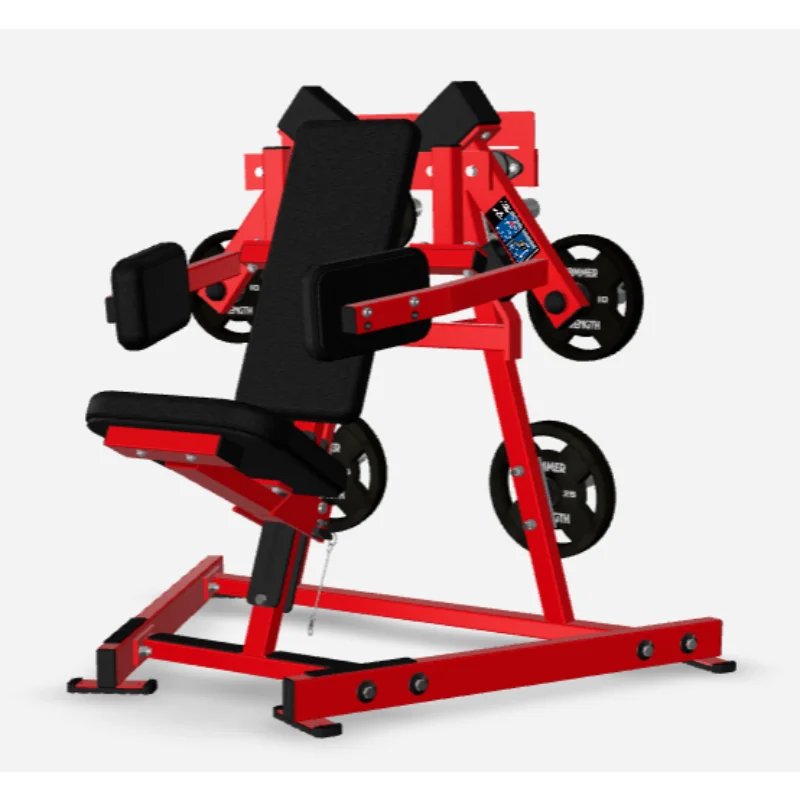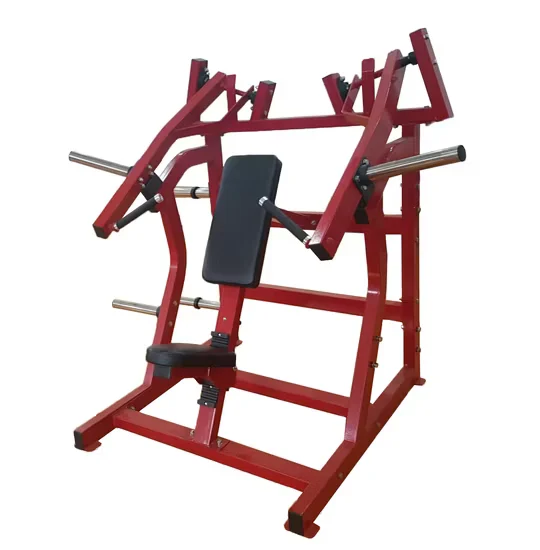
Steel-Frame Pivot Engineering — sealed bearings and reinforced welding deliver silent articulation under continuous high-repetition loading in commercial strength zones.
Technical Specifications
| Parameter | Value |
|---|---|
| Product Type | ISO-Lateral Strength Machine |
| Designation | OS-H5008 |
| Resistance Type | Plate-loaded / ISO-Lateral |
| Exercise Target | Chest (Incline Press) |
| Drive Mechanism | Independent arm pivot with sealed bearings |
| Frame Material | Steel |
| Product Dimensions | 1500 × 1350 × 1650 mm |
| Net Weight | 137 kg |
| Power Source | Manual |
| Foldable | No |
| Certification | ISO 9001, CE |
| OEM | Available |
| Color Options | Optional |
| Application | Fitness Center / Gymnasium |
Application Suitability
| Deployment Scenario | Typical Use |
|---|---|
| Hotel fitness center on guest room floors | Low-noise chest training adjacent to occupied spaces |
| Chain gym cardio and strength zone | High-frequency bilateral and unilateral incline pressing |
| Corporate wellness room | Durable plate-loaded equipment with minimal maintenance |
| High-end residential home gym | Compact footprint with commercial-grade frame integrity |
| Sports performance training center | Independent arm path for athletic upper-body programming |
Why Plate-Loaded ISO-Lateral Design Eliminates the Noise Complaints That Cable Machines Generate
Mechanical pivot articulation produces no cable-stack resonance, keeping strength zones acoustically compatible with adjacent occupied floors.
Cable-driven incline press machines transmit vibration through weight stacks and guide rods every repetition. In mixed-use facilities where the strength floor sits above a spa or conference level, that metallic rattle travels through the slab before maintenance ever logs a ticket [NEED_CITE: structural vibration transmission from cable-stack resistance equipment]. Plate-loaded ISO-lateral systems replace the entire cable path with a direct pivot arm, so the commercial ISO-lateral incline press machine generates resistance through gravity and leverage alone — no guide-rod chatter, no pulley squeak, no stack slam at the bottom of each set.
Positioning Within the Strength Training Floor Layout
This commercial ISO-lateral incline press machine targets the upper pectoral and anterior deltoid chain through a converging incline arc. It pairs with flat and decline press stations to cover the full pressing spectrum without redundant movement patterns. The 1500 × 1350 mm footprint fits standard plate-loaded bays, and the ISO-lateral independent arm mechanism accommodates users with asymmetric strength profiles or rehabilitation requirements. Placement along a perimeter wall keeps loading paths clear while leaving the central floor open for functional training zones.
Continuous Loading Demands and Facility Environment Requirements
Commercial strength equipment endures repetitive loading cycles that expose weak pivot seals within weeks [NEED_CITE: commercial strength equipment duty cycle standards for pivot bearing longevity]. The sealed pivot bearings on this unit reduce grease migration and particulate ingress, extending service intervals in high-traffic gymnasium environments. Floor mounting requires a level concrete substrate with vibration-dampening pads to prevent frame resonance transfer to lower floors. Ambient ventilation should maintain airflow across the frame to prevent sweat-induced corrosion on the steel welds, particularly in humid hotel fitness center environments.
Decoding the Resistance Path: Plate-Loaded Pivot vs. Cable-Stack Mechanics
A plate-loaded ISO-lateral arm converts gravitational force on Olympic plates directly into rotational resistance at the pivot axis. This eliminates the friction losses and elastic hysteresis inherent in cable-and-pulley systems, where the cable stretches under load and recovers at release, creating inconsistent resistance through the range of motion. The independent arm mechanism allows each side to move through its own natural arc without the fixed-bar constraint that forces bilateral symmetry on users with shoulder mobility differences. Steel frame construction with reinforced welding at the pivot junction prevents frame flex under heavy loading, maintaining alignment of the bearing axis and preserving smooth articulation across thousands of repetitions.
The Hidden Cost of Underspecified Pivot Bearings and Frame Gauge
Light-duty pivot bearings without proper seals degrade rapidly under commercial loading frequency, developing play that manifests as clicking and lateral wobble during pressing movements [NEED_CITE: bearing seal degradation patterns in commercial plate-loaded equipment]. Undersized frame tubing flexes under heavy loads, shifting the pivot axis and altering the intended resistance curve. Facilities that procure strength machines without verifying frame steel gauge and bearing seal specifications often face premature replacement cycles and member complaints about inconsistent feel across identical units.
Why This Product Line for Your Strength Zone
Each ISO-lateral unit undergoes continuous high-frequency durability testing to verify pivot bearing integrity and frame weld performance under commercial loading. The 1500 × 1350 mm footprint integrates into 3D strength-zone layouts that account for plate-loading clearance, user circulation paths, and sightline requirements. OEM customization covers frame color, logo placement, and upholstery specification at flexible minimum order quantities. The six-series cardio and strength family allows a facility to source every training discipline from one manufacturing partner, simplifying spare parts logistics and maintenance training. Full technical support remains available around the clock for commissioning and service inquiries.
Documentation & Test Records
- CE declaration of conformity for OS-H5008 commercial strength equipment
- EN 957 test report covering static and dynamic load verification
- ISO 9001 certificate for manufacturing quality management
- Durability test record documenting pivot bearing and frame weld performance
- Noise level assessment confirming low acoustic output during operation
- Spare parts list with pivot bearing and frame component references
Installation, Commissioning & Maintenance
- Maintain minimum 600 mm clearance on all sides for plate loading and user access
- Install on level concrete substrate with vibration-dampening pads beneath frame feet
- Verify pivot bearing seal integrity and lubrication at initial commissioning
- Inspect pivot bearings quarterly for play, contamination, and grease condition
- Wipe steel frame and pivot housings daily to prevent sweat-induced corrosion
- Confirm all frame bolts are torqued to specification after first 500 use cycles
Sourcing and Specification Inquiry Guidance
Provide strength zone floor area and equipment count to receive a 3D layout with plate-loading clearance and user flow planning. Specify average daily usage frequency so pivot bearing and frame gauge recommendations match your facility’s duty cycle. Indicate deployment floor level and adjacent occupied spaces to confirm acoustic compatibility requirements. State target market voltage for any electronic accessories and confirm whether console-based data tracking integration is needed for your facility management system.
Frequently Asked Questions
Q: How does ISO-lateral independent arm movement differ biomechanically from a fixed-bar incline press?
A: ISO-lateral arms allow each side to follow its own natural pressing arc without forcing both arms into a single fixed path. This accommodates shoulder mobility asymmetries and reduces joint stress during heavy loading. Users with unilateral strength imbalances can load each side independently, making it suitable for rehabilitation protocols alongside general strength training.
Q: What maintenance advantages does plate-loaded resistance offer over pin-loaded cable systems in commercial settings?
A: Plate-loaded machines eliminate cables, pulleys, and weight-stack guide rods entirely. There are no cables to fray, no pulleys to replace, and no guide rods to lubricate. Maintenance focuses on pivot bearing inspection and frame bolt torque checks, which require fewer specialized parts and less frequent service intervals than cable-system upkeep.
Q: Which bearing seal types are appropriate for high-traffic commercial strength equipment?
A: Sealed cartridge bearings with integrated dust shields prevent particulate ingress and grease migration under repetitive loading. Open bearings require frequent regreasing and contamination checks. For commercial gymnasium deployment, sealed bearings reduce maintenance frequency and prevent the clicking and lateral play that develop when unsealed bearings degrade under continuous use.
Q: How should floor space be planned when integrating ISO-lateral machines into a mixed strength-cardio zone?
A: Account for the machine footprint plus plate-loading clearance on both sides, typically requiring a total bay width significantly wider than the frame itself. Maintain clear sightlines between strength and cardio zones so staff can monitor form. Position plate-loaded units along perimeter walls to keep the central floor open for circulation and functional training areas.
![Hammer Strength Incline Bench-30 Degree OS-H5063 for Commercial Gyms [WARN] draft identifier mismatch](https://bicksport.com/wp-content/uploads/2026/08/hammer-strength-incline-bench-30-degree-os-h5063-for-commercial-gyms-warn-draft-identifier-mismatch-3ed955.webp)